regulation

Content tagged with "regulation"

Displaying 31 - 40 of 134

Rewriting the Rules, Santa Cruz County Encourages Competition

South of California’s Bay Area with its buzzing tech startups and expensive housing, Santa Cruz County has been overlooked by the big Internet Service Providers (ISPs). The city of Santa Cruz had less than stellar connectivity, and the rest of Santa Cruz County was no better. That’s when county leaders decided to rewrite the rules.

Throughout 2014 and early 2015, the Board of Supervisors for Santa Cruz County developed a broadband master plan, created a “dig once” policy, and streamlined the regulatory permit process. Cutting down red tape at the county level encouraged both small and large ISPs to reconsider investing in Santa Cruz.

Streamlining To Increase Competition

Although large ISPs have enough money and personnel to focus exclusively on permit acquisition, smaller ISPs must find a way to contend with the permitting process with limited resources. Santa Cruz County's new policies and processes enable all ISPs interested in Santa Cruz County to compete on better terms. Under these new rules, ISPs have a more equal playing field.

The policies reduce the amount of time spent on the regulatory process for ISPs building fiber networks. A master lease agreement simplifies the procedure to use county assets for networks. Modified ordinances enable ISPs to easily install or upgrade infrastructure in the county’s right-of-way. (Right-of-way is public land managed for the public good, especially boulevards and medians along roadways.)

We spoke with Santa Cruz County Board Supervisor Zach Friend about the impact of these policies and the Santa Cruz County master broadband plan. He credited the new policies for encouraging providers to offer better services. (Cruzio is building a fiber network in the city of Santa Cruz, and Comcast decided to increase speeds without raising prices in Santa Cruz county.) Supervisor Friend also emphasized that the public discussions brought attention to the need for improved Internet access in the community.

Calories? Carbs? Data Caps? ISP Nutrition Labels From BroadbandSearch

Depending on where you live, you may be able to choose between two or three big name ISPs. No matter which one you ultimately select, you might face some difficulty obtaining the kind of service you deserve. If you know what to expect, it’s easier to prepare yourself and, in the event you DO have a choice, pick the one that’s right for you.

BroadbandSearch has likened transparency in the telecommunications industry to nutrition information on food packaging. They have produced a set of “Nutrition Labels” for your Internet access diet.

xfinity-label.jpg

They describe the project:

We believe that anything that makes buying broadband Internet service easier is a good thing, and for that reason we've created these ready-made broadband nutrition labels to help you choose from the biggest providers in the nation. 

Here is Comcast’s Xfinity label, a big provider in our Minneapolis area.

Of course, rates from Xfinity and other providers vary from place to place and they offer introductory deals that depend on a number of factors. For more on how BroadbandSearch obtained their data, check out their Sources page.

Now that the FCC’s network neutrality rules have been challenged and upheld in the Appellate Court, providers are required to be more transparent. These labels can help them share the information that subscribers need to make informed decisions. Check out the complete set at BroadbandSearch.

The FCC's Pro-Competition Agenda - Community Broadband Bits Podcast 192

This week we welcome Gigi Sohn, Counselor to Chairman Wheeler of the Federal Communications Commission, to Community Broadband Bits for episode 192. Before joining the FCC, Gigi was a founder of Public Knowledge. Gigi discusses the pro-competition agenda that Chairman Wheeler has advanced, including the efforts to ensure communities can decide locally whether to build a municipal network or partner. 

We also discuss other elements of FCC action to encourage competition in the Internet access market, even how television set-top boxes fit in. Echoing some of the comments I regularly hear from some thoughtful listeners, I asked if competition was the best approach given the argument that telecom, and particularly fiber, has the characteristics of a natural monopoly. 

This show is 15 minutes long and can be played on this page or via Apple Podcasts or the tool of your choice using this feed

Transcript below. 

We want your feedback and suggestions for the show-please e-mail us or leave a comment below.

Listen to other episodes here or view all episodes in our index. See other podcasts from the Institute for Local Self-Reliance here.

Thanks to Kathleen Martin for the music, licensed using Creative Commons. The song is "Player vs. Player."

Nebraska Farmer Wants Fiber, Won't Be Ripped Off By Windstream

Windstream has the distinction of being one of the worst providers we have ever covered from consumers' perspective, but in rural areas many people have little or no choice. The latest Windstream debacle involves a Nebraska farmer, an outrageous price quote, and a local company that is taking on the project for about one-ninth of Windstream's estimate.

Ars Technica recently introduced us to Nelson Schneider, CTO of the Norman R. Schneider Family Trust Farm in Ceresco, Nebraska. Like many other farms today, the Schneider business needs fast, reliable connections for a variety of reasons including checking ever changing grain prices. Schneider had Windstream's DSL for $80 per month, but his promised speeds of 1.5 Mbps were clocked at 512 Kbps download and 256 Kbps upload, making business online impossible.

When he attempted to take advantage of the business class speeds Windstream advertised online, the company dismissed him. Schneider had to file a complaint for false advertising with the FCC just to get Windstream to negotiate. He wanted fiber, was willing to pay for construction costs, and considered it an investment in the vitality of the farm. 

Windstream told him it would cost Schneider $383,500 (gulp) to install 4.5 miles of fiber from his property to its facilities in town. Even though Windstream's fiber network map shows they run fiber about one-half mile away, they insisted he would need to connect to the facility farther away. When he asked about connecting to this closer line, Windstream refused to connect him. The company would not provide a reason when Ars asked for a reason.

Even though Schneider was prepared to pay thousands of dollars to bring fiber to his farm, such a preposterous quote and Windstream's refusal to commit to anything higher than 10 Mbps symmetrical were too much. He contacted Northeast Nebraska Telephone Company when he learned that they had been connecting local farms with fiber. Soon an NNTC executive visited the farm and the two talked about the possibilities. The final estimate was $42,000 or about one-ninth what Windstream demanded and now NNTC is working with Schneider to make the project easier:

Comcast's Contradictory Conundrum: Title II Tightrope

Comcast must continue to prove growth is a breeze to satisfy stockholders while simultaneously arguing that, gadzooks FCC! how do you expect us to grow under Title II?! As DSL Reports points out, contradicting itself just doesn't work:

At the time [of the FCC's proposal to implement Title II regulations], Comcast CFO Michael Angelakis proclaimed the switch to Title II introduced "higher uncertainty" into the company's broadband investment strategy. Meanwhile, top lobbyist David Cohen was quick to insist in a blog post that we'd see an immediate investment hit should the FCC proceed with its plans:

quote:

"To attempt to impose a full-blown Title II regime now, when the classification of cable broadband has always been as an information service, would reverse nearly a decade of precedent, including findings by the Supreme Court that this classification was proper. This would be a radical reversal that would harm investment and innovation, as today's immediate stock market reaction demonstrates."

DSL Reports points out that the change has not slowed down Comcast's desire to invest or innovate:

So what are we to make of Comcast's announcement that it's making a major investment to push 2 gigabit fiber to 18 million homes before the end of the year, followed by a major DOCSIS 3.1 push in 2016? While more speed to more people is a welcome announcement by any measure, Comcast's pretty clearly interested in charming the regulators currently considering the company's $45 billion acquisition play for Time Warner Cable. 

Comcast must perform a tightrope act to rival the Flying Wallendas to keep everybody happy and achieve its goal of world domination.

Oddly enough, we believe Comcast is lying about both things! Its supposed upgrade to 2 Gbps is smoke and mirrors AND there continues to be no evidence that outlawing paid prioritization will reduce investment beyond the status quo. 

Answering Questions About Title II and Munis - Community Broadband Bits Episode 138

As we near the FCC open meeting at the end of next week, when it will decide on both the Chattanooga and Wilson petitions regarding their wish to expand as well as a proposal to reclassify Internet access a Title II service in order to ensure it can maintain the same open Internet we have long loved. 

We have mostly focused on the muni petitions, but after hearing some concerns from some munis regarding Title II, we realized we have to delve into the Title II reclassification more deeply. Enter Chris Lewis, VP of Government of Affairs for Public Knowledge. I've always enjoyed talking with Chris on various issues around telecom policy and we asked him to come on and answer some of the questions we have heard. 

We talk about the prospects of rate regulation, unbundling, transparency requirements, and the process for filing complaints until Title II. Overall, our conclusion is that the rules as we understand them, are quite reasonable and should not pose a problem to munis that are already committed to providing a high quality service. You can read a Fact Sheet about the proposed rules here

This show is 22 minutes long and can be played on this page or via Apple Podcasts or the tool of your choice using this feed.

Transcript below.

We want your feedback and suggestions for the show-please e-mail us or leave a comment below.

Listen to other episodes here or view all episodes in our index. See other podcasts from the Institute for Local Self-Reliance here.

Thanks to Persson for the music, licensed using Creative Commons. The song is "Blues walk."

Network Neutrality - Warnings From Radio Regulation

Many of us in the public interest telecommunications sphere are excited that the FCC appears poised to reclassify Internet access, which seems a necessary first step of protecting the open Internet. Though we often focus on the false claims of the self-interested cable and telephone lobbyists when criticizing those who oppose FCC action on this, a recent Smithsonian Magazine article is a reminder that we must be vigilant with how the FCC uses this power. Clive Thompson penned "Air Waves" for the October, 2014, issue. It offers some context from the history of radio to discuss regulation of communication technologies. When groups like the Electronic Frontier Foundation and other pro-open Internet groups question an enhanced FCC role in protecting the open Internet, they are often motivated by the somewhat terrible record of the FCC and its precursor in balancing the speech rights of everyone vs a motivated and self-interested for-profit industry.
In 1927 Congress created the Federal Radio Commission, endowed with the power to assign wavelengths. It began aggressively doing so, booting hundreds of small stations off the air, to produce “clear channels” for the big firms—wide-open zones where they could broadcast with no interference. Amateur time was over, as the FRC explicitly warned in a memo: “There is not room in the broadcast band for every school of thought, religious, political, social, and economic, each to have its separate broadcasting station, its mouthpiece in the ether.”
Using modern technology, there can be no doubt there is room in the broadcast for every school of thought - but we certainly have to be vigilant to ensure no current or future government agency turns the Internet into the morass of broadcast radio today. This goes both for the ways over-commercialization and consolidation has killed interesting content and the ways the FCC strictly polices some forms of offensive content (the famous seven dirty words) while ignoring blatantly racist or homophobic content. My view: the FCC should stay far from content and let households do their own filtering as necessary.

Community Connectivity Toolkit

Community Broadband Networks Logo

Many people have come to us for advice on how to get started on an effort to improve Internet connectivity. We've created resources to help you and your community and have curated materials from other organizations to help as you seek a path to better Internet access. Please let us know if you have suggestions or additional comments by emailing us - broadband@muninetworks.org.

An increasing number of municipalities and cooperatives are investing in telecommunications infrastructure to serve public facilities, local businesses, and residences (see our map here). They're filling the gaps created by large national cable and telephone companies, which have focused their investments in primarily areas with assured returns. As a result, rural areas and urban regions with higher concentrations of low-income households don't have the Internet access they need. Often the infrastructure just isn't there; sometimes it's unaffordable.

In order to correct these errors and bring fast, affordable, reliable connectivity to all of their citizens, communities are implementing change at the local level. Each municipality, county, and region is unique, and so need to review potential policies to determine which suit their community and vision.
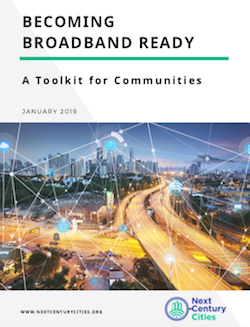
cover-small-NCC-toolkit.png In the summer of 2019, Next Century Cities (NCC) released the Becoming Broadband Ready Toolkit, the most comprehensive resources we've seen to help local communities. This comprehensive resource covers considerations from early in the process to determining success throughout implementation. In addition to offering guidance with examples from across the country, the toolkit offers links to other resources, such as model ordinances, reports, podcasts, and organizations laser-focused on specific and relevant issues.

The toolkit organizes material into overreaching themes, such as building community support, establishing policies to encourage investment, and the pros and cons if publicly owned models, among many other considerations. Within each broad topic, however, NCC has dug deep into specifics, such as addressing simplified permitting practices, creating digital inclusion plans, and ways to work around legislative or regulatory barriers. Throughout the toolkit, NCC turned to the many members of the organization for real-world examples of workable solutions.

Download the toolkit from the NCC website here

When Your Community Decides to Move Forward

Over the years, we've also developed resources that can help educate and spread the word about the benefits of community networks as your project moves forward. Whether your project begins at the grassroots with regular folks in the community or in City Hall, these resources are easily accessible and help explain why community networks are a potential alternative.

Resources

Tools:

Videos:
 
Key Studies:
Fact Sheets:
Related Resources and Nonprofit Organizations:

IP Transition Discussion on WAMU Kojo Nnamdi Radio Show

Discussion over the "IP transition" has taken a back seat in the media lately as news outlets focus on the question of local authority over the right to invest in fiber network infrastructure. The IP transition is the gradual change from older analog mostly copper networks to packet-switched IP approaches that may use any medium (copper, fiber, wireless, etc). Some big carriers, like AT&T, are pushing to change the traditional rules applied to telephony and telecommunications as part of this technological change.

In October, Kojo Nnamdi interviewed Jodie Griffin from Public Knowledge, Technology Reporter Brian Fung, and Rick Boucher, a lobbyist from the Sidney Austin law firm. The show, The Future of Phone Service, is archived and available for you to hear.

As technology creates options for how we speak with each other, rules, regulations, and policies must also stay current. In this interview, Nnamdi and his guests touch on some of the basic concerns we face moving forward. From the WAMU show description:

American phone companies began laying the nation’s vast copper wire telecom network in the 1800s. But today less than one-third of the country uses the old copper lines, and a mere 5 percent rely on them exclusively. The advent of fiber optic cable and wireless phone service makes the copper network obsolete. We explore the fate of landline phone service and concerns about pricing, safety and access as the nation transitions to an all-digital phone future.

If you are interested in learning more about the pros and cons in the IP transition debate, we encourage you to visit Public Knowledge's IP Transition issue page. They provide legal, anecdotal, and statistical data. PK also provides an advocacy toolkit to help you understand the transition and give you the info you need to defend your rights.

Understanding Title II and Network Neutrality - Community Broadband Bits Podcast #101

With all of the recent media discussions around network neutrality, reclassification, and "Title II," we decided to spend this week talking with Matt Wood, Policy Director for Free Press to simplify some key issues. For all the hub-bub around reclassification and dramatic claims that it represents some kind of fundamental policy shift, the truth is actually less exciting. Internet access via DSL was previously regulated under Title II of the Communications Act (as Verizon well knows and has used to its advantage). 

And again regulating Internet access as Title II still allows for various forms of innovation and even paid prioritization if done in a "reasonable" manner. Matt and I discuss how Internet access came to changed from Title II to Title I last decade and the implications of moving it back now. Free Press also runs the popular SaveTheInternet.com

This show is 20 minutes long and can be played on this page or via Apple Podcasts or the tool of your choice using this feed.

Transcript below.

We want your feedback and suggestions for the show-please e-mail us or leave a comment below.

Listen to other episodes here or view all episodes in our index. See other podcasts from the Institute for Local Self-Reliance here.

Thanks to Valley Lodge for the music, licensed using Creative Commons. The song is "Sweet Elizabeth."