
regulation

Content tagged with "regulation"

Displaying 11 - 20 of 134

Republican Broadband Agenda Would Preempt Local Authority and Ban Municipal Networks

Last week, House Republicans introduced a bill package ostensibly to promote broadband expansion and competition across the country. In reality, the legislation is a wish list of monopoly cable and telephone companies that will protect them from competition and decrease their accountability to the public. It would also ban communities from building their own networks or engaging in public-private partnerships.


A Rights of Way Free-for-All

About a third of the bills in the Boosting Broadband Connectivity Agenda would preempt regulations (including application timelines and fee schedules) set by government subdivisions on wireless deployment. The major mobile carriers are already in the process of slowly rolling out 5G networks which will require the installation of hundreds of thousands of small-cell sites over the next several years. AT&T spent more than $23 billion on the recently concluded 3.7 GHz C-band auction, with T-Mobile spending $9.3 billion. Verizon outspent every other bidder combined at $45 billion. Establishing shorter shot clocks and maximum fees for the installation of new hardware in public Rights of Way would simultaneously reduce the income municipalities receive and lead to the proliferation of poles and attachments across the country with limited public input. We’ve already seen how it has negatively impacted cities like Milwaukee and Tucson

This Christmas Morning, Listen to a Podcast Episode on the Future of US Broadband

On Episode 265 of the Techdirt podcast, Sonic CEO Dane Jasper joins host Mike Masnik to talk about how the broadband market in the United States is a failed competitive market, how the regulatory environment brought us from a place with thousands of Internet Service Providers (ISPs) to one where the vast majority of households have just one or two options at basic broadband speeds of 25/3 Megabits per second (Mbps), the arbitrariness of imposing usage caps and future of net neutrality, and the array of other interrelated issues that will dictate the way Internet access looks over the next decade.

Listen to it here.

Happy Holidays!

U.S. Mayors Face Uphill Battle to Preserve Local Control Of 5G Deployment

As Mayors must concern themselves with everything from public safety and health to the development of the local economy and the provision of essential municipal services, they tend to have a particular focus on the infrastructure necessary to support it all, amid a cacophony of competing interests.

Over the summer, having reached consensus on the fundamental importance of “the digital infrastructure of tomorrow,” a particular focus of the United States Conference of Mayors 88th National Annual Meeting was to issue a resolution declaring the necessity of “Preserving Local Public Rights-of-Way and Regulatory Authority to Most Effectively Deploy 5G Broadband Access and Bridge the Digital Divide during the COVID-19 Pandemic.”

Image

The Mayors’ resolution comes in response to the Federal Communications Commission’s (FCC's) 2018 preemption of local governments’ authority to regulate 5G infrastructure in their cities. 

At the heart of the regulatory debate: local governments’ ability to determine the amount of fees to charge mobile carriers that want to place 5G equipment in Rights-of-Way. In addition to putting limits on those fees, the FCC Order also sets strict timelines by which cities and towns must respond to carrier applications. The FCC decision, issued over the objections of industry observers and policy experts, essentially eliminates local communities’ ability to negotiate in order to protect their own Rights-of-Way and the poles, traffic lights, and other potential structures within those Rights-of-Way.

Preempting Local Authority

Two New Reports Detail Connectivity Challenges and the Potential of Community Networks

July has seen the release of two complementary reports which shed light on two of the topics we care about a great deal around these parts: availability and affordability of Internet access, and municipally-enabled networks.  

The Open Technology Institute at New America recently released “The Cost of Connectivity 2020” [pdf], which digs into the factors (some of which are explicit and others hidden) dictating how much Americans can expect to spend for Internet access in comparison to Europe, Asia, Canada, and Mexico. They conclude that, compared to the rest of the world, a lack of competition, regulation, and accurate data collection by the FCC has led to higher prices, slower speeds, exorbitant data cap fees, and deep digital divides running between those with high-speed access and those in Black, Indigenous, and People of Color (BIPOC) communities and low-income parts of American cities. And among its most compelling policy recommendations — based on data points from 296 standalone Internet plans in the United States — is that municipal networks offer a solution. 

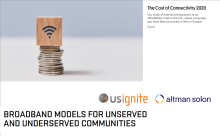
If OTI’s report outlines the deep and persistent problem of connectivity in the United States, US Ignite and Altman Solon’s “Broadband Models for Unserved and Underserved Communities” [pdf] provides a clear and thoughtful roadmap for local communities who ask “What can we do?” Above all else, the guide shows that high-speed broadband is a solvable proposition, and sketches out five models for local governments to follow according to their unique conditions. Like the OTI report, US Ignite and Altman Solon highlight the many inherent benefits of community-enabled networks. 

Download the full reports at the bottom of this post.

Digging into the Data

FCC Ends Speculation On Broadband Speeds, Mobile Internet Access

On January 18th, the FCC ended months of speculation and released a fact sheet that included several key conclusions to be included in the 2018 Broadband Deployment Report. The most important is that the FCC continues to recognize that mobile Internet access is not a substitute for fixed access. The Commission has also decided to leave the definition of broadband at 25/3 Mbps (down/up).

Download the fact sheet here.

“Broadband” Will Not Slow Down

The Commission had proposed reverting to a slower definition of broadband from the current standard of 25 Megabits per second (Mbps) download and 3 Mbps upload. Under Tom Wheeler’s leadership, the FCC decided to update the standard to its current definition in January 2015, but current Chairman Ajit Pai and other Republican Commissioners suggested in last year’s Notice of Inquiry (NOI) that the FCC might effectively take us backward to a 10 Mbps/1 Mbps standard. 

The suggestion rankled better connectivity advocates and Internet users. Many recognized that lowering the standards would make it easier for the FCC to proclaim that the U.S. was making strong progress toward universal household deployment. The Commission would have been justified making such a conclusion under the standard because large sections of rural American receive DSL, fixed wireless, satellite, or mobile Internet access that would meet a lowered 10/1 standard.

Hundreds of thousands of people, organizations, and businesses filed comments opposing a slower standard. Many of them live in areas where 10/1 speeds are already available but who have been waiting for better options. Commissioners Rosenworcel and Clyburn also spoke out against the lowering broadband speeds. 

Commissioner Rosenworcel tweeted:

The Challenge of Mobile Only - Community Broadband Bits Podcast 287

With the Federal Communications Commission Republicans poised to redefine broadband to include slow, unreliable, and often bandwidth-capped mobile service, we talk with two high school students from southeast Ohio, Herron Linscott and Lilah Gagne, that have succeeded despite the lack of fixed broadband access in their homes. Soon the FCC may include those homes as having broadband though they clearly don't fit the description of what any sane person would call advanced telecommunications. 

We start off episode 287 of the Community Broadband Bits podcast with Next Century Cities Executive Director Deb Socia, who reminds us why mobile Internet access is not an adequate subsitute for fixed access. Next Century Cities has launched the Mobile Only Challenge - share MobileOnlyChallenge.com around - to highlight the challenges of relying solely on mobile Internet access. 

We then talk to Herron Linscott and Lilah Gagne about their experiences in southeast Ohio as high school students without home fixed Internet access. Both have had to schedule lots of time away from home in order to complete assignments and partake in extra-curricular activities and both offer a window into the importance of connectivity for the next generation. 

This show is 25 minutes long and can be played on this page or via Apple Podcasts or the tool of your choice using this feed

Transcript below. 

We want your feedback and suggestions for the show-please e-mail us or leave a comment below.

Listen to other episodes here or view all episodes in our index. See other podcasts from the Institute for Local Self-Reliance here.

Thanks to Arne Huseby for the music. The song is Warm Duck Shuffle and is licensed under a Creative Commons Attribution (3.0) license.

Transcript: Community Broadband Bits Episode 281

This is the transcript for Episode 281 of the Community Broadband Bits podcast. Will Rinehart of the American Action Forum in Washington D.C. discusses telecommunications and economics with our host Christopher Mitchell. Listen to this episode here.

Will Rinehart: And I do think that obviously good policy is very very important and that's where you and I agree a lot. You know there's obviously some good policies that can be enacted. There's probably better conversations that could be had in this space and that's also something else that I really do really want to see. You're

Lisa Gonzalez: listening to episode 281 of the Community Broadband Bits podcast from the Institute for Local Self-Reliance. I'm Lisa Gonzales as a research organization. We here at the institute make it a habit to hear all sides of the debate along the way we make connections with people who offer perspectives on policy that differ from ours. We consider these conversations critical as we analyze factors that help us create policy recommendations and resources for local communities. This week Christopher talks with Will Rinehart from the American Action Forum. They got together at the recent broadband community's economic development conference in Atlanta. In this conversation you'll hear the two discuss a variety of topics they talk about the area of telecommunications and economics and the forum's approach. You'll also hear that these different perspectives aren't as black and white as they first appear. Now here's Christopher with Will Rinehart from the American Action Forum.

Christopher Mitchell: Welcome to another edition of the community broadband bits podcasts. I'm Chris Mitchell with the Institute for Local Self-Reliance. Coming to you from Atlanta sitting practically on a runway at the Atlanta airport with Will Rinehart the Director of Technology and Innovation Policy with the American Action Forum. Welcome to the show. Thanks Chris. Thanks for having me. We're at the broadband community's event here. We just had our second panel which is called a blue ribbon panel and general session kind of thing. And you and I are typically brought on as people who have very opposing points of view.

Another Perspective on Policy From American Action Forum - Community Broadband Bits Podcast 281

Christopher went to Atlanta for the Broadband Communities Economic Development Conference in early November, and while he was there, he touched base with this week’s guest Will Rinehart. Will is the Director of Technology and Innovation Policy at the American Action Forum, a DC nonprofit organization that’s been around since 2009.

Will and Christopher don’t always see eye to eye on issues that affect telecommunications and broadband policy, but both agree that it’s important to have spirited debate to share perspectives. Only by examining issues from different sides can we craft policy that creates lasting benefits.

In this interview, Will describes his organization and his work there. Chris and Will look at compelling issues such as ISP competition, government regulations, and how the FCC’s 2015 upgraded definition of broadband has reverberated in the market. The two get into franchising and ubiquitous broadband, local authority, and connectivity in rural America. It’s a spirited discussion chock-full of issues.

You can tweet to Will, he’s @WillRinehart on Twitter.

This show is 30 minutes long and can be played on this page or via Apple Podcasts or the tool of your choice using this feed

Transcript below. 

We want your feedback and suggestions for the show-please e-mail us or leave a comment below.

Listen to other episodes here or view all episodes in our index. See other podcasts from the Institute for Local Self-Reliance here.

Thanks to Arne Huseby for the music. The song is Warm Duck Shuffle and is licensed under a Creative Commons Attribution (3.0) license.


Transcript: Community Broadband Bits Episode 271

This is the transcript for Episode 271 of the Community Broadband Bits Podcast. Research Associate Hannah Trostle takes over as host in order to quiz Christopher Mitchell on the latest developments in community networks. Listen to this episode here.


Christopher Mitchell: I can't believe we're freek'n talking about satellite again!

Lisa Gonzalez:This is Episode 271 of the community broadband bits podcast from the Institute for Local Self-Reliance. I'm Lisa Gonzalez. What do the FCC satellite internet access mobile broadband. Madison, Wisconsin, and utility poles in Louisville, Kentucky, have in common. They're all in the recent community broadband news and they're all in this week's podcast. In this episode, Research Associate Hannah Trostle boots Christopher from the host chair to interview him about some significant recent developments. For more details on these and other topics check out the appropriate tags at MuniNetworks.org. Now, here's Hannah and Christopher.

Hannah Trostle: Welcome to the Community Broadband Bits podcast. This is your host this week Hannah Trostle. Joining me is the normal host Christopher Mitchell.

Christopher Mitchell: I don't know how normal I am but thank you for having me on my show.

Hannah Trostle: Now we're going to kick you off, and I'm only going to do the podcast from now on.

Christopher Mitchell: I can't say I don't deserve it.

Hannah Trostle: Well you've been gone quite a bit. Where have you been?

Fiber For All and More - Community Broadband Bits Podcast 271

After a friendly coup in the offices of the Institute for Local Self-Reliance, Hannah has taken the podcast host chair from Christopher for episode 271 of the Community Broadband Bits. Hannah grills Christopher on where he has recently traveled, interesting lessons, and recent news around community broadband. (Christopher mentions a great event in Pittsfield - video available here.)

The conversation starts with a discussion of why recent travels strengthened our belief that full fiber-optic networks are the best approach for the vast majority of America in the long term. Christopher and Hannah discuss the future of low-latency networks and what is more cost-effective over decades rather than just over the first few years.

They go on to discuss their fears of the FCC legitimizing satellite and mobile wireless connectivity as good enough for carrier of last resort in rural regions. The show wraps up with a discussion about One Touch Make Ready in Louisville and Madison's RFP for a fiber network partner. 

This show is 26 minutes long and can be played on this page or via Apple Podcasts or the tool of your choice using this feed

Transcript below. 

We want your feedback and suggestions for the show-please e-mail us or leave a comment below.

Listen to other episodes here or view all episodes in our index. See other podcasts from the Institute for Local Self-Reliance here.

Thanks to Arne Huseby for the music. The song is Warm Duck Shuffle and is licensed under a Creative Commons Attribution (3.0) license.