
FTTH

Content tagged with "FTTH"

Fiber to the Home
Displaying 391 - 400 of 1312

Coosa Valley Electric Cooperative Brings Fiber to Rural Alabama

Talladega, AL has long been known as the epicenter of NASCAR, a sport synonymous with speed. In 1987, Bill Elliot set the fastest recorded time of 212.089 mph on that very track. 

Cars aren’t expected to start racing down the Talladega Superspeedway track until late April, but the Coosa Valley Electric Cooperative (CVEC) chose the location to announce the fittingly super fast speeds it expects to begin serving up with its new broadband subsidiary, Coosa Valley Technologies, last Wednesday. 

Unfortunately, many residents in Talladega County and surrounding counties have long gone without fast connectivity, with average speeds as low as 5 Mbps (Megabits per second)

CVEC often holds events at the Superspeedway, but for this event they wanted to make sure that since people were gathering, social distancing was possible. Also they wanted to communicate a message.

“It also served as a good backdrop for what we were trying to communicate, which was, we’re going to be provided the fastest broadband service in our area,” Jon Cullimore, CVEC Manager of Marketing and Member Services, told us in an interview as the cooperative prepares to embark on a fiber build intended to bring fast, affordable Internet access to everyone in its electric footprint over the next four years.

Driven by Membership

It all started in 2019 with feasibility studies conducted by two different firms. Both found a profound lack of broadband service throughout CVEC’s service territory, which is situated east of Birmingham.

When the studies were completed, CVEC quickly put together a comprehensive information packet for members to get educated before their annual meeting last September. The members were asked to vote on whether or not CVEC should form a new broadband subsidiary and embark on a new phase of life.

“We got the word out, and we had a record attendance at our annual meeting. We’ve never had that many members show up before,” Cullimore said. “I think we only had 12 ‘no’ votes out of all the [more than] one thousand people that showed up.”  

Vermont House Backs $150 Million Broadband Plan

A bill dedicating $150 million of anticipated federal funding to create a new state broadband office to coordinate and accelerate the expansion of high-speed Internet access throughout Vermont passed the State House of Representatives last week with overwhelming bipartisan support.

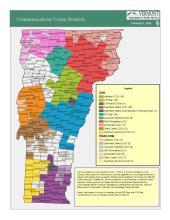
On March 24th, the Vermont House approved H.B. 360 by a vote of 145-1, backing the creation of the Vermont Community Broadband Authority. If the bill becomes law it would help fund and organize the deployment of broadband infrastructure between Vermont’s nine Communications Union Districts (CUDs) and their potential partners, which include electric distribution utilities, nonprofit organizations, the federal government, and private Internet Service Providers (ISPs).

The bill was introduced in the state Senate last Friday, and discussed for the first time in the Senate Finance Committee on Wednesday.

Enabled by a 2015 law, CUDs are local governmental bodies consisting of two or more towns joined together to build communications infrastructure. They were established to create innovative solutions to build broadband networks and provide a combination of Fiber-to-the-Home and fixed wireless Internet connectivity in their respective territories across Vermont, especially in areas where incumbent ISPs fail to provide adequate service. 

Vermont’s CUDs, which have called for federal funding assistance since the onset of the pandemic, are ideally positioned to distribute funds in a way that will provide reliable and high-performance Internet access to every nook-and-cranny of the state. Vermont’s active CUDs have already constructed deep pockets of fiber.

Whether or not the CUDs will be able to reach the state’s goal of delivering universal 100/100 Megabits per second (Mbps) Internet service by 2024 now rests in the hands of Vermont’s Senate, Congress, and the Biden Administration as state and federal lawmakers wrestle with how to best expand access to broadband.

Community Broadband Legislation Roundup – March 29, 2021


Snapshot 

Colorado House passes bill that reduces broadband board membership and conceals mapping data

Michigan legislature approves bill granting ISPs property tax exemptions 

New Mexico and Virginia bills await governors’ action 


The State Scene

Tennessee

Tennessee is home to some of the most creative local solutions to bridging the digital divide. Municipal fiber networks across the state, including Chattanooga’s EPB Fiber network, Morristown’s FiberNet, and Bristol’s network, have been a boon to economic development, job creation, educational initiatives, and overall quality of life in the past decade.

The next city to potentially join the ranks of providing municipal broadband in Tennessee is Knoxville. On March 11, the Knoxville Utility Board approved a business plan to provide Internet services across its service area. 

Despite the widespread success of municipal networks across Tennessee, the state restricts what populations they can serve. Although Tennessee law allows cities and towns to offer advanced telecommunications services if they have a municipal electric utility, the networks are not permitted to offer those services to residents who live outside of the utility’s service area. Removing these restrictions would permit substantial fiber expansion to connect more residents at no cost to the state or taxpayers.

Knoxville Knocking on Door to be Tennessee’s Next Gig City

Although Tennessee is one of 19 states in the nation with laws that limit municipal broadband networks, it is also home to several of the nation’s premier municipal Fiber-to-the-Home (FTTH) networks, including EPB Fiber, a division of Chattanooga’s city-owned electric and telecommunications utility.

In the Volunteer State, municipal electric providers are restricted from offering Internet service on fiber networks beyond their service areas. But now, Knoxville, a city of approximately 187,000 residents and the home of the University of Tennessee, is aiming to get on the community fiber track and become the state’s next gig city.

Earlier this month, the Knoxville Utilities Board (KUB) Board of Commissioners approved a business plan that, if approved, will set the utility on a path to bring high-speed Internet connectivity to its more than 468,000 customers spread out across Knoxville, Knox County, and small parts of seven neighboring counties.

The plan has been sent off to the Tennessee State Comptroller office for review, one of the initial steps in the process to bring triple-play services (Internet, phone and TV) to its broadband-hungry customers.

Image

A Need for Speed

Franklin, Kentucky Expands Fiber Pilot Partnership with Recent RDOF Wins

Franklin, Kentucky’s (pop. 8,400) electric utility is gearing up for an expansion of its partnership with Warren Rural Electric Cooperative Corporation (WRECC) with the help of $2.3 million from the recent FCC Rural Digital Opportunity Fund (RDOF). The new partnership will allow Franklin EPB to add new service to roughly 250 locations adjacent to a current project in the area.

The expansion project will add subscribers in the northeast region of Simpson County and nearby parts of the city of Franklin in the south-central part of the state, where the two entities are operating a two-area fiber pilot.

Old Town-Orono Fiber: Poetry in Slow Motion

Born in Orono, Maine, the poet Frances Laughton Mace’s most notable verses were published in 1854 as a hymn entitled “Only Waiting.” Over a century and a half later, residents in her native town – and in the neighboring community of Old Town just four miles up the road – might be inclined to hum a line or two. Not because they are getting religion, but because of the wait in getting Fiber-to-the-Home (FTTH) Internet connectivity.

After a decade of hopeful planning, disappointing setbacks, design work, and putting out multiple RFPs to move the project forward, the nonprofit OTO Fiber Corporation is on the verge of lighting up a six-mile fiber network this summer. With three miles of fiber deployed in Orono, a town of 11,000 residents and home to the University of Maine’s flagship campus, and the other half covering a portion of Old Town, the budding network will provide FTTH service to a limited number of residences and businesses in both towns. It’s a pilot project that, if successful, will serve as a core network which can eventually be extended to cover the entirety of both communities.

“It’s taken us forever to get to this point it seems. We started this process ten years ago and we are still slogging our way through while we’ve seen other communities zip ahead,” Belle Ryder, Orono Assistant Town Manager and President of OTO Fiber, told us this week. “It is really, really, really hard for communities relying on volunteers to pull off the feat of building and operating these networks.”

Ryder wasn’t complaining or exasperated. She was just being candid about the process she and her colleagues at OTO Fiber are committed to see through to the finish. The slog she is referring to goes back a decade when Orono was in the process of putting together a comprehensive development plan.

Families and Fiber, Fits and Starts

With just about half of the town’s population made up of college students living in off-campus apartments and the other half made up of residents 60 and older, “we really needed to draw families back,” Ryder explained. 

Lighting Up the Dark (Fiber) in Jacksonville

Is a major metropolitan Fiber-to-the-Home (FTTH) network on the horizon for one of the Sunshine State’s most populous cities?

Longtime Jacksonville, Florida (pop. 890,000) resident Eric Geller is spearheading a citizen-led effort to rally residents and officials around a vision that would catapult Jacksonville into the fiber-connected frontier of Internet access and reinvigorate the economy of a city that was once known as the "Bold New City of the South."

As an IT consultant and former public policy research analyst, from Geller’s tech-savvy perspective the key is for the city’s utility company, JEA, to move beyond providing electricity, water, and sewer services and expand into building the necessary Internet infrastructure that would give all Jacksonville residents access to reliable and truly high-speed connectivity.

“Nationally, it’s been well accepted that we are at a point where the Internet is absolutely mandatory. Every business and home has to be connected,” Geller said in a recent interview with WJCT Radio, noting how the pandemic has made it clear that universal access to broadband is nearly as important as running water and electricity.

JEA’s Dark Fiber Infrastructure

If it’s a pipe dream, it’s one with light at the end — if Jacksonville residents can first see and appreciate all the dark. That is to say, the city’s existing dark fiber network, or the unused capacity of the fiber optic cables JEA has already deployed and how it could be leveraged and lit up to serve as the backbone for a citywide FTTH network.

JEA already leases routes to businesses along its 500-mile fiber optic network spanning the Jacksonville metropolitan area, which includes all of Duval Country and parts of St. Johns and Nassau Counties. In fact, with all that underground (and overhead) fiber already in place, Jacksonville can boast of having “more fiber in the ground than any city in Northeast Florida,” much of it passing through vital commercial and industrial parts of the city.

Broadband Comes Ashore on Block Island

The streaks of paint and tiny white flags popping up across Block Island are not signs of surrender. They are signs of progress. The popular summer tourist destination, nine miles off the coast of Rhode Island, is on the verge of building a Fiber-to-the-Home (FTTH) network, bringing gig-speed Internet connectivity to the more than 1,000 residents who call the community home.

The markers on residents’ property are plot points along the construction route as network planners prepare to start building the last-mile portion at the end of March.

On Feb. 4, BroadbandBI launched its website, announcing that the construction materials had finally arrived on the Island and signaling the start of construction would soon be underway. 

Sertex, the company partnering with the town to build the network, is anticipating deploying more than 60 miles of fiber to deliver high-speed Internet service directly to homes and businesses in New Shoreham, the only town on Block Island.

Pop the Champagne

Residents there unanimously voted in July 2020 to pay for the construction of the island-wide network with $8 million in bonds. Approval for the project was so overwhelming that when the vote took place the Block Island School gymnasium erupted with cheers and applause.

Currently, there are still only three options for Internet service on the Island: Verizon DSL, satellite, and mobile services with the fastest speed advertised at 35 Megabits per second (Mbps). And for a period of time, it seemed as if residents were doomed to those tortoise-like speeds forever.

In 2014, the Block Island Times captured experiences from its readers after an especially frustrating summer of spotty service. One reader, Jessica Fischburg wrote, “We have Verizon and live down in Franklin Swamp. No cell service. Our Internet is painfully slow unless you wake up super early. We have no choice but to disconnect when we come out to the island!” 

The Answer Was Blowing in the Wind

Outside Gettysburg, A Battle for Better Broadband

In the heart of Adams County, Pennsylvania, not far from the site of the pivotal Battle of Gettysburg and where President Abraham Lincoln later delivered his famous 1863 Gettysburg address declaring “a new birth of freedom,” plans are being drawn up in the battle for better broadband.

In the borough of New Oxford, ten miles east of the county seat (Gettysburg), the non-profit media group Community Media of South Central Pennsylvania is leading the charge to bring Fiber-to-the-Home (FTTH) victory for the approximately 102,000 residents spread out across the rural county’s 520 square miles.

But with restrictive state laws that protect incumbent providers from competition by not allowing municipalities to provide broadband service, and scarce funding for non-governmental entities to build broadband infrastructure, victory is far from certain.

Small Steps, Big Broadband Problem

The goal right now, Community Media’s Director of Operations Mark Wherley told us this week, is to secure $3 million to bring fiber access to 1,200 homes in New Oxford and Abbottstown, two of the 34 municipalities that make up Adams County, encircling Gettysburg.

Image

Working in conjunction with the Adams County Economic Alliance, Community Media is looking to tap the state’s Redevelopment Assistance Capital Program (RACP) for funds to start building the network. Through RACP, Community Media would be eligible to receive between $1 million and $5 million, provided they are able to raise a 50 percent matching contribution.

Weaving a Fiber Net Through Oregon’s Silicon Forest: Hillsboro’s Municipal Network Goes Live

HiLight — Hillsboro, Oregon’s (pop. 105,000) citywide Fiber-to-the-Home (FTTH) network — has officially launched and begun connecting its first subscribers. After five years of consideration and planning, it’s an exciting moment, with hundreds of homes and businesses brought online over the last few months. Over the next seven years, at least $28 million will be put towards the rollout, bringing the municipal network to tens of thousands of locations across the city.

Hillsboro sits just outside of Portland, and has been looking for better connectivity options for years. A large proportion of its population is comprised of tech workers and residents with advanced degrees; the city, in fact, anchors the state’s Silicon Forest, so named for the group of technology firms employing tens of thousands of workers across three Intel campuses as well as operations by Oracle, Salesforce, Epson, and Synopsis. A citywide fiber network serves to provide competition and capacity to keep them in the area:

Hillsboro is the tallest tree in the Silicon Forest and the center of Oregon’s high-tech cluster. With an affordable high-speed network, Hillsboro’s homegrown talent — our students and entrepreneurs — will be better positioned to lead the world in innovating for the future. Hillsboro will continue to attract and retain talent and be a hub for innovation.

But Hillsboro also faces a stark digital divide fueled by economic inequality, and bridging it has been one of the city council’s (and now the network’s) main agenda items. This has driven the project’s second focus: bringing affordable, high-quality access to economically vulnerable residents stuck with no quality options today. It’s why the city has introduced one of the fastest low-cost access program we’ve seen established by any broadband network in the United States, with qualifying families getting access to symmetrical gigabit service for $10/month.

Putting Glass in the Ground