
FTTH

Content tagged with "FTTH"

Fiber to the Home
Displaying 411 - 420 of 1312

Report: Case Studies Detail How Tribes Are Expanding Internet Access

The rate of connectivity in Indian Country lags behind the rest of the country. As of December 2018, only 60% percent of Tribal lands in the lower 48 states had high-speed Internet access. A new case study report [pdf] from the Institute for Local Self-Reliance delves into the experiences of four Native Nations — the Coeur d’Alene, the Nez Perce, the Fond du Lac Band of Ojibwe, and the St. Regis Mohawk — as they constructed their own Internet service providers. 

The case studies examine the unique challenges Native Nations confront as they seek to build Internet infrastructure and address the digital divide while also retaining the tribal sovereignty that is essential to their identity and heritage. As the report states, “Native Nations are sovereign over their data, and have the obligation to protect that information and use it for the betterment of tribal citizens.” 

Each section of the report contains key takeaways that other tribes could use and learn from. The report also pulls these individual case studies together for comprehensive key lessons that Native Nations, lending institutions, and the federal government can use to improve the process for implementing tribal ISP’s, which include:

Cultivating Connectivity in Clarksville, Arkansas

Chickens, peaches, and college students. Those may be the first things that come to mind if you have ever visited Clarksville, Arkansas – a small town of about 9,200 residents situated at the foot of the Ozarks.

Clarksville’s largest employer is a Tyson poultry facility. Every summer, Clarksville hosts the oldest food festival in the state, the annual Johnson County Peach Festival (which was cancelled in 2020 because of the COVID-19 pandemic). And, just two blocks north of downtown Clarksville is The University of the Ozarks, which gives Clarksville a bit of that college town flavor.  

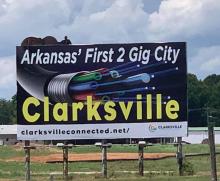
But, if you ask Clarksville Connected Utilities (CCU) Business Development Director Barry Sellers, he will tell you: “the biggest thing we have [in Clarksville] is this fiber network. That’s why we put up a billboard right off I-40 that says: ‘Clarksville is Arkansas’ first two gig city.’ I get calls weekly asking if it’s true.”

Yes, it’s true. Last summer CCU began the last step of a Fiber-to-the-Home (FTTH) build-out with the project already nearing completion.

“We are starting to light people up, about 200 so far. We should be able to have 1,000 customers lit up and being served before end of 2021,” CCU GM John Lester told us last week, adding that they have a 30% take-rate so far and are hopeful that as many 50% of the city’s 4,300 potential residential and business customers will sign up for service within the next 3 to 4 years.

Birth of a Network

Image

It was in 2013 that CCU operators were looking for a way to provide better connectivity for its utility operations and its Supervisory Control and Data Acquisition (SCADA) systems, which monitors and manages its utility infrastructure. After studying what kind of network to put in place, CCU found that a fiber network would be the best fit.

Listen to How One Citizens Group in Falmouth, Mass. is Banding Together for Better Broadband

Local citizens and officials have been moving the needle on the Falmouth Community Network, completing a feasibility with the help of CCG Consulting in December and continuing to pursue public awareness and education efforts in the area. ILSR's Christopher Mitchell joined Cape, Coast, and Islands Radio on Tuesday to talk about the effort and the promises it holds for those who live in the area.

Other guests on the show include:

David Isenberg, Distinguished Member of Technical Staff at Bell Labs, Senior Advisor to the FCC's National Broadband Plan, and Board Member of FalmouthNet.

Marilois Snowman, CEO of MediaStruction, a media and marketing firm in the Boston area, V.P. of FalmouthNet, Inc.

Sam Patterson, Falmouth Select Board member and Select Board's Representative to the Falmouth Economic Development and Industrial Corporation (EDIC).

Listen to the episode here.

Staying Ahead of the Curve in Conway, Arkansas

Conway is right in the middle – in the middle of Arkansas with its utility company, Conway Corp, in the middle of beefing up its broadband network.

In this city of 66,000 – home to the information technology company Acxiom Corporation and three colleges – residents and businesses have long relied on Conway Corp for more than just electricity since the utility first launched its cable and Internet service in 1997.

Conway Corp, which has been Conway’s electric utility for the past 90 years, has a unique relationship with the city’s government. “We are different in the way we are set up as compared to many other municipal networks. We are set up as a non-profit. We lease the network and operate it on behalf of the city,” explained Conway Corp Chief Marketing Officer Crystal Kemp.

At the heart of the utility’s network management has been the on-going work to stay ahead of the curve.

Prepared for the Pandemic

“When we launched Internet services in 1997, upstream capacity wasn’t a concern and systems were built with the average homes (and) businesses per geographic area, or node, at 500. Today those numbers are less than 95 per node. That’s been achieved through physical changes in the network and changes in our engineering practices,” Conway Corp’s Chief Technology Officer Jason Hansen told us last week. 

Upgrades to the Hybrid-Fiber-Coax (HFC) network began to take shape in 2019 with the deployment of DOCSIS 3.1, allowing Conway Corp to double its downstream capacity. They also began upgrading equipment that paved the way for expanded use of the RF (Radio Frequency) spectrum to boost the network’s bandwidth. As of December 2020, about 50 percent of the upstream upgrade work had been completed with the remainder expected to be finished by the summer of 2021.

Cummington Connect Turns One Massachusetts Town From a Broadband Desert to an Oasis

Western Massachusetts stands as maybe the most dynamic place for municipal broadband at the present, with almost two dozen cities pursuing projects. And while the slate has many similarities between them, each has a unique starting point and has followed its own path along the way. 

Cummington (pop. 800), which straddles the banks of the Westfield River thirty miles northwest of Springfield and twenty miles east of the New York border, has just completed its municipal Fiber-to-the-Home (FTTH) network. It has been almost a decade in the making, and despite seeing its share of obstacles along the way, residents can now look forward to years of fast, affordable Internet access. 

Stuck on DSL

Ten years ago, Cummington had no high-speed Internet access options. Verizon offered the only DSL service in town, and its network in the area remained a relic of upgrades focused not on residents there but in the population centers to the east. Only half the town was covered, relegated to download speeds in the single digits and upload speeds at a fraction of that. The rest of the town’s residents were stuck with satellite service, which was even slower and more unreliable with changing weather. 

The story of broadband for western Massachusetts is a winding road. At the end of the first decade of the twentieth century, the state of Massachusetts received initially funding for its MassBroadband 123 backbone network (currently, it’s operated by KCST USA, formerly Axia Networks), which would bring middle-mile infrastructure to schools and libraries in 120 towns and communities in the area (including a spur in Cummington [pdf]) by 2014. Residents, however, remained unconnected. 

Broadband Beckons for Becket in the Berkshires

What Becket Town Administrator William Caldwell called “one of the most anticipated news [events]” in town was announced at the North Becket Village fire station weeks before Christmas.

But town officials weren’t there to roll out a shiny new ladder truck or to bring their kids to meet Santa. They were there to bring glad tidings of the launch of construction for Becket Broadband, a municipal Fiber-To-The-Home (FTTH) network that will usher high-speed Internet connectivity into this small Massachusetts hill town.

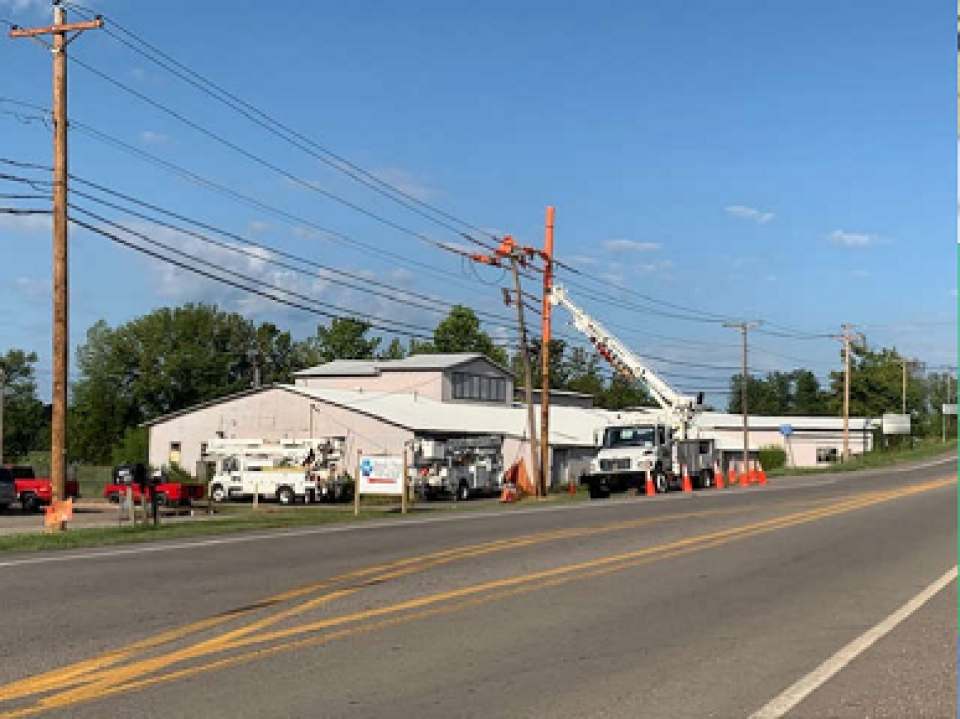
Since the town received a $3 million state grant to fund the initial work to build the network nearly four years ago, Sertex construction crews have been working and will continue through the winter to string fiber cables on utility poles along the town’s approximately 100 miles of roads with the build-out expected to be complete in 2022.

The project manager for the network’s construction is Westfield Gas & Electric, the city of Westfield’s gas and electric utility which received $10.2 million from the Federal Communications Commission’s (FCC) Connect America Fund Phase II (CAF II) auction to expand fiber networks in 20 nearby communities in western Massachusetts, including Becket.

A Call in Vermont to Assemble A Broadband Corps

A new report out by CTC Technology and Energy and Rural Innovation Strategies, commissioned by the state of Vermont, gives us one of the clearest and most detailed pictures so far of the impact of the Covid 19 pandemic on our attempts to live and work remotely. 

The “Covid-19 Responses Telecommunications Recovery Plan” [pdf], presented to the state in December 2020, includes both a comprehensive survey of conditions after a half-year of social distancing and intermittent lockdowns as well as recommendations for addressing immediate needs. But it offers solutions that provide a path forward by making sure that dollars spent now are in service to the state’s long-term goals of getting everyone in the Green Mountain State on fast, affordable wireline broadband service at speeds of at least 100/100 Megabits per second (Mbps). 

The report brings together network performance assessments from every level of government across the state over the last six months, pairs it with survey responses from citizens, libraries, hospitals, businesses, regional development corporations, and Communications Union Districts (CUDs), and offers analysis based on conditions for moving forward.

“Covid-19 has laid bare the challenges of lack of universal broadband in Vermont,” the report says, with “inequities in the availability and affordability of broadband create further inequities in areas such as education, telehealth, and the ability to work from home.” It offers a wealth of findings:

Le Sueur County, MN Hitting on All Cylinders

Over the last three years, Le Sueur County, Minnesota has assembled a task force of citizens, local officials, and business leaders which have succeeded in dramatically improving broadband for thousands of residents who previously had poor or no connectivity. In doing so, they’ve also forged relationships, inventoried local resources, and created a model which is likely to see the landscape go from one where nearly all residents in the county were under- or unserved by basic broadband at the beginning of 2018 to one where the vast majority of the community will have access at 100/20 Mbps in the next couple years. And if efforts continue to succeed, it’s possible we might see full fiber coverage in Le Sueur by the end of the decade, making it one of the most connected counties in the state.

Le Sueur is located ninety miles southwest of Saint Paul, and had just under 29,000 residents and 11,000 households in 2019. There are 11 whole or partial cities in the county, of which Le Center and Montgomery are the largest at around 2,500 people each. The remaining communities sit between 200 and a 1,000 residents. More than a thousand farms dot the landscape, and agriculture, along with some tourism and resort development centered on the lake communities, comprise the bulk of the county’s economic picture.

Image

Broadband infrastructure outside of the population centers in Le Sueur is generally poor, which was a problem for residents, for businesses, and for farmers looking to remain competitive and modernize operations: “the lack of this service means students have trouble completing schoolwork and seeking future opportunity, small businesses have trouble connecting with customers and vendors, farmers have less efficient operations, home sales and development lags, and options for telemedicine are closed.”

Grant Program Helps Arkansas Communities Large and Small Get Started on Broadband

A host of cities and counties in Arkansas are about to get a major broadband boost thanks to local officials taking steps to act on a grant program deployed by the state last year. Borne out of the state’s 2020 1st Extraordinary Session at the end of March 2020 in response to the Covid 19 pandemic, the new Rural Broadband I.D. Expenses Trust Fund Grant Program will disburse $2 million in funds divided into 30 one-time grants of $75,000 each to towns, cities, and counties to tackle the digital divide in the Toothpick State. The program is financed via Arkansas’ Restricted Reserve Fund with money given to the state by the CARES Act, and is administered by the University of Arkansas for Medical Sciences (UAMS) Institute for Digital Health & Innovation. And while an array of projects have been awarded funds, money remains available and applications are being accepted on a rolling basis for those who have yet to take advantage.

A Win for Local Self-Reliance and Increasing Competition

The program is expressly designed to bridge the gap for communities that want to begin to improve local Internet access but are stymied by a necessary first step: paying for those economic, design, and feasibility analyses which require pulling together the wide range of options available in the context of local conditions. That’s where this program comes in, according to Rachel Ott, the UAMS Institute’s for Digital Health and Innovation Grant Director. Communities can use the work produced to apply for federal grants down the road, including the recently concluded Rural Digital Opportunity Fund (RDOF), the U.S. Department of Agriculture’s ReConnect Program, funds from the Agriculture Improvement Act of 2018, and any other forthcoming federal funding programs. 

Milton, Mass. Municipal Fiber Initiative Launches Petition for Community Broadband

The Milton, Massachusetts Municipal Fiber Initiative recently launched a friendly petition to collect signatures to present to the city select board in support of a city-wide Fiber-to-the-Home (FTTH) network to increase competition, speed, reliability, and customer service while lower Internet access costs for residents. From the group's website:

We are a community-led effort to create a fiber-optic, municipal broadband network in the town of Milton, MA.  We believe a community-owned, state of the art, 100% fiber network is necessary to provide everyone in town - residents, town government, local businesses and non-profits - with better access, more choice, lower prices, blazing fast speeds, and superior reliability...now and for decades to come!

The group indicates that the town has already created a municipal broadband committee as well as a design and cost estimate done by CTC Energy and Technology [pdf]. 

From the petition:

To all our Milton friends and neighbors -

The MMFI is collecting signatures for a friendly petition to the Milton Select Board. Our intention is to demonstrate public support for municipal broadband, and to urge the board to take the next steps towards the establishment of a municipal broadband network.

The Select Board has made some great progress already with the appointment of a Municipal Broadband Committee.   The committee's efforts culminated in a cost and design estimate for the creation of a 100% fiber, municipally-owned broadband network, providing the town with a viable road map to a town-wide, fiber-to-every-premise network.   

We're asking you to join us in our efforts to keep the process going.  We hope we can make the case to you, our Milton friends and neighbors, that municipal broadband is an investment in Milton's future, a public asset that will serve community needs for generations.