
transparency

Content tagged with "transparency"

Related Topics
Displaying 11 - 20 of 35

Report: Lack of Fiber in the United States is a Market Failure, and Open Access is the Solution

A new report by the Electronic Frontier Foundation argues that the general lack of fiber network coverage across the United States - with barely a third of homes able to choose a fiber option -  comes in large part from the domination of the broadband marketplace by incumbent providers who both own and operate the infrastructure that provides Internet access to the vast majority of Americans. It’s a classic market failure, authors Benoît Felten and Thomas Langer argue, where there’s a clear profitable business case for the existence of more fiber access that continues to go unaddressed. At its core, the failure is driven by the attitudes of monopoly Internet Service Providers (ISP) which prefer to reap the profits from existing legacy copper and cable infrastructure rather than invest in new build outs. As a result, a larger proportion of Americans than many other nations remain stuck on slower, more expensive connections.

The solution, the report shows, is relatively straightforward and economically viable for as many as 78 percent of all households across the country: the construction of a series of local or regional fiber networks operated on a wholesale basis, whereby any ISP that wants to can join an open, transparent marketplace, creating much more competition than exists in the current arena. 

“Wholesale Fiber is the Key to Broad US FTTP Coverage” offers an economic case for open access fiber in improving access, affordability, and driving competition. Comparing the potential of what it calls a Vertically Integrated Operators deployment (i.e. traditional incumbent broadband providers that build, own, and operate networks for end users) and Wholesale Network Operators deployment (an open access arrangement where the physical infrastructure is owned by one entity that invites providers to operate on the network and connect end users for a fee), the report finds that the Wholesale Network Operator model reduces the risk of capital investment, drives infrastructure expansion, and would lead to future-proof connectivity for hundreds of millions of Americans. 
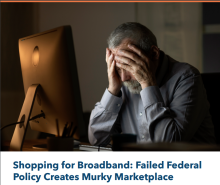
Shopping for Broadband: Failed Federal Policy Creates Murky Marketplace

Image
Shopping for Broadband

Report updated in January, 2022.

A new report from the Institute for Local Self-Reliance (ILSR) examines Internet Service Providers’ (ISPs) transparency — or lack thereof — around the Internet service packages they offer. Shopping for Broadband: Failed Federal Policy Creates Murky Marketplace [pdf] finds that locally-controlled broadband networks are the most transparent around key service details. Large ISPs, on the other hand, are more likely to make information like upload speed and pricing difficult or impossible to find. 

Missing or unclear information is frustrating for anyone shopping for a new Internet service. It can make it especially difficult for low-income customers, who need to know pricing details (such as the difference between a service’s promotional price and standard monthly cost) in order to navigate the market and budget for service. Federal standards for transparency exist, but are not currently enforced in any real way by either federal regulation or market pressure.

Recently, Congress passed the Infrastructure Investment and Jobs Act, which includes new information disclosure requirements for ISPs. To underscore the value of these requirements and the need for their proper enforcement, this report offers detailed analysis of 50 of the nation’s largest private wireless, private fiber, cable, municipal, and cooperative ISPs based on how clearly they disclose basic service and pricing information. Key findings include:

New Report: Failed Federal Policy Generates Customer Frustration in Broadband Marketplace

Frustrated while shopping for Internet service? Blame federal policy (and monopoly power). 

A new report from the Institute for Local Self-Reliance (ILSR) examines Internet Service Providers’ (ISPs) transparency — or lack thereof — around the Internet service packages they offer. Shopping for Broadband: Failed Federal Policy Creates Murky Marketplace [pdf] finds that locally-controlled broadband networks are the most transparent around key service details. Large ISPs, on the other hand, are more likely to make information like upload speed and pricing difficult or impossible to find. 

Missing or unclear information is frustrating for anyone shopping for a new Internet service. It can make it especially difficult for low-income customers, who need to know pricing details (such as the difference between a service’s promotional price and standard monthly cost) in order to navigate the market and budget for service. Federal standards for transparency exist, but are not currently enforced in any real way by either federal regulation or market pressure.

Recently, Congress passed the Infrastructure Investment and Jobs Act, which includes new information disclosure requirements for ISPs. To underscore the value of these requirements and the need for their proper enforcement, this report offers detailed analysis of 50 of the nation’s largest private wireless, private fiber, cable, municipal, and cooperative ISPs based on how clearly they disclose basic service and pricing information. Key findings include:

Submit Your Broadband Bill and Help Fight for More Affordable, Transparent Broadband Pricing

A month ago we announced the launch of Let's Broadband Together, a coalition of organizations and advocacy groups led by Consumer Reports to collect as many broadband bills as possible and crowdsource the data necessary to fight the trend towards deliberately confusing, obfuscatory broadband pricing in the United States.

If you've had the intention to help out but were looking for that reminder, here it is. Head over to Let's Broadband Together and take a speed tests, submit a PDF of your bill, and answer a few questions. More submissions mean a better the dataset and more comprehensive evidence to support reform. 

Click here to begin, and join Consumer Reports, ILSR, and dozens of other organizations. 


Biden Executive Order on Internet Service

In case you missed it, earlier this month President Biden signed an executive order that aims to promote competition in the U.S. economy. The order includes 72 initiatives, directing a dozen different federal agencies to promote competition in key sectors. 

The White House published a fact sheet to explain what the EO aims to do. [Read the full factsheet is here]. It begins by pointing out how a "lack of competition drives up prices for consumers," which is why "families are paying higher prices for necessities—things like prescription drugs, hearing aids, and Internet service."

It goes on to say that the order will, among other things, "save Americans money on their Internet bills by banning excessive early termination fees, requiring clear disclosure of plan costs to facilitate comparison shopping, and ending landlord exclusivity arrangements that stick tenants with only a single Internet option."

As you might imagine, we are particularly interested in the section on “Internet Service,” which you can read below:

Internet Service

The Order tackles four issues that limit competition, raise prices, and reduce choices for Internet service.

In the Order, the President encourages the FCC to:

• Prevent ISPs from making deals with landlords that limit tenants’ choices.

Submit Your Broadband Bill and Join Us in the Fight for More Affordable, Transparent Prices

Internet access in the United States is among the most expensive in the world, both in terms of absolute prices and in cost-per-megabit. Millions of families around the country can't afford to get online, making them even more disconnected from social services, family, and friends, more economically vulnerable, increasingly bearing the burden of the homework gap, and less healthy. 

All of this is a direct result of the broken broadband marketplace, dominated by just a few monopoly providers regularly raising prices to extract wealth from communities. It's also the result of an FCC which has consistently refused to mandate the submission of pricing data from Internet Service Providers (ISPs), or collect it from users themselves. Instead of investing in infrastructure upgrades or innovating, huge providers like Charter Spectrum, AT&T, Comcast, and Suddenlink have sunk time and energy into making our broadband bills harder to interpret, all while raising prices, changing plan terms, and playing around with data caps to pad their profits. 

Image

Let's change that, together.

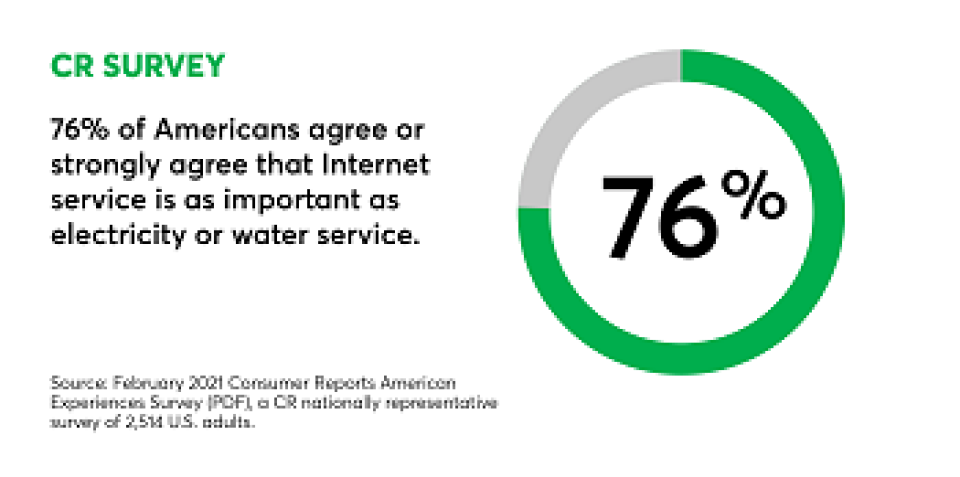
The Institute for Local Self-Reliance is joining with Consumer Reports to collect bills from 30,000 households across diverse geographic and demographic backgrounds in an initiative called Let's Broadband Together.  

In Our View: FCC Making Improvements to Data Collection But Not There Yet

Welcome to In Our View, a new series here at MuniNetworks. From time to time, we'll use this space to explore new ideas and share our thoughts on recent events playing out across the digital landscape, as well as take the opportunity to draw attention to important but neglected broadband-related issues.

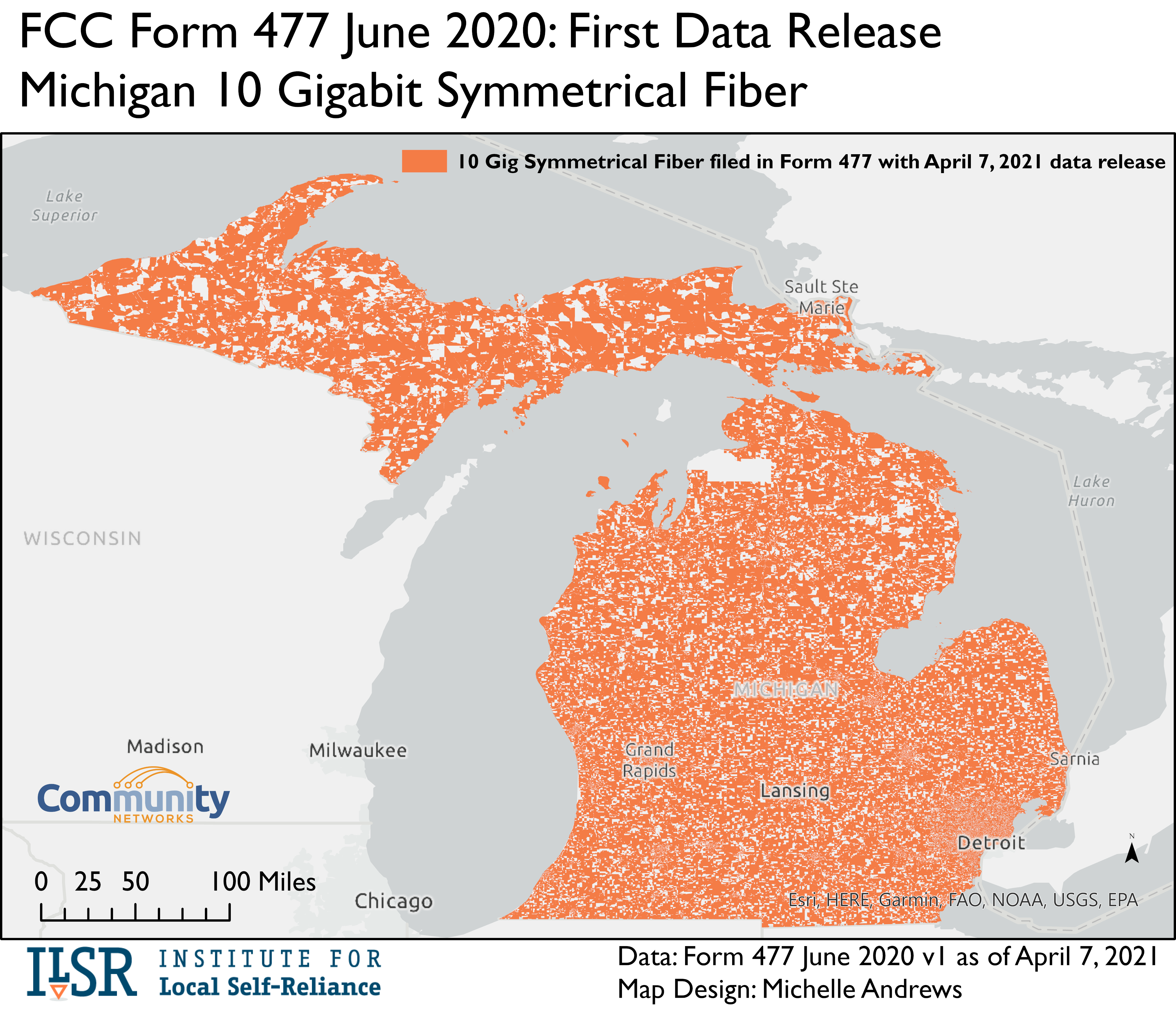
Special thank you to ILSR Data and Visualization Researcher Michelle Andrews for noticing the Michigan discrepancy, and for her contributions to this piece.

Earlier this month, the Federal Communication Commission (FCC) released updated Form 477 data, the primary source of information used for the FCC’s broadband coverage maps and the basis upon which federal agencies and states make major funding decisions.

With new interim leadership from FCC Chair Jessica Rosenworcel – who has been well-aware of the FCC’s dubious track record of publishing imprecise, insufficient, and often inaccurate broadband coverage data – you will be disappointed if you were expecting any improvements in the newest data set. 

Filers had until March 26, 2021 to make revisions to data that was submitted by September 1, 2020 for service they provided as of June 30, 2020. When the updated data was first released on April 7, it indicated that nearly the entire state of Michigan had access to 10 Gbps (Gigabit per second) broadband, thanks to Form 477 data provided by Strategic Alliance CDC (see map below, or a high-resolution version here).

Historical Error Repeats Itself

Community Broadband Legislation Roundup – March 29, 2021


Snapshot 

Colorado House passes bill that reduces broadband board membership and conceals mapping data

Michigan legislature approves bill granting ISPs property tax exemptions 

New Mexico and Virginia bills await governors’ action 


The State Scene

Tennessee

Tennessee is home to some of the most creative local solutions to bridging the digital divide. Municipal fiber networks across the state, including Chattanooga’s EPB Fiber network, Morristown’s FiberNet, and Bristol’s network, have been a boon to economic development, job creation, educational initiatives, and overall quality of life in the past decade.

The next city to potentially join the ranks of providing municipal broadband in Tennessee is Knoxville. On March 11, the Knoxville Utility Board approved a business plan to provide Internet services across its service area. 

Despite the widespread success of municipal networks across Tennessee, the state restricts what populations they can serve. Although Tennessee law allows cities and towns to offer advanced telecommunications services if they have a municipal electric utility, the networks are not permitted to offer those services to residents who live outside of the utility’s service area. Removing these restrictions would permit substantial fiber expansion to connect more residents at no cost to the state or taxpayers.

In Our View: Grid Disaster in Texas Leads to Open Access Soul Searching

Welcome to In Our View, the first installment of a new series here. From time to time, we'll use this space to explore new ideas and share our thoughts on recent events playing out across the digital landscape, as well as take the opportunity to draw attention to important but neglected broadband-related issues.

The disaster in Texas resulting from an electric grid that was deliberately left exposed and likely to fail in rare cold weather events has received a lot of dramatic coverage, as well it should given the loss of life and damage to so many homes and businesses. It also raised some questions in my mind regarding competition and designing markets that will be discussed below. Texas was a leader in allowing different electricity firms to compete in selling electricity over the same electric grid, an arrangement that has some similarities to open access broadband approaches.

In digging into that recent electricity history, I made another interesting and relevant finding that I discuss first as part of the background to understand the lessons from Texas. In 20 years of competing models between, on the one hand, municipal and cooperative structures to deliver electricity and, on the other hand, a largely deregulated and competitive market, the munis and co-ops delivered lower prices to ratepayers.

Many of the sources used in this article are behind paywalls. We wish that weren't the case but we support both paying for news and the libraries that have databases that may allow you to track this down if you have the inclination.

Electricity Deregulation, Texas Style

More than 20 years ago, Texas largely deregulated electricity markets. Residents still have a monopoly in charge of the physical wire delivering electricity to the home, but they could choose among various electricity providers that would effectively use the wire and charge different amounts, differentiating themselves via a variety of factors, including how the electricty was produced.

Two New Reports Detail Connectivity Challenges and the Potential of Community Networks

July has seen the release of two complementary reports which shed light on two of the topics we care about a great deal around these parts: availability and affordability of Internet access, and municipally-enabled networks.  

The Open Technology Institute at New America recently released “The Cost of Connectivity 2020” [pdf], which digs into the factors (some of which are explicit and others hidden) dictating how much Americans can expect to spend for Internet access in comparison to Europe, Asia, Canada, and Mexico. They conclude that, compared to the rest of the world, a lack of competition, regulation, and accurate data collection by the FCC has led to higher prices, slower speeds, exorbitant data cap fees, and deep digital divides running between those with high-speed access and those in Black, Indigenous, and People of Color (BIPOC) communities and low-income parts of American cities. And among its most compelling policy recommendations — based on data points from 296 standalone Internet plans in the United States — is that municipal networks offer a solution. 

If OTI’s report outlines the deep and persistent problem of connectivity in the United States, US Ignite and Altman Solon’s “Broadband Models for Unserved and Underserved Communities” [pdf] provides a clear and thoughtful roadmap for local communities who ask “What can we do?” Above all else, the guide shows that high-speed broadband is a solvable proposition, and sketches out five models for local governments to follow according to their unique conditions. Like the OTI report, US Ignite and Altman Solon highlight the many inherent benefits of community-enabled networks. 

Download the full reports at the bottom of this post.

Digging into the Data