
transparency

Content tagged with "transparency"

Related Topics
Displaying 31 - 35 of 35

FCC on Net Neutrality: More Bush than Obama
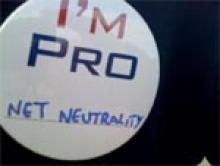
Whenever the discussion of Network Neutrality comes up, we like to remind everyone that when the network is locally owned and accountable to the community, anti-subscriber discrimination is not a problem. That said, we are strong supporters of proper safeguards to ensure massive companies like AT&T cannot abuse their market power and discourage innovation. As the FCC prepares to discuss a half measure to preserve parts of the open Internet, a number of us have been frustrated that while we cannot read the proposal, AT&T appears to be helping write it. Karl Bode's take:
[T]he question shouldn't be whether or not consumers can now view a neutrality proposal after it was hashed out in private meetings (predominately with only the largest, wealthiest carriers), it should be: why weren't consumers absolutely integral in crafting it? AT&T has met with the FCC half a dozen times in the course of three weeks and likely knows precisely what's in this plan -- do you?
We've written to FCC Commissioners to make it clear that they must not compromise on the future of the open Internet. You should too. Photo used under Creative Commons license from AdamWillis.


Rules Matter - Network Neutrality and Transparency

I was briefly checking out the Open Internet Workshop when I got into a short tweet-argument with someone I did not know. Bear with me as I recount the discussion then explain why I think it worth delving into for a post. This person caught my attention by tweeting, "Which means the Net is already open, right?" I responded, "Yes Internet is open. Trying to keep it that way. Idea that net neutrality is 'new' is absurd." Shortly thereafter, I got a response that fits a standard script: "Then how about proving actual harm first? Burden of proof to hand Net to govt is on you guys." I responded, "Comcast, RCN, Cox block applications ... why must we wait for you to break the Net further to fix it?" The final response was that the market forces will solve the problem and my "examples are outdated." I later discovered that I was wasting time responding to someone from an astroturf think tank. Odds are that this person was simultaneously tweeting that cigarette smoking is not correlated with cancer and that burning coal actually cleans the air. But this is a common argument from those who want to allow companies like Comcast and AT&T to tell users what sites they can visit and what applications they can use. Some "free market" advocate (who is actually defending firms with serious market power, the antithesis of a free market) says that no private network owner would violate network neutrality. Then, when presented with companies that have violated network neutrality, the response is invariably that those are "old" examples" or somehow not relevant. To sum up:
Person A: No company would violate network neutrality. Person B: What about Comcast, Cox, RCN, and the famous Madison River Communication? Person A: Those don't count.
Aside from the absurdity, the larger problem is that we do not always know when companies are violating network neutrality. Comcast was violating network neutrality for at least a year before tech journalists successfully outed the practice. Over the course of that year, many subscribers called Comcast and asked why they were having problems with certain applications. Comcast lied to them and said the company was not interfering with them. When finally backed into a corner with incontrovertible evidence, it admitted it was.

Rules Matter - Burlington Telecom

As someone who has long researched and followed developments in Burlington Telecom (BT), the city-owned triple-play full fiber-to-the-home network in Vermont, recent developments between BT and the Mayor's office have been deeply disappointing. For those who haven't heard, BT is in the middle of a major controversy -- and it is hard to tell just what is going on (for background prior to current problems, read my Burlington Telecom Case Study and Fact Sheet). I have wanted to comment on the situation for many weeks but have been waiting as each day seems offer another piece of the BT puzzle. I'll be offering more commentary about it in the future. However, I do not want to the let the current problems lend any credence to the idea that BT has failed. BT is caught in the middle of a political controversy around the Mayor but should continue providing the best telecom services available in the community. BT has two main problems currently:
  1. It has not passed the entire city within the timeline to which it agreed in receiving its Certificate of Public Good (CPG)
  2. BT has, apparently, borrowed $17 million from the city's pool (used generally for short-term financing of projects) in contravention of its CPG which states that any money borrowed from the City must be paid back within 60 days. This CPG condition makes running a network more difficult for BT than it would for a company like Comcast - who can readily self-finance short-term borrowing. Across the U.S., communities have to deal with laws and regulations that benefit private companies over public networks. When the economy fell apart, BT was unable to refinance its debt to continue its expansion and chose to borrow from the City to continue connecting new customers. This was the right decision - the CPG did not anticipate such conditions and the terms for outside financing in late 2008 were wretched.
I say "apparently" borrowed above because it is far from clear if all of those funds actually went to BT. As Steve Ross explains here, it is not even clear if BT really required all that it borrowed from the City.

Comcast, Caps, and the Public Interest

While I try to keep postings on this site to the subject of publicly owned networks, I think it important to discuss the ways in which some major carriers routinely flout the public interest. Thus, a little history on how Comcast has acted against the public interest. Most of the readers of this blog are probably aware that Comcast has been dinged by the FCC following its practice of interfering with subscribers legal content (and undoubtedly illegal content as well) by blocking and disrupting the BitTorrent traffic. BitTorrent is frequently used to transfer large media files because it efficiently breaks large files into many little pieces, allowing the user to download from a variety of sources concurrently - the file is then reassembled. When Comcast detected BitTorrent connections, it would effectively hang up on them, regardless of the congestion level on the network at the time. The FCC (the Bush Administration's FCC) said it couldn't do that and Comcast is currently in the courts trying to tell the FCC that it can't tell Comcast what it can't do on its network. Prior to a journalistic investigation that proved Comcast was doing this, net geeks had repeated asked Comcast if it were blocking the BitTorrent protocol. Comcast never admitted to anything, often claiming it did not "block" anything... as time would go on, Comcast would refuse to admit it was blocking anything - as if permanently delaying traffic was anything other than a blockage. "I'm not blocking you, try back in 20 million years." Around this time, Comcast quietly changed its policy regarding the maximum amount of bandwidth subscribers could consume in a month. At the time, I thought it was a result of the FCC cracking down on the arbitrary policies frequently used by cable companies, but it turns out we can thank the State of Florida for forcing Comcast to enact a transparent cap on monthly usage. Prior to the official cap, there was an unofficial cap. Every month, some number of people would be notified they were kicked off Comcast's service for using too much bandwidth - but no one knew how much was too much and, perhaps more importantly, how to keep track of how much bandwidth they were using. Discussions on geek-hangout Slashdot suggested a monthly cap of between 100 Gigabytes and 300 Gigabytes depending on the neighborhood.

FCC Chair: We Need Network Neutrality

The Chair of the Federal Communications Commission has taken a stand for network neutrality - the founding principle of openness of the Internet. In short, network neutrality means the entity providing you access to the Internet cannot interfere with the sites you choose to visit - it cannot speed them up or slow them down in order to increase their profits. See video at the bottom of this post for a longer explanation.

FCC Chair Julius Genachowski recently spoke at the Brookings Institution [pdf] on the importance of an open Internet. He started by noting many of the ways we depend on services delivered over the Internet: