
News

New Resource: Tracking Rural Digital Opportunity Fund Winners

With so much attention on how the Broadband Equity, Access, and Deployment (BEAD) Act is continuing to unfold (including from us), it’s important to remember that the FCC’s Rural Digital Opportunity Fund (RDOF) is still in the process of authorizing bids from its $9.2 billion auction conducted in December of 2020. Today we’re releasing a new resource we hope will be helpful in keeping tabs on which providers have gotten money, how much has been authorized, and in which states.

Our Big List of American Rescue Plan Community Broadband Projects Hits 250

It’s been nine months since we launched our Big List of American Rescue Plan Act (ARPA) Community Broadband Projects, tracking what communities are doing with the various pots of federal money intended to go towards solving local broadband challenges. Since then, we’ve recorded 250 community projects and 27 states which have announced significant broadband grant programs or disbursement for new infrastructure projects. Here we highlight some of the community projects we’re really excited about, including those that have decided to build their own networks and those building on existing projects, as well as those using ARPA dollars for open access networks, affordable connectivity, or Internet access for students. We also discuss some examples of solutions we believe are less permanent, forward-thinking, or likely to result in long-term success, including the distribution of hotspots and the allocation of funds to monopoly providers. 

Congressional Intent, Supply Chain Requirements, and Overbuilding with BEAD

The BEAD Notice of Funding Opportunity (NOFO) released by NTIA is packed with guidance and regulations for how tens of billions in new funding with be spent. Reading the rules closely gives us a sense of who they might advantage, at least early on, and the line NTIA is trying to walk in giving the money the most bang for its buck while also heading off abuse. 

The Future of Fiber Takes Center Stage in Nashville at Fiber Connect 2022

With a fiber-to-the-home (FTTH) boom sweeping across the nation as communities look to build or expand access to ubiquitous, reliable, high-speed Internet infrastructure, Fiber Connect 2022 is poised to bring together leading network operators well versed in a multitude of technologies, local government and public sector leaders, network builders, and an assortment leading industry experts later this month. Coming on the heels of last year’s gathering – the largest Fiber Connect conference to date – this year’s event will return to Nashville from June 12 – 15.

Cambridge Looks to Graduate into Muni Broadband

After years of discussing the possibility of building a city-wide municipal broadband network in the face of resistance from the city manager, the city of Cambridge, Boston’s next-door neighbor, is now getting serious about moving forward.

UTOPIA Fiber Completes West Valley City Buildout

In an announcement at the Mountain Connect conference last week in Keystone, Colorado, municipally owned open-access network operator UTOPIA Fiber announced it has completed its build in West Valley City, Utah. It marks a major milestone, both for residents in the city (who have worked for years to take back control of their information infrastructure) and for the network as a whole (finishing work on one of the original partner cities in the project itself). 

Sterling MA Now Has Its Own Little LAMB Fiber Network

As communities across the Commonwealth of Massachusetts are at various planning stages in laying the groundwork to build their own municipal broadband networks, a rural Bay State town about 50 miles west of Boston has moved past the planning phase and is now offering municipal fiber-to-the-home (FTTH) service. In Sterling (est. pop. 8,000) – the town that lays claim to Mary Sawyer Tyler, the real life woman said to have inspired the “Mary Had a Little Lamb” poem – the town’s municipal utility is building out its aptly named Local Area Municipal Broadband (LAMB) network.

The Fate of the Affordable Connectivity Program

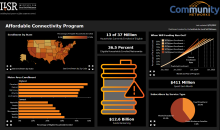
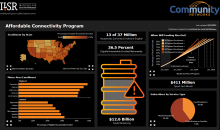
There's no argument that the ACP offers relief to households that need it most. But is it a long-term solution? Our analysis shows that even if only a third of eligible households ultimately enroll, absent additional allocation the fund will be exhausted by November 2024. But even under the best-case scenario, with the benefit reaching as many people as possible, current enrollment rates show that only 68 percent of eligible households would be able to sign up before the funds run out. In this model, the money will be exhausted just 18 months from now, in January 2024.

Submit a Proposal to the National Digital Navigator Corps

The National Digital Inclusion Alliance's (NDIA) expanded National Digital Navigator Corps is running its first round of awards, and will support new projects at 18 sites around the country (including six in Tribal communities) beginning in the second half of this year. 

New Video Diaries Highlight Chattanooga’s Long-Term Solution to the Broadband Affordability Gap

Thanks to Chattanooga’s wildly successful municipal broadband network, EPB Fiber, and its partnership with The Enterprise Center and Hamilton County Schools, over 15,000 low-income students in 8,500 households in Hamilton County are already getting a decade of free high-speed Internet service at no cost through a program known as HCS EdConnect. We wanted to visually document the power the program has had in transforming the lives of participants by weaving together a compilation of video diaries that will give you a glimpse of how a visionary municipal network made this Tennessee county more resilient in the face of the pandemic and ensured no one in their community was left on the wrong side of the digital divide.

Summit County, Ohio Defends Community Broadband from State Opposition and Forges Ahead with Plans to Bolster Economic Development

Summit County has put together a multi-part, $75 million broadband plan to improve connectivity in the area: a middle-mile institutional fiber ring to connect the county’s public safety facilities and expand its broadband capacity, a new datacenter, and a fiber investment to specifically target residents and businesses in the county’s underserved areas and economic activity hubs.

Tribal Broadband Bootcamps Bring Broadband Solutions to Indian Country

An effort to foster digital sovereignty and support tribal citizens to build and operate their own broadband networks in Indian Country is gaining momentum. Responding to the challenges of COVID and the opportunities created by the federal attention and investment into tribal broadband, our own Christopher Mitchell, Director of the Community Broadband Initiative at the Institute for Local Self-Reliance, prominent Tribal broadband advocate and 20-year veteran behind the Tribal Digital Village, Matt Rantanen, along with a loose coalition of public interest tech people have organized a series of trainings to help tribes tackle building and running networks for themselves.