
News

Field Reports: Municipal Broadband and Digital Equity in Baltimore

This week, we bring you a special field report from Maryland-based radio and podcast producer Matt Purdy. Through interviews, Purdy documents the connectivity struggles that have persisted in Baltimore's historically marginalized neighborhoods for decades. Those challenges have only become more pronounced with the pandemic, prompting local officials to begin making moves in the direction of something we've not yet seen in a community the size of Baltimore: building a city-owned, open access fiber network.

Is High-Speed Internet Access Getting More Affordable, Really?

A recent report by BroadbandNow suggested that the average price for broadband access for Americans has fallen, by an average of 31 percent or nearly $34/month, since 2016. But you don’t have to follow broadband policy closely to get the sense that something a little off is going on here. The reality is that the report, unfortunately, poorly frames the national broadband marketplace. At best, it muddies the waters with a lack of clarity about the relationship between broadband access speed tiers and relative pricing. At worst, it leaves the average reader with the incorrect assumption that broadband prices must be falling, and gives the monopoly cable and telephone companies ammunition to push for millions more in taxpayer dollars while building as little new infrastructure as possible.

A Wave (of Fiber) Crests Across Maryland’s Eastern Shore

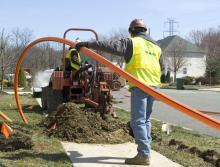
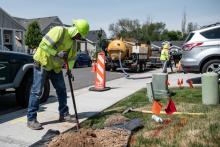
Building on the fiber backbone that connects Choptank Electric Cooperative’s smart grid, the member-owned cooperative began construction of a fiber-to-the-home network (FTTH) last year that will reach all 54,000 of its members spread out across nine counties. Now subscribers are being lit up for service as the co-op continues to extend the network.

Nebraska Lawmaker Looks to Shuck Muni Broadband Restrictions - Again

As it has become increasingly clear that the private market alone is not going to solve America’s connectivity crisis, last year two states (Arkansas and Washington) rolled back their preemption laws that were protecting monopoly incumbent providers from competition and now allow local and regional governmental entities to build the telecommunications infrastructure their residents need. Now, one Nebraska lawmaker has recently filed a bill that, if passed, would significantly remove the Cornhusker State’s current barriers to municipal broadband. 

In Our View: Success Stories to Counter the Tide of Big Telecom Propaganda

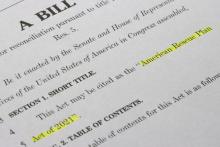
As federal funds to expand high-speed Internet access began to flow to states and local communities through the American Rescue Plan Act, and with billions more coming under the Infrastructure Investment and Jobs Act, Big Telecom is beginning to mount its expected opposition campaign designed to discourage federal (and state) decision-makers from prioritizing the building of publicly-owned networks. Part of the impetus, no doubt, was the flood of responses to the NTIA’s Notice and Request for Comment (including ours) documenting the need for community-driven solutions in this once-in-a-generation investment that could close the digital divide forever. Meanwhile, successful municipal broadband projects abound, hitting new milestones each year.

Event: Building for Digital Equity - Demystifying Broadband Policy and Funding

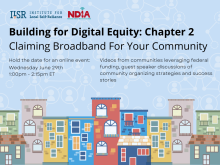
We're living through a time with an unprecedented level of broadband infrastructure funding, fueled not only by the American Rescue Plan, but the Consolidated Appropriations Act, the Coronavirus Capital Projects Fund, and the Infrastructure Investment and Jobs Act. Hundreds of community-driven projects are already underway, but finding solid footing amidst these programs, statutes, and evolving rules is difficult. To help, the Institute for Local Self-Reliance is teaming up with the National Digital Inclusion Alliance for a two-hour livestream event to demystify the landscape. On Wednesday, March 16th, from 2-4pm ET, we're hosting an online conversation to bring together local stakeholders, policy advocates, and funding experts in one place. We're calling it Building for Digital Equity: Demystifying Broadband Policy and Funding.