


Vermont’s Communications Union Districts (CUDs), which were the subject of a 2024 ILSR report, continue to make steady inroads in delivering high-quality broadband access to long-neglected rural Vermont residents.
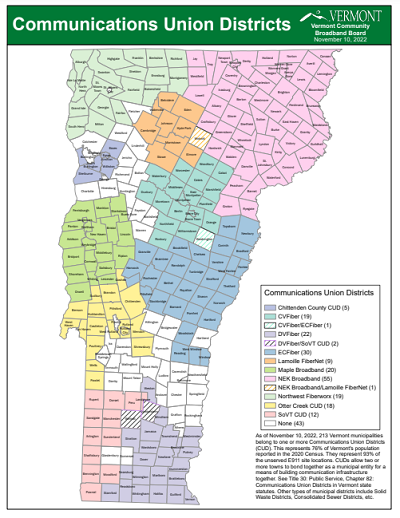
That includes the Chittenden County Communication Union District (CCCUD), which recently announced the completion of a planned fiber extension into the heavily rural communities of Essex Town, Essex Junction, Jericho, Shelburne, Westford, and Williston.
The deployment was completed in partnership with Fidium Fiber, which says the expansion brought fiber optic connectivity to more than 1,900 homes and businesses across the six towns for the first time ever.
Users in these markets have the option of three tiers of service: a symmetrical 100 megabit per second (Mbps) tier for a promotional rate of $30 a month; a symmetrical 1 gigabit per second (Gbps) tier for a promotional rate of $50 per month; and a symmetrical 2 Gbps option for a promotional rate of $60 per month. Those prices jump to $70, $110, and $125 per month when the promo period ends.
Phase one of this deployment was made possible by a 2024 $2.1 million grant awarded by the Vermont Community Broadband Board (VCBB), courtesy of the 2021 federal American Rescue Plan Act (ARPA). Phase 2 will be dependent on additional federal funding sources (potentially including BEAD) and is tenuously slated to begin in 2027.
With this deployment completion, Fidium says they now offer fiber to 17,000 locations across Chittenden County, including previous buildouts in Colchester, Essex Junction, Essex Town, Milton and Williston.
“This partnership with Fidium brings more than just fast internet - it brings possibility,” said Michael Vance, chair of CCCUD. “By extending Fidium’s fiber network to these communities, we’re ensuring that every resident has access to the tools needed to thrive in today’s connected world. Whether it’s for learning, working, or staying in touch, this technology helps close the gaps and opens new doors.”
The Vermont legislature’s 2021 passage of Act 71 made it possible for CUDs to play a key role in expanding fiber access in the Green Mountain state.
In Vermont, municipally-led CUDs – municipal entities created by two or more towns with a goal of building communication infrastructure – can legally fund needed broadband expansions through debt, grants, and donations – but not taxes, though they themselves are tax-exempt nonprofits.
As Chittenden County aptly demonstrates, the CUD model allows municipalities to bond together to tackle broadband network deployments that might otherwise prove too costly or logistically difficult if attempted alone.
The results have been transformative for state residents long underserved or completely unserved by the state’s regional incumbent monopoly providers. Locals at times have likened the transformation to moving out of the “dark ages.”
Much of Vermont’s $150 million ARPA-based broadband package went toward assisting CUDs in a state where 85 percent of municipalities and 90 percent of all underserved locations fall under an existing CUD’s jurisdiction.