
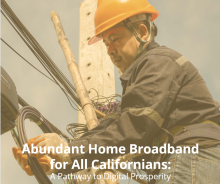
Broadband ISPs should be held to a higher public interest standard and regulated like traditional utilities in California, a new joint study by nonprofit state policy news outlet Cal Matters and UC Berkeley’s Possibility Lab argues. State governments should also vocally support community broadband networks as a direct challenge to monopoly power, the authors state.
The study specifically looked at the broadband sector in California, where 15 percent of California households – predominately in low income and minority communities – lack broadband access. It concludes that dramatic federal and state policy failures have resulted in unchecked monopolies and muted competition that directly harms the public interest.
While the study lauds California’s dramatic $6 billion “Broadband For All” initiative, which is driving historic new investment into last and middle mile network upgrades, it also states that the state’s full vision for equitable access cannot be achieved without rate controls, universal access requirements, and strict reliability standards for large incumbent ISPs.
The study also urges state leaders to aggressively embrace municipal broadband cooperatives to address regionalized market failure and improve overall accountability.
“California should actively encourage and support the formation of municipal broadband
cooperatives across the state, particularly in underserved rural and suburban communities
where incumbent providers have failed to deliver adequate service,” the study observes.
Monopoly Dysfunction, Muted Competition
Like most U.S. states, California communities are dominated by a handful of cable and phone giants that have leveraged their immense political power to box out local competition creating dominant regional monopolies and duopolies.
“This lack of competition creates a vicious cycle of underinvestment and overpricing,” writes study author Edward Helderop, associate director of the Center for Geospatial Sciences at the University of California, Riverside. “Incumbent telecommunications companies, driven by profit maximization rather than public service, have systematically neglected rural and low-income communities where the return on infrastructure investment appears less attractive.”
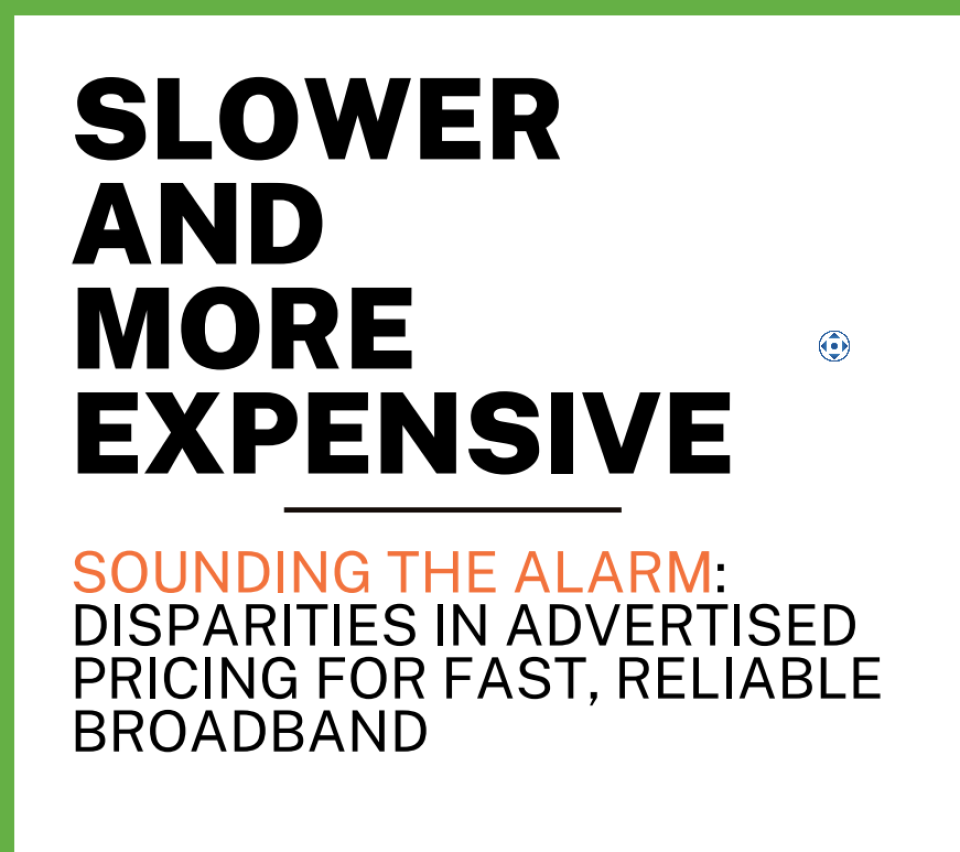
This neglect has resulted in a stark digital divide between affluent and marginalized communities across rural and urban communities alike. Data has consistently shown that lower income, marginalized communities often wind up paying significantly more money for notably slower service than their more affluent, less diverse counterparts.
One recent study by digital equity organization Digital Equity LA, for example, found that residents in higher poverty neighborhoods (which tend to be people of color) pay anywhere from $10 to $40 more per month than mostly white, higher-income neighborhoods for the exact same service.
This disparity in access, speed, and quality, which often mirrors redlining seen in energy utilities and other services, comes despite generations’ worth of taxpayer subsidies given to regional monopolies in exchange for next-generation fiber buildouts routinely left half-completed.
“As a result, low-income families often face a difficult choice between essential household expenses and internet access that is increasingly necessary for children’s education and adult employment,” the study found. “Small businesses struggle to compete in an increasingly digital economy, and communities lose their connection to the broader information ecosystem that drives innovation and opportunity.”
California Is Well Positioned To Take The Lead
Entrenched U.S. telecom monopolies have long fought against regulating broadband as an essential utility. This multi-decade legal fight recently culminated in the federal government effectively giving up on not just equitable and affordable access, but regulatory independence and corporate oversight of telecom giants almost entirely.
Some U.S. states are increasingly responding to this vacuum in federal leadership on issues like equitable access, affordability, and consumer protection with everything from new net neutrality laws to legislation mandating affordable access to low income residents.
Helderop’s study found that in the wake of federal apathy, California is particularly well positioned to gradually embrace the trifecta of monopoly accountability: rate regulation, universal service obligations, and transparent quality and control standards.
“Rate regulation would prevent arbitrary pricing by establishing reasonable rates based on actual service delivery costs rather than pricing power distorted by market structures,” Helderop writes. “Universal service obligations would require providers to serve all areas within their service territories rather than cherry-picking only the most profitable locations. Quality standards, meanwhile, would mandate minimum service reliability, speed consistency, and customer service responsiveness.”
Telecom lobbyists have historically been specifically and vehemently opposed to rate regulation, often treating it as an extreme form of government control over “free markets.” Yet those same telecom monopolies have repeatedly proven that the U.S. telecom monopoly is anything but free, and tougher guardrails are needed to combat consolidated market power and the state and federal corruption that tends to enable it.
The Trump administration has aggressively opposed states demanding that telecoms provide affordable access to the public, even going so far as to of already-awarded state broadband grant awards should they try to do so.
The study argues that as the planet’s fourth-largest economy, California is perfectly positioned to ignore the federal government and do so anyway.
“The state’s large market size gives it significant leverage over providers who cannot easily exit
the California market without suffering major revenue losses,” Helderop concludes. “The existing California Public Utilities Commission has established regulatory expertise and enforcement capabilities that can be adapted to broadband oversight. Most importantly, the state-owned middle-mile network will provide California with direct infrastructure assets that can be leveraged to ensure compliance with regulatory requirements.”
The study adds that the embrace of municipal broadband cooperatives adds an additional layer of accountability and competition that can help ensure more direct, local, democratic accountability for all providers, while ensuring a steady flow of revenues back into the local communities.
By treating broadband as the essential public utility it has become, the state can eliminate artificial scarcity, reduce digital inequalities, and provide a foundation for shared economic prosperity in an increasingly connected world,” Helderop writes. “The technical solutions exist and the resources are available. What remains is the political will to prioritize universal access over incumbent profits and build digital infrastructure that serves all Californians.”
Read Abundant Home Broadband for All Californians: A Pathway to Digital Prosperity [pdf].