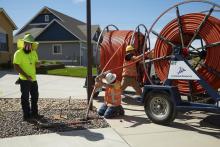


A new speed analysis published by Ookla finds that municipal broadband providers consistently leave their private Internet service provider (ISP) competition in the dust.
“Small Towns, Big Speeds: How Some Municipal Broadband Providers Outperform Their ISP Peers” examined speed test data that included some of the largest municipal networks in the U.S. from December 2024 through December 2025 and compared their performance to each other and to their privately-owned ISP competitors.
Though it wasn’t in-depth study on other aspects of performance (or business models) – but a more narrowly-focused comparison of speed among 14 municipal providers – still the analysis shines a light on a leading performance indicator: “eight municipal providers in the U.S. that we monitored using Ookla Speedtest data beat their broadband competitors in median upload speeds and one municipal provider, Sherwood Broadband, outpaced the competition in median download speeds.”
Here are some of the report’s topline takeaways:
- Fort Collins, Colorado’s Connexion was the leader in median upload speed, delivering an average median upload speed of more than 300 (Megabits per second) Mbps for the entire 13-month period from December 2024 to December 2025.
- Sherwood Broadband in Sherwood, Oregon, was the top provider in median download speeds, delivering an average median download speed that surpassed 400 Mbps eight months out of a 13-month period from December 2024 to December 2025.
- UTOPIA Fiber in Utah is a standout in latency, delivering the lowest latency of all 14 municipal broadband providers with a multi-server latency consistently in the low 6 milliseconds (ms) to 8 ms range.
The Problem With 'Unfair Competition'
The study’s author, Ookla editorial director and analyst Sue Marek, explains that the 14 municipal providers in the analysis were selected “because they are some of the largest in the U.S. based upon reported subscriber numbers and because we had the most test samples from these providers,” noting how EPB Fiber in Chattanooga, Tennessee – the largest municipal broadband provider in the U.S. – did not have any competitors with enough test samples to compare its performance too.

Marek goes on to explain how a larger, more robust analysis was limited by the fact that there are (by our count) 16 states, which includes Nebraska and Missouri, where “municipalities are prohibited from selling telecom services directly to the public” and in states like Virginia and Louisiana “a local referendum must be passed before a municipal network can be launched.”
Acknowledging the criticism from large ISPs and municipal broadband naysayers who claim that municipal networks create “unfair competition,” the study notes how “in states where these arguments win over the legislature, community broadband initiatives are suppressed,” but also noted how Colorado and Washington recently repealed its anti-municipal broadband laws after recognizing those restrictions hamstrung their ability to close the digital divide. (Minnesota and Arkansas also recently repealed their anti-municipal broadband preemption laws.)
Omitted from the Ookla report, however, is further evidence that the “unfair competition” claims made by municipal broadband critics actually obscures who benefits from the competition between private ISPs and municipal providers – as noted in a separate University of Tennessee at Chattanooga study published earlier this year that examined EPB Fiber.
According to that study, which found that Chattanooga’s municipal network has generated $5.3 billion in net community benefits for Hamilton County since 2011, EPB actually made the local broadband market more competitive, not less.
“The infrastructure has served to lower broadband prices and push competitors to improve service offerings in the area,” the EPB study found.
Munis Beat ‘Bufferbloat’
The Ookla report singled out four municipal networks in particular – Pulse Fiber, Connexion, BrightRidge, and Sherwood Broadband – for “smash(ing) the FCC’s minimum broadband standard” of 100 Mbps download/20 Mbps upload speed.
“Sherwood Broadband registered median download speeds that surpassed 400 Mbps eight months out of the 13-month period while Pulse and Connexion logged speeds over 400 Mbps for two of the 13 months we analyzed.”

The main reason these networks were generally faster than their private counterparts, particularly when it comes to the growing importance of upload speed, is largely due to the fact that all of the municipal networks examined in the report offer fiber service, the gold-standard of Internet connectivity.
“Unlike their ISP competitors, municipal broadband networks typically are built using fiber optic technology and aren’t reliant on any legacy infrastructure such as copper phone lines or coaxial cable,” the report notes.
It’s a key insight about Internet access technologies that “technology-neutral” arguments miss.
“One of the big benefits of having a fiber network is that they can deliver symmetrical upload and download speeds and avoid ‘bufferbloat’ – a phenomenon that occurs when there’s a large amount of traffic that congests the connection,” the report explains.
“Cable networks often suffer from bufferbloat because they have asymmetrical speeds and slower upload speeds, often leading to higher latency during times of congestion. Because municipal networks use fiber networks with symmetrical speeds, they can avoid the bufferbloat problem.”

The inherent advantage that fiber networks provide in comparison to other Internet access technologies is why Congress called for the prioritization of building fiber networks in the infrastructure law that established the federal BEAD program, which the Trump administration upended in restructuring the program to funnel more federal taxpayer dollars to Starlink’s satellite service.
Beyond that, municipal networks typically have an additional advantage.
“Municipal broadband networks are designed to provide broadband only to a specific community which means that the network’s central office or the heart of the network where all switching and routing occurs, is located in close proximity. This is different from a large regional or national network where traffic may need to be routed to distant regional hubs,” the analysis points out.
It should be noted that while in practice this is generally true, it’s also true that the big private ISPs could improve their network topology to lower latency if they wanted, but would rather use that money to pay shareholders.
Standout in UTOPIA
The Ookla report didn’t just look at one type of municipal broadband provider, but rather categorized the networks into four distinct groups: networks that were required to pass a local referendum (Connexion, NextLight, Pulse Fiber, LFT Fiber, and Cedar Falls Utilities); those operated by city-owned electric utilities (BrightRidge, CDE Lightband, EPB Fiber, NorthCentral Connect, and OptiLink); community-led networks operated as a department within the city (FairLawnGig and GreenLight Community Broadband); and open-access networks (UTOPIA Fiber and Sherwood Broadband).

The study singled out the Utah Telecommunication Open Infrastructure Agency (UTOPIA) Fiber as a “standout” because of something often overlooked by speed-conscious broadband subscribers: low-latency. UTOPIA, the report found, “consistently delivered a multi-server latency in the low 6 milliseconds (ms) to 8 ms range. This was the lowest latency of all 14 municipal broadband providers in nine of the 13 months we analyzed.”
Here, again, is another area in which the anti-municipal broadband argument about competition falls flat: “UTOPIA builds and maintains the network and hosts more than 15 competing ISPs that sell the service to the consumer…because it’s an open access fiber optic network…more than 15 private ISPs (operate) on its network.”
With over 86,000 subscribers getting fiber service from UTOPIA across 20 cities – competing against the likes of Google’s GFiber, Comcast’s Xfinity, and TDS Telecom – UTOPIA “outpaces Xfinity and TDS… with a latency of just 6 ms.”
‘Greenfield’ Fiber Leaves Legacy Networks Behind
Zooming out, the study’s conclusions make clear that these performance gains are not incidental, but rooted in how municipal networks are built and who they are built to serve.
“By leveraging fiber technology and prioritizing community-specific needs, municipal networks are delivering speeds that outperform their competitors in the market,” the report concludes.
“While traditional cable providers are making strides with network upgrades like mid-split technology to improve upload performance, they still largely trail the symmetrical speeds and low-latency profiles inherent to the ‘greenfield’ fiber networks built by municipalities.”
Header image of UTOPIA Fiber technician examining splice case courtesy of UTOPIA Fiber Facebook page
Inline image of EPB Fiber at local home show courtesy of EPB Fiber Facebook page
Inline image of Connexion service truck courtesy of Connexion Facebook page
Inline image of Sherwood Broadband booth at local music festival courtesy of Sherwood Broadband Facebook page