
open access

Content tagged with "open access"

Displaying 1 - 10 of 481

New York Expands Its Historic Investment In Municipal Broadband

New York Governor Kathy Hochul has announced a dramatic expansion of the state’s Municipal Infrastructure Program (MIP), resulting in an additional $36 million cash infusion for the growing number of creative, community-owned and operated fiber expansion projects in the state.

According to a state announcement, the existing MIP program, launched in early 2024, has already funded more than $268 million in assorted open access fiber projects across the state. A state broadband office dashboard tracks all active municipal projects funded to date.

That includes efforts like the growing open access municipal fiber network in Dryden, New York, which has been steadily delivering affordable next-gen fiber to the long-underserved rural communities of Dryden and nearby Caroline (population 3,321).

New York State officials say the $268 million in MIP grant funding has funded active projects across 24 New York counties, resulting in more than 2,300 miles of new fiber optic infrastructure and 68 new wireless hubs serving more than 96,000 homes and businesses. Most of this funding was made possible by the 2021 federal American Rescue Plan Act (ARPA).

The MIP program is part of New York state’s billion dollar ConnectALL Initiative, and was specifically designed to support municipal broadband projects proven to be a viable, and increasingly popular, way to bring affordable, high-quality Internet service to long-neglected U.S. communities.

Kitsap PUD Continues To Expand Popular Open Access Fiber Network

Kitsap Public Utility District (KPUD) continues to expand its popular open access fiber network, bringing affordable next-generation broadband access to island locals long trapped on the wrong side of the digital divide.

“Kitsap PUD is accelerating its community-owned, open-access fiber build, with new distribution nodes coming online by early 2026, expanding capacity and reaching more underserved addresses,” the organization states in a recent update.

KPUD provides water, wastewater, and Internet service on Bainbridge Island and the neighboring peninsula in the Puget Sound in Washington state.

In 2016, officials long-frustrated by substandard regional broadband access decided to finally build an open access network that continues to expand, and now brings affordable gigabit fiber to locals via a half-dozen different competing broadband ISPs.

Image
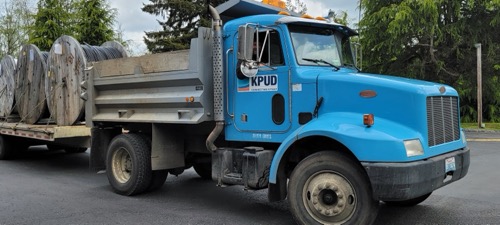
A dump truck carries a flat bed trailer behind it with large spools of fiber loaded onto the back

An updated KPUD case study indicates that the existing network is currently comprised of more than 900 miles of fiber, with 21 new distribution nodes coming online early 2026. That node expansion is being heavily aided by $6.6 million in American Rescue Plan Act (ARPA) funding. According to officials, each node is capable of serving between 1,920 and 7,680 addresses.

Construction of the expansion is underway now, and is expected to be completed sometime in 2026.

Superior, Wisconsin’s ‘Game Changing’ Open Access Fiber Network Goes Live

Superior, Wisconsin’s community-owned open access fiber network has gone live in its first two deployment neighborhoods, as the city works toward providing affordable next-generation fiber access to the city’s long under-served community of 26,000.

When we last checked in with Superior back in April, the city was working with Nokia for final configuration and testing before launch. Now, the municipal broadband network says its ConnectSuperior fiber network is live in its first two target neighborhoods in the northern part of the city (see the city’s latest deployment map).

The city’s open access network means that multiple broadband providers can compete over the same shared infrastructure. Historically such a model helps boost competition and drive down costs for both consumers and competitors. That’s already the case in Superior, where the city’s website lists two providers – Advanced Stream and Superion Networks – with more on the way.

Image
Superior Wisconsin UW Superior entrance

Advanced Stream is offering locals three tiers of service: a symmetrical 300 megabit per second (Mbps) tier for $63 a month; a symmetrical 650 Mbps tier for $75 a month; and a symmetrical one gigabit per second (Gbps) tier for $83 a month.

Superion is offering three tiers of service as well: a symmetrical 300 Mbps tier for $63 a month; a symmetrical 650 Mbps tier for $75 a month; and a symmetrical 1 Gbps tier for $85 a month. Both companies offer phone bundles for a modest additional surcharge.

Wisconsin Public Radio Covers New City-Owned Broadband Network in Superior with Assist from ILSR

This week Wisconsin Public Radio aired a story that looked at the city of Superior, Wisconsin and its city-owned open access fiber network, known as ConnectSuperior.

Wisconsin Public Radio reporter Richelle Wilson not only spoke with city officials about how "the new network has been a game-changer for Superior," Wisconsin Public Radio also reached out to our Christopher Mitchell, Director of ILSR's Community Broadband Networks initiative.

Chris provided context and insight on how the rapidly changing federal policy landscape may or may not affect ConnectSuperior, how state preemption laws hinder communities in Wisconsin and some other states from duplicating Superior's success, and how tribes in Wisconsin have participated and benefited from a recent Tribal Broadband Bootcamp in the Upper Peninsula.

Listen to the Wisconsin Public Radio story here.

In addition to Wisconsin Public Radio's story on ConnectSuperior, you can check out our extensive coverage of ConnectSuperior here

Or, you can listen to ConnectSuperior Broadband Manager Stephanie Becken on our Community Broadband Bits podcast go more in-depth into the city’s quest to deliver affordable access to city residents below:


Community Broadband Film Series Returns, Hosted by ILSR and AAPB

The second installment in the ongoing Community Broadband Film Series spotlights  “Rocketeers: The UTOPIA Fiber Story” – an eye-opening documentary that tells the story of how a publicly-owned fiber network has ignited local Internet choice and competition across dozens of cities, delivering connectivity at the speed of light.

Hosted by ILSR’s Community Broadband Networks Initiative and the American Association for Public Broadband (AAPB), the screening will be streamed to a live audience on September 3 at 4pm ET.

Register now for the virtual event here.

Image
Flyer with details about film series screening

The event  will begin with a screening of the 24-minute film and then treat attendees to a live Red Carpet discussion with UTOPIA Fiber CEO Roger Timmerman and key leaders of two communities that are now part of the fast growing UTOPIA network – Sid Boswell, CEO of Yellowstone Fiber in Bozeman, Montana; and Bountiful, Utah Councilmember Kate Bradshaw.

The discussion will be moderated by AAPB Executive Director Gigi Sohn and ILSR’s own Sean Gonsalves, the Community Broadband Network team’s Associate Director for Communications.

On the virtual red carpet, the special guests will dive into UTOPIA Fiber's open-access journey and the network of people bringing future-proof connectivity and local Internet choice to thousands of homes and businesses.

Bring your popcorn and join us for another exciting showcase of how local communities are seizing control of their digital futures.

Bountiful, Utah Finishes Muni-Fiber Network A Year Ahead Of Schedule

Officials in Bountiful, Utah say they’ve completed the city’s $48 million open access fiber network a year ahead of schedule, bringing fast, affordable broadband access to the Salt Lake City suburb of 45,000.

“We have completed the Bountiful City fiber project and built out the entire city with an open access network,” Utopia Fiber Executive Director Roger Timmerman recently said at the Fiber Connect Conference in Nashville, Tennessee. “This was a three-year project, and we completed it nearly a full year ahead of schedule.”

In a unanimous city council vote in the summer of 2023, officials approved $48 million in bonds to fund construction of the city-owned open access fiber network. 

Like UTOPIA’s broader network, the city then leases access out to numerous independent ISPs, creating a massive influx of competitive, affordable last mile fiber access.

Image
Bountiful map

The city of Bountiful owns the network while UTOPIA designed, built and manages the network and takes a share of the revenue.

Thanks to the partnership, locals now have access to 14 different competing broadband providers, offering symmetrical and affordable 250 megabit per second (Mbps), 1 gigabit per second (Gbps), 2.5 Gbps, and 10 Gbps tiers – plus a $38 to $44 local network access charge.

UTOPIA officials say the network currently passes around 16,500 addresses, and they’ve been seeing 200 signups per month.

“We need a year to really answer that question,” Timmerman said when asked for specifics on area adoption rates. “In Bountiful we’re confident we’ll get take rates of 40% or higher. There’s a lot of demand there.”

Sonoma County, CA To Offer Free Broadband To Low-Income Residents

In the wake of a federal abandonment of most meaningful Internet equality efforts, California municipalities continue to take the fight for equitable broadband access into their own hands. 

That includes Sonoma County, California, where county officials have freshly greenlit expanded plans to provide free broadband access to low income residents.

Image
Map of California that shows Sonoma County on Northern California's coastline

Target: Affordable Housing

The Sonoma County Board of Supervisors recently announced that it has approved a list of new affordable housing sites that are eligible to receive free Internet for one year.

According to the county, 556 low-income Sonoma County households across 10 different housing locations should qualify for the free broadband service.

The deployments are being made possible by the 2021 American Rescue Plan Act (ARPA), which continues to result in some fairly transformative fiber deployments countrywide.

“The Board has prioritized finding creative solutions to broadband infrastructure development in Sonoma County,” Board of Supervisors Chair Lynda Hopkins says of the effort.

“This free internet program is a step toward equity as we continue to pursue public funding and strategic partnerships that can finally close the digital divide facing many of our shared communities.”

Monahans, Texas Builds Its Own ‘Labor Of Love’ Fiber Network

Tired of the high prices, spotty coverage, and slow speeds of regional monopoly broadband providers, the remote West Texas city of Monahans has spent the last decade taking matters into their own hands.

Now, thanks to hard work, determination, and local philanthropy, the city’s 7,500 residents are headed for the right side of the digital divide.

Carroll Faulkner, who consulted with the city on its project, and Teresa Burnett, executive director of the Monahans Chamber of Commerce, told ILSR the project to bring Monahans into the modern era has been a challenging labor of love.

It has recently culminated in the completion of the first phase of the project, bringing affordable fiber to around 2,000 residents in city 36 miles southwest of Odessa.

Image
oil rig behind a wired fence in Sandhills State Park

“We are very passionate about this project,” Burnett told ILSR. “It's been a lot of ups and downs, and it's been 10 long years.”

The city’s network build is in partnership with Hosted America, which is acting as the first last mile ISP serving residents, and View Capital’s American Fiber Infrastructure Fund, which technically owns the finished network. Hosted America enjoys early exclusive usage of the network, but the duo say the network will ultimately be open access, allowing numerous partners.

Phase one of the network plan was completed roughly a year ago, bringing affordable fiber for the first time ever to around 2,000 locals. The full cost of phase one was expected to be around $4.5 million, said Faulkner, of which around $1 million was funded by the 2020 Coronavirus Aid, Relief, and Economic Security (CARES) Act.

The remainder of the funding was obtained from View Capital and a coalition of philanthropic organizations.

Clallam County, WA Launches $22 Million Fiber Expansion Plan

Clallam County, Washington and Astound Broadband have begun construction on a major new joint partnership that will bring affordable fiber access to more than 1,500 homes across the largely rural Northwestern part of The Evergreen State.

In a joint announcement, Astound states that it will be deploying more than 100 miles of fiber across long-neglected Clallam County, starting with a 15-mile deployment along the State Route 112 Highway corridor, beginning just west of Port Angeles.

The deployment is a joint collaboration between The Public Utility District (PUD) No. 1 of Clallam County, Astound Broadband, and the Northwest Open Access Network (NOANet), a nonprofit coalition developed by regional Washington Communications Utility Districts (CUD) to bring more reliable, affordable fiber access to neglected rural Washington communities.

Image
Clallam County WA map

Clallam county uses the NOANet fiber optic system for real-time metering, energy management, load control, and networking among remote utility facilities, though they’re keen to leverage the open access network to help provide last mile residential service.

The new $22 million fiber investment is being funded by a combination of a $16 million grant from the the Washington State Broadband Office made possible by the American Rescue Project Act (ARPA), $4.5 million from the Washington State Department of Commerce Public Works Board Broadband Program, and $1.7 million in funding from Clallam County.

The expansion will provide last mile fiber access to at least 1,500 new local residents, but will also prioritize bringing fiber to fire houses, schools, libraries, medical clinics, and other key anchor institutions in the county of 78,000.

Oakland Unveils Ambitious Plan to Build City-Owned Open Access Network

Just 40 miles north of the heart of Silicon Valley, the City of Oakland has its sights set on implementing an ambitious Broadband Master Plan.

Dubbed the OaklandConnect project – unanimously approved on May 20 by the Oakland City Council – the plan calls for the construction of a city-owned open access fiber network to expand affordable broadband connectivity to over 33,000 households that city surveys indicate are languishing without home Internet service.

While Oakland is served by Comcast and AT&T mostly (with a smattering of Sonic and T-Mobile hotspots), the service in many areas is substandard, expensive, or both – in a city where surveys indicate affordability as the primary reason so many do not have home Internet service.

Image
Oakland fiber map

Once the East Bay city of 436,000 completes network construction, it would be one of the largest publicly-owned open access networks serving a major metro area in the nation – and may serve as inspiration for other large cities to follow suit with a model that’s been proven to bring affordable local Internet choice in monopoly-dominated markets.