
Tribes

Content tagged with "Tribes"

Displaying 41 - 50 of 118

Dr. Traci L. Morris on Tribal Connectivity and Digital Sovereignty in the Context of BEAD

With billions of federal dollars on the horizon to support broadband infrastructure and digital inclusion, it is essential that states, local officials, service providers, and other organizations work effectively with Tribes so that those living on Tribal lands get connected.

Last week, the National Digital Inclusion Alliance (NDIA) hosted Dr. Traci L. Morris, Executive Director of the American Indian Policy Institute (AIPI) at Arizona State University for a webinar titled “Indigenous Digital Sovereignty: From the Digital Divide to Digital Equity,” which situated Tribal broadband work and Tribal sovereignty in the context of recent federal funding opportunities like BEAD.

“Sovereignty and self-determination are critical aspects of broadband and telecommunications investments in Tribal communities. Putting in a network is an act of self-determination – it is nation-building. It is exercising sovereignty in the active sense. As the United States makes historic investments [in broadband], we must hold it to upholding its trust responsibility to our Nations.” - Dr. Traci L. Morris

A member of the Chickasaw Nation of Oklahoma, Morris has led AIPI for 10 years, and has 14 years of experience in digital equity and inclusion, network neutrality, and Tribal broadband. Morris co-authored Tribal Technology Assessment: The State of Internet Service on Tribal Lands (2019), which helped to fill a gap in quality data on connectivity needs in Indian Country.

Morris’s webinar dug into her own participatory research data investigating the digital divide in Indian Country, which was prompted by a dearth of quality data representing connectivity needs for Native Americans living on Tribal lands.

More than Just a Coupon: The ACP Could Promote Infrastructure Investment in Low-Income and Rural Communities

As digital equity advocates push Congress to replenish the rapidly diminishing funds that support the Affordable Connectivity Program (ACP), a recently published report should help bolster the case that the program – which subsidizes the cost of monthly Internet service for income-eligible households – won’t just help more Americans get broadband access, it can also incent Internet service providers (ISPs) to make infrastructure investments in unserved and underserved areas.

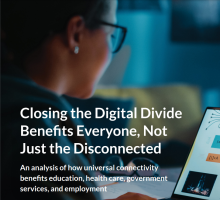
The report, titled "Closing the Digital Divide Benefits Everyone, Not Just the Disconnected" – published by Common Sense and the Boston Consulting Group (BCG) – emphasizes the benefits of universal Internet access across education, health care, government services, and employment. It makes the case that universal connectivity would allow institutions to “integrate Internet-based technologies into their services, improving them for the benefit of all.”

Most notably, the report advocates for increased ACP enrollment, arguing that in addition to providing low-income households some short-term relief from pricey Internet bills, the program can provide an economic incentive for ISPs to invest in unserved and underserved communities by increasing the return on investment (ROI) in areas that have previously been considered unprofitable.

The referenced media source is missing and needs to be re-embedded.

The Affordable Connectivity Program has been considered by some to be a “coupon” solution to the broadband affordability problem, and ILSR has long believed that while the ACP is critical to ensuring low-income customers can afford Internet access right now, more structural solutions are needed to make connectivity affordable to everyone over the long term.

CBN Welcomes New ACLS Fellow to Work on Advancing Digital Sovereignty in Indian Country

The Community Broadband Networks (CBN) team here at the Institute for Local Self-Reliance (ILSR) is thrilled to announce we will once again welcome a postdoctoral fellow this coming fall to undertake a two-year project that advances policy initiatives in support of expanding broadband access and digital sovereignty for Tribal Nations across the U.S.

It’s the second time the American Council of Learned Societies (ACLS) has selected ILSR as a host organization for a Leading Edge Fellowship, which embeds humanities and social science PhDs with nonprofits committed “to solve problems, build capacity, and advance justice and equity in society.”

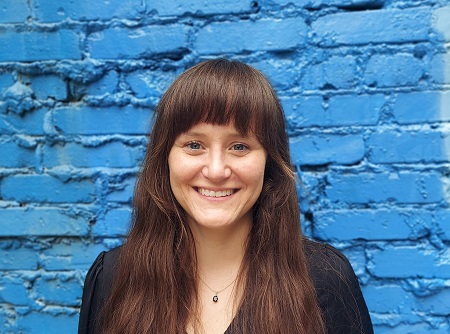
Earlier this month, ACLS announced 18 new ACLS Leading Edge Fellows for 2023. In September, one of those fellows – Jessica E. Auer (PhD, History, University of North Carolina at Chapel Hill) – will join the CBN team, kicking off her full-time fellowship as a Tribal Broadband Policy Analyst.

Image
ACLS Fellow Jessica Auer

Jessica will conduct original research and writing to help develop policy narratives that can be used to support new and existing tribal broadband efforts.

With less than 60 percent of those living on Tribal lands in the lower 48 states having access to basic broadband connections – as Native Nations have regularly been excluded from policy conversations around these issues – Tribal citizens miss out on educational, economic, telehealth, social networking, and a panoply of other activities that foster community resiliency and democratic engagement in the modern world.

Building and Sustaining a Tribal Network Surrounded by Mountains and Mesas - Episode 548 of the Community Broadband Bits Podcast

This week on the podcast, Christopher is joined by Kevin Shendo, Education Director at the Pueblo of Jemez Department of Education, and Angela Diakah, Network Operations Supervisor at Jemez Pueblo Tribal Network (JPTN). JPTN is a wireless network serving more than 500 households in the Jemez Pueblo north of Albuquerque. Kevin and Angela share the origins of the network, spurred in part by prior serve from Windstream that was costing households on average $100/month for 4/1Mbps service. 

Angela shares the story of her first install and then Kevin walks Christopher through how the Tribe currently subsidizes the entire cost of the network with the help of federal dollars, and the plan for shifting to a traditional subscription service model subsidized at the household level by the Affordable Connectivity Program. Finally, Angela shares some of the network's digital equity and inclusion work to make sure that every household that wants can make the fullest use of its connection.

This show is 25 minutes long and can be played on this page or via Apple Podcasts or the tool of your choice using this feed

Transcript below. 

We want your feedback and suggestions for the show-please e-mail us or leave a comment below.

Listen to other episodes here or view all episodes in our index. See other podcasts from the Institute for Local Self-Reliance here.

Thanks to Arne Huseby for the music. The song is Warm Duck Shuffle and is licensed under a Creative Commons Attribution (3.0) license.
No-Cost GIS Resources Available to Tribes Through BIA

Geospatial software licenses and training can be a huge help to Tribes building their own broadband networks, and federally recognized Tribes can access a number of geospatial resources at no cost.

Since 2002, the Department of the Interior has held an agreement with Esri, a leading GIS software, to make licenses and training available to the Bureau of Indian Affairs (BIA) and the governments of federally recognized Tribes.

The licenses and training are administered under the BIA’s Branch of Geospatial Support (BOGS), which “support[s] Tribes’ land management projects such as irrigation, floodplain analysis, forestry harvesting, wildfire analysis, oil and gas management, and other economic analysis,” but the resources have broadband applications well.

BOGS offers free geospatial software, geospatial training, and geospatial technical assistance to more than 900 BIA employees and 4,000 Tribal personnel.

Image

Geographic information system (GIS) resources allow Tribes to map their networks as they are built, greatly assisting with documentation. GIS can be used to document culturally or environmentally sensitive areas, which is especially relevant if Tribes are working with contractors unfamiliar with the area.

Tribes can also leverage GIS to collect their own location data, and submit this data to the FCC to improve the agency’s maps, which are notoriously inaccurate on Tribal lands. Additionally, Tribes with existing networks can use mapping resources to compile data to feed into submission reports to the FCC as the FCC’s new reporting requirements will require some form of GIS.

Modernizing a Tribal Network - Episode 545 of the Community Broadband Bits Podcast

This week on the podcast, Christopher is joined by Kristan Johnson, Telephone Operations Manager of the Tohono O'odham Utility Authority (TOUA), which provides telephone, electric, water, gas, and Internet service to a large portion of those living throughout the Tohono O'odham Nation in south-central Arizona. Currently, the utility authority serves 4,000 telephone and broadband subscribers. Kristan joins the show to talk about what's like serving as a telephone and Internet service provider for more than two decades at this point, in an extremely rural area. TOUA's plan is to extend new fiber infrastructure to the entirety of the reservation by the end of 2024. To get it done, Kristan says, the utility will use USDA ReConnect Round 3 and other grant funds, as well as internal investment.

She shares with Christopher how the network has been mindful that the devil is in the details, including everything from using modern software platforms to plot both old and new assets, report properly, and manage local politics and member expectations for a public that often doesn't know how the Internet reaches it.

Kristan mentions ArcGIS and we tracked down this information that is related.

The Branch of Geospatial Support of the Bureau of Indian Affairs provides software, support, and training to federally recognized Tribes (employees or and contracted or compacted Tribal employees). 

To be eligible for these benefits, the organization must submit an application to participate in the Enterprise License Agreement (ELA) program. The products offered through this program are provided at no cost to ELA participants. Following receipt of the application, applicants can expect to receive a decision within 15 business days.

The software available includes ArcGIS Desktop, Pro, or Enterprise + additional add-on licenses (e.g., 3D Analyst, Spatial Analyst, Geostatistical Analyst, and Network Analyst); Portal for ArcGIS; ArcGIS Online; and ArcGIS Insights. 

With or without software downloaded, eligible Tribal entities can register for ESRI-led training online at no cost. These trainings range in experience from introductory courses for those getting started in GIS to managing geospatial data in ArcGIS. Registration for each course opens about one month prior to the course start date.

This show is 26 minutes long and can be played on this page or via Apple Podcasts or the tool of your choice using this feed

Transcript below. 

We want your feedback and suggestions for the show-please e-mail us or leave a comment below.

Listen to other episodes here or view all episodes in our index. See other podcasts from the Institute for Local Self-Reliance here.

Thanks to Arne Huseby for the music. The song is Warm Duck Shuffle and is licensed under a Creative Commons Attribution (3.0) license.
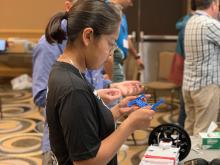
Building for Digital Equity Podcast Episode 3: Mikhail Sundust Offers Digital Equity Lessons from Gila River Indian Community

In our third episode on the Building for Digital Equity podcast, we are joined by Mikhail Sundust, Executive Director of the Digital Connect Initiative (DCI) at GRTI - Gila River Telecommunications Incorporated.

A tribal telecommunications company, GRTI has offered telecommunications and now high-quality Internet access to tribal citizens living on the Gila River reservation (and beyond with subsidiaries) for more than 30 years.

The podcast covers the lessons DCI has learned along its digital equity path, including making sure people have the basic digital skills needed to build more advanced skills and confidence. Sundust also discusses how they developed a "bring your own device" program for learning, and have crafted programs that work well with tribal elders.

Finally, Sundust talks about how other Tribal telecom companies are starting to incorporate digital equity planning into their work.

This show is 14 minutes long and can be played on this page or using the podcast app of your choice with this feed.

Listen to other episodes here or see other podcasts from the Institute for Local Self-Reliance here.

Thanks to Joseph McDade for the music. The song is On the Verge and is used per his Free-Use terms.


Mikhail Sundust Offers Digital Equity Lessons from Gila River Indian Community - Building for Digital Equity Podcast Episode 3

Building for Digital Equity logo

Mikhail Sundust is the Digital Connect Initiative (DCI) Executive Director for the Digital Connect Initiative at GRTI - Gila River Telecommunications Incorporated. GRTI has offered telecommunications and now high-quality Internet access to the reservation (and beyond with subsidiaries) for more than 30 years.

We talk about lessons DCI has learned along its digital equity path, including making sure people have the basic digital skills needed to build more advanced skills and confidence. They developed a "bring your own device" program for learning and have crafted their programs to work well with elders. We also discuss how other Tribal telecom companies are starting to incorporate digital equity planning into their work. 

This show is 14 minutes long and can be played on this page or using the podcast app of your choice with this feed

Transcript below. 

We want your feedback and suggestions for the show-please e-mail us or leave a comment below.

Listen to other episodes here or see other podcasts from the Institute for Local Self-Reliance here.

Thanks to Joseph McDade for the music. The song is On the Verge and is used per his Free-Use terms.

Training to Build the Networks We Want at Broadband Bootcamps - Episode 537 of the Community Broadband Bits Podcast

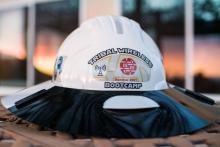
This week on the podcast, Christopher is joined by ILSR Communications Team Lead Sean Gonsalves to talk about the most recent Tribal Broadband Bootcamp, in Gila River. Tribal attendees from across North America came together - some experienced, and others tackling structural broadband inequities in their regions for the first time - came together to meet each other, share lessons learned, and get hands-on experiences with the nuts and bolts about improving connectivity for families that have long been left behind by the private marketplace. With help from representatives from Gila River Telecommunications, attendees learned about deployment technologies, fiber splicing, security, operations, digital inclusion, and more. Christopher and Sean also chat during the show their recent participation at the the digital equity Los Angeles summit, and first urban broadband bootcamp from ILSR.

This show is 27 minutes long and can be played on this page or via Apple Podcasts or the tool of your choice using this feed

Transcript below. 

We want your feedback and suggestions for the show-please e-mail us or leave a comment below.

Listen to other episodes here or view all episodes in our index. See other podcasts from the Institute for Local Self-Reliance here.

Thanks to Arne Huseby for the music. The song is Warm Duck Shuffle and is licensed under a Creative Commons Attribution (3.0) license.
Tribal Broadband Bootcamps Announced for 2023

The Tribal Broadband Bootcamps, which have worked with 20 Tribes and more than 100 participants over the past 2 years, offering hands-on training in wireless and fiber-optic networks, will continue in 2023 with an expanded schedule and expanded curriculum.

Tribal Broadband Bootcamps are planned by Matt Rantanen and our own Christopher Mitchell as part of the Indigenous Connectivity Institute at Connect Humanity.

Additional events will be announced in coming months, but the first event will be hosted by Gila River in January.

Hoopa Valley will be hosting one in May. Additional events are planned in March and June and will continue over the course of the year. More information on the bootcamps can be found in this two page pdf explainer.

For an inside look at a previous Tribal Broadband Bootcamp, watch video below:

Remote video URL