
reliability

Content tagged with "reliability"

Related Topics
Displaying 1 - 10 of 31

Abundant Home Broadband for All Californians: A Pathway to Digital Prosperity
Image
Abundant Home Broadband

Broadband ISPs should be held to a higher public interest standard and regulated like traditional utilities in California, a new joint study by nonprofit state policy news outlet Cal Matters and UC Berkeley’s Possibility Lab argues. 

The study specifically looked at the broadband sector in California, where 15 percent of California households – predominately in low income and minority communities – lack broadband access. This neglect has resulted in a stark digital divide between affluent and marginalized communities across rural and urban communities alike. Data has consistently shown that lower income, marginalized communities often wind up paying significantly more money for notably slower service than their more affluent, less diverse counterparts. The study concludes that dramatic federal and state policy failures have resulted in unchecked monopolies and muted competition that directly harms the public interest. It urges state leaders to aggressively embrace municipal broadband cooperatives to address regionalized market failure and improve overall accountability.

Read Abundant Home Broadband for All Californians: A Pathway to Digital Prosperity [pdf].
California Should Regulate Broadband ISPs Like Utilities, Report Says

Broadband ISPs should be held to a higher public interest standard and regulated like traditional utilities in California, a new joint study by nonprofit state policy news outlet Cal Matters and UC Berkeley’s Possibility Lab argues. State governments should also vocally support community broadband networks as a direct challenge to monopoly power, the authors state.

The study specifically looked at the broadband sector in California, where 15 percent of California households – predominately in low income and minority communities – lack broadband access. It concludes that dramatic federal and state policy failures have resulted in unchecked monopolies and muted competition that directly harms the public interest.

While the study lauds California’s dramatic $6 billion “Broadband For All” initiative, which is driving historic new investment into last and middle mile network upgrades, it also states that the state’s full vision for equitable access cannot be achieved without rate controls, universal access requirements, and strict reliability standards for large incumbent ISPs.

The study also urges state leaders to aggressively embrace municipal broadband cooperatives to address regionalized market failure and improve overall accountability.

“California should actively encourage and support the formation of municipal broadband
cooperatives across the state, particularly in underserved rural and suburban communities
where incumbent providers have failed to deliver adequate service,” the study observes.

Monopoly Dysfunction, Muted Competition

Like most U.S. states, California communities are dominated by a handful of cable and phone giants that have leveraged their immense political power to box out local competition creating dominant regional monopolies and duopolies.

Small Towns Building Broadband, Broadband Usage, and the Continued Retreat from Fiber | Episode 124 of the Connect This! Show

Connect This! Show

Catch the latest episode of the Connect This! Show, with co-hosts Christopher Mitchell (ILSR) and Travis Carter joined by regular guests Kim McKinley (Tak Broadband) and Doug Dawson (CCG Consulting) to talk about all the recent broadband news that's fit to print.

Topics include:

Join us live on November 20th at 3pm ET, or listen afterwards wherever you get your podcasts.

Email us at broadband@communitynetworks.org with feedback and ideas for the show.

Subscribe to the show using this feed or find it on the Connect This! page, and watch on LinkedIn, on YouTube Live, on Facebook live, or below.

Who Benefits from this Bargain? | Episode 118 of the Connect This! Show

Connect This! Show

Catch the latest episode of the Connect This! Show, with co-hosts Christopher Mitchell (ILSR) and Travis Carter (USI Fiber) joined by regular guests Kim McKinley (TAK Broadband) and Doug Dawson (CCG Consulting) and special guest Heather Mills (Tilson) to talk about the FCC giving out participation trophies to the monopoly providers, how state offices are responding to the BEAD guidance changes, disaster response and resilient Internet networks, and more. The full list of topics includes:

Join us live on July 24th at 2pm ET, or listen afterwards wherever you get your podcasts.

Email us at broadband@communitynets.org with feedback and ideas for the show.

Subscribe to the show using this feed or find it on the Connect This! page, and watch on LinkedIn, on YouTube Live, on Facebook live, or below.

Advancements in Cable Networks - Connect This! Show Episode 108

Connect This! Show

Catch the latest episode of the Connect This! Show, with co-hosts Christopher Mitchell (ILSR) and Travis Carter (USI Fiber) joined by regular guests Kim McKinley (TAK Broadband) and Doug Dawson (CCG Consulting) and special guest Jason Livingood (Comcast) to talk how cable network operators are innovating to reduce latency, combat buffer bloat, and improve their networks around the county. Join us live on February 21 at 2pm ET, or listen afterwards wherever you get your podcasts.

Join us live on February 21 at 2pm ET, or listen afterwards wherever you get your podcasts.

Email us at broadband@communitynets.org with feedback and ideas for the show.

Subscribe to the show using this feed or find it on the Connect This! page, and watch on LinkedIn, on YouTube Live, on Facebook live, or below.

A Local Coalition Gets Organized to Bring Quality Connectivity to Maine’s Midcoast

Five small towns in rural Maine are connecting with one another in a steady grassroots effort to expand broadband access in the Midcoast. After conducting a survey which affirmed the towns’ acute need for better connectivity, a local coalition is navigating state funding and weighing network options. 

In Waldo County, a collection of local officials and community volunteers have formed the Southwestern Waldo County Broadband Coalition (SWCBC) to organize efforts to bring broadband to five towns in rural Maine, clustered about 30 miles east of Augusta. Freedom, Liberty, Montville, Palermo and Searsmont combined have only 3,300 houses along 340 miles of road. The need for better Internet access became particularly visible during the pandemic, as local officials tried to convene online for Selectmen’s meetings. Two selectpersons from neighboring towns connected over this shared need for access, and the coalition grew from there. 

Nonprofit Directing Efforts to Improve Internet Access for Six Counties in Southern Pennsylvania

Nonprofit Alleghenies Broadband is leading a cohesive effort across a six-county region in south-central Pennsylvania to bring high-speed Internet access to areas that are unserved or underserved by reliable networks.

Part of its work is a recently completed Request for Proposals (RFP) in search of forming a series of public-private partnerships to help identify target areas and offer robust solutions to bring new infrastructure to the businesses and residents who need it most. As that process continues to unfold, however, the nonprofit is already working with city and county leaders to pursue a range of wireline and fixed wireless options that will result in better service and publicly owned infrastructure. 

A Regional Approach

Formed in October 2020, Alleghenies Broadband is part of the Southern Alleghenies Planning & Development Commission. By coordinating efforts in six counties (Bedford, Blair, Cambria, Fulton, Huntingdon, and Somerset, collectively representing about 500,000 residents), it hopes to address the broadband gaps scattered across the region. Somerset, Fulton, and Huntingdon seem to be in the worst shape at present: while many residents have access to cable service, large swaths of the counties are stuck with DSL or satellite service only, leading to median download speeds of just 3.7-8 Megabits per second (Mbps) (see Fulton and Huntingdon coverage maps below, with satellite-only areas in grey). The remaining three counties also have significant gaps where no wireline access is available, representing thousands of households with poor or no service.

Plagued by Bad Service, Eastern North Carolina Mayors Petition State Legislature to Let Them Build Municipal Networks

The mayors of nine cities in eastern North Carolina have had enough of Suddenlink's poor service. WRAL reports that they've called on the state legislature to overturn HB 129 and let them build their own networks after years of unreliable connectivity:

“[HB 129] forbade any kind of municipality from establishing broadband as one of their utilities,” Rocky Mount mayor Sandy Roberson said.

Roberson said Internet service in Nash and Edgecombe counties had been a problem for years.

There have been so many complaints against the area’s major provider, Suddenlink, since the COVID-19 pandemic began that the mayor of Tarboro called for the state Attorney General to investigate the company in January.

Months later, area leaders have started to take matters into their own hands, with the mayors of nine cities across Eastern North Carolina petitioning the state legislature to allow them to set up their own fiber networks.

The call to action comes on the heels of the mayors of Tarboro, Rocky Mount, New Bern and Washington calling on the state Attorney General to investigate the company.

Head over to WRAL to read the whole story.

In Our View: Grid Disaster in Texas Leads to Open Access Soul Searching

Welcome to In Our View, the first installment of a new series here. From time to time, we'll use this space to explore new ideas and share our thoughts on recent events playing out across the digital landscape, as well as take the opportunity to draw attention to important but neglected broadband-related issues.

The disaster in Texas resulting from an electric grid that was deliberately left exposed and likely to fail in rare cold weather events has received a lot of dramatic coverage, as well it should given the loss of life and damage to so many homes and businesses. It also raised some questions in my mind regarding competition and designing markets that will be discussed below. Texas was a leader in allowing different electricity firms to compete in selling electricity over the same electric grid, an arrangement that has some similarities to open access broadband approaches.

In digging into that recent electricity history, I made another interesting and relevant finding that I discuss first as part of the background to understand the lessons from Texas. In 20 years of competing models between, on the one hand, municipal and cooperative structures to deliver electricity and, on the other hand, a largely deregulated and competitive market, the munis and co-ops delivered lower prices to ratepayers.

Many of the sources used in this article are behind paywalls. We wish that weren't the case but we support both paying for news and the libraries that have databases that may allow you to track this down if you have the inclination.

Electricity Deregulation, Texas Style

More than 20 years ago, Texas largely deregulated electricity markets. Residents still have a monopoly in charge of the physical wire delivering electricity to the home, but they could choose among various electricity providers that would effectively use the wire and charge different amounts, differentiating themselves via a variety of factors, including how the electricty was produced.

Study Finds Chattanooga Fiber Network 10-Year ROI: $2.69 Billion

For communities across the country considering whether to invest in building a municipal broadband network, a new study published last week on the economic value of the EPB fiber network in America’s first “gig city” is a must-read.

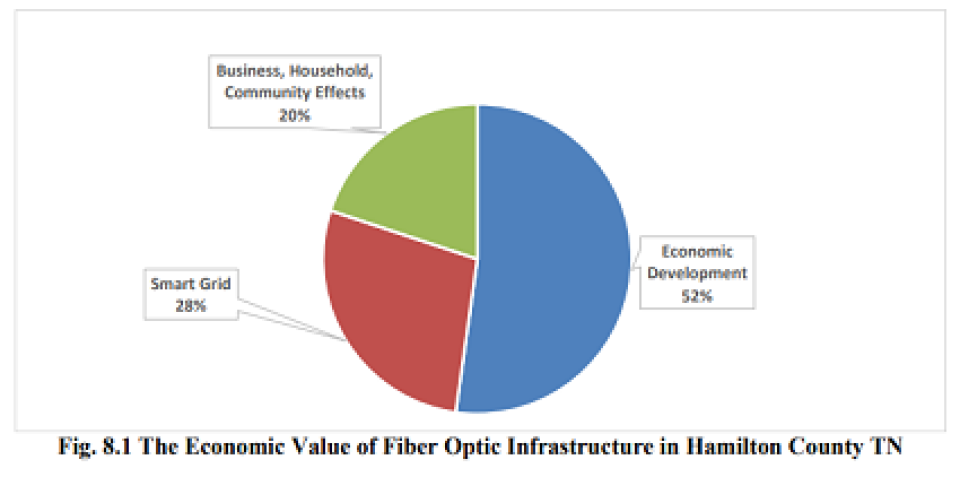
The independent study, conducted by Bento Lobo, Ph.D., head of the Department of Finance and Economics at the Rollins College of Business at the University of Tennessee at Chattanooga, found that the celebrated city-owned fiber network has delivered Chattanoogans a $2.69 billion return on investment in its first decade.

In 2010, EPB Fiber, a division of Chattanooga’s city-owned electric and telecommunications utility formerly known as the Electric Power Board of Chattanooga, became the first city in the United States to build a Fiber-To-The-Home (FTTH) network offering up to 1 Gig upload and download speeds. In 2015, EPB began offering up to 10 Gig speeds.

It cost approximately $220 million to build the network, however, “the true economic value of the fiber optic infrastructure for EPB’s customers is much greater than the cost of installing and maintaining the infrastructure,” Lobo said. “Our latest research findings show that Chattanooga’s fiber optic network provides additional value because it provides high speeds, with symmetrical uploads and downloads, and a high degree of network responsiveness which are necessary for the smart grid and other cutting-edge business, educational and research applications.”

Image

Among the study’s key findings: