

reliability

Content tagged with "reliability"

Related Topics
Displaying 21 - 30 of 31

Webpass and Its Fixed Wireless Seek Fix for Landlord Abuses - Community Broadband Bits Episode 197

San Francisco is one of the rare cities that has multiple high quality ISPs competing for market share, though the vast majority of people still seem to be stuck choosing only between Comcast and AT&T. This week, we talk to a rising ISP, Webpass, about their success and challenges in expanding their model. Charles Barr is the President of Webpass and Lauren Saine is a policy advisor - both join us for episode 197 of the Community Broadband Bits podcast. 

We discuss the Webpass model, which uses fixed wireless and fiber to serve high density apartment buildings where they are allowed in by the landlord. Unfortunately, they have been locked out of many of these buildings and are looking to the city of San Francisco to adopt better policies to ensure a single provider like AT&T cannot monopolize the building. Though the FCC has made exclusive arrangement unenforceable, the big providers are still finding ways to lock out competition. We also talk a little about the role of fiber and fixed wireless technologies, chokepoints more generally, and why Webpass is so sure it could succeed if residents were all able to to choose the ISP they wanted. 

This show is 27 minutes long and can be played on this page or via Apple Podcasts or the tool of your choice using this feed

Transcript below. 

We want your feedback and suggestions for the show-please e-mail us or leave a comment below.

Listen to other episodes here or view all episodes in our index. See other podcasts from the Institute for Local Self-Reliance here.

Thanks to Kathleen Martin for the music, licensed using Creative Commons. The song is "Player vs. Player."

More Feasibility Studies in Colorado and Ohio

Two more communities in Ohio and Colorado are seeking information through broadband feasibility studies.

The Aspen Daily News recently reported that Pitkin County has already completed phase one of its feasibility study. This past spring the primary Internet path coming into Aspen via CenturyLink fiber was severed causing widespread outage for 19 hours. The first half of the feasibility study sought ways to introduce a redundant path.

The first option was a 100 percent fiber solution and a hybrid fiber/microwave solution was proposed as an alternative. For option A, the consultants recommended a fiber backbone along Highway 82 with fiber lines running into Redstone, Marble, and Snowmass. Microwave could serve nearby Fryingpan Valley. Option B would travel the same route but make more use of microwave.

Early cost estimates:

Estimated operating costs for option A would be more than $122,000 per year, while option B would cost just over $92,000 annually. Yearly maintenance costs for the fiber-only model were projected at just under $62,000, and the hybrid model would run more than $123,000.

A survey or residents in several communities in Pitkin County indicated most are not happy with speeds or reliability of current Internet access. Approximately half of the region does not have broadband as defined by the FCC at 25 Mbps download and 3 Mbps upload. 

[One of the consultants] said that according to the survey, customer satisfaction in the area is “significantly low.” It also noted that 34 percent of responders said they run a business out of their home, and an additional 10 percent replied that they will start up an in-house business within the next three years.

Adams relayed that more than half of respondents felt that the county should build some sort of “state-of-the-art communications network.”

“It’s clear that the residents would like to see the county do something,” he said.

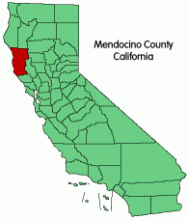
Mendocino County Analyzes Losses From Communications Outage

In November, the Broadband Alliance of Mendocino County (BAMC) released a report documenting the results of an online survey to determine the effects of a summer communications outage. The Willits News reported that the survey revealed losses of over $215,000 in the county, although actual losses likely reach the millions.

In August, an accident wiped out Internet, telephone, cell, and 911 services for eight communities along the coast in Mendocino County. AT&T aerial fiber optic cable was destroyed. Approximately 17,400 people lost access to 911 services. Depending on the location, 911 service was out for 24 to 45 hours.

Only about 6.5 percent of the people in Mendocino County participated in the survey according to the report. Ninety-five percent of those responding said they were directly impacted.

The article quotes the BAMC report:

According to the BAMC, the outage was lengthy because "the AT&T backbone fiber network was not configured to be redundant nor diverse with protection routing. This was not due to the lack of fiber in the surrounding routes. AT&T did provide diverse fiber and protection for their cable station, but elected not to provide the same for the surrounding community and emergency services."

Mendocino County has been working for several years on an initiative to improve connectivity along California's north coast. They are now part of a larger collaboration called the North Bay/North Coast Broadband Consortium.

The incident in Mendocino County is much like a similar event in 2010 in which Cook and Lake Counties in Minnesota were cut off in the same way. At that time, a single Qwest line was cut and, since there was no redundancy, 911 service, Internet, and many business services came to a screeching halt.

Yet another reminder of the risks that come with depending on distant mega-corporations for essential infrastructure.

Missoula Releases Results of Broadband Feasibility Study

The culmination of more than a year of discussion, funding searches, vendor selection, and research, Missoula has released the results of its broadband feasibility study. The study’s final report makes a range of recommendations, highlighted by the urging to invest $10.5 million from various sources to construct an open access fiber optic network connecting local businesses and over 50 key anchor institutions. 

Beginning in early 2013, Missoula City and Missoula County governments collaborated with the Bitter Root Economic Development District to win a grant from the Montana’s Big Sky Economic Development Trust Fund, which they matched with local funds. The result was a $50,000 pot from which to finance the feasibility study.

The long-awaited final study results indicate a significant demand for affordable, reliable high speed connectivity in the Missoula area from both businesses and public institutions, especially in the unincorporated areas outside the central city. In a survey (page 31 of the report), a shocking 73% of Missoula businesses reported moderate, severe, or total disruption of their business from Internet problems related to reliability or speed. A further 38% said their connections were insufficient for their businesses needs, but the vast majority of those reported that they were unable to upgrade because the needed connections were either unavailable or the price was out of reach. 

The total cost of the network, which would include over 60 miles of fiber, is estimated to be just over $17 million. That figure is a conservative estimate, however, as it assumes 100% of the network would be built underground and minimal existing assets would be used or shared (neither of which is likely to be the case when all is said and done). 

The study recommends bringing in local anchor institutions as key network tenants, while making dark fiber available to third party service providers who can sell connections to local businesses, in what the Bitter Root Economic Development District refers to as a public-private partnership:

High Speed in the Blue Grass State: Russellville's Gig

The Logan Journal recently reported that the Russellville Electric Plant Board (EPB) now offers gigabit service to local businesses. The article notes that Net Index, an online tool to measure download and upload speeds, recognizes EPB as the first Gig city in Kentucky. To learn more about the community and its network, we talked with Robert White, General Manager of EPB.

The community of 7,000 is the county seat of south central's Logan County. Russellville is located in the center of several other larger communities: Nashville, Bowling Green, Hopkinsville, and Clarksville, Tennessee. Manufacturing has been a large part of the local economy for generations, but community leaders recognize the vulnerability of a narrow economic base. In order to encourage a versatile economy, Russellville invested in its telecommunications utility.

The community wants to encourage small business while simultaneously providing manufacturers the connectivity they need. Leadership sees the ability to remain competitive directly tied to their network. In addition to the economic development opportunities a fiber network can provide, communities like Russellville rely on electricity revenue from large consumers. Retaining the large electric consumers that also provide jobs in the community is a must.

Russellville's electric utility created a strong advantage when it was time to venture into telecommunications. EPB had already established a strong relationship with its Russellville customers, says White, and locals felt they could trust their municipal electric provider.

Cedar Falls Shows Long Term Muni Network Success: Community Broadband Bits Episode #75

Cedar Falls Utilities operates one of the oldest community owned networks in the nation. It started as a cable network in the 90's, upgraded to FTTH recently, and this year began offering the first citywide gigabit service in Iowa. CFU Communication Sales Manager Kent Halder and Network Services Manager Rob Houlihan join me for Community Broadband Bits podcast 75. We discuss why Cedar Falls Utilities decided to add cable to their lineup originally and how it has achieved the incrediblely high take rates it maintains. We also discuss the importance of reliability for municipal network and why they decided to transition directly to a FTTH plant rather than just upgraded to DOCSIS 3 on their cable system. Finally, we discuss its expansion into the rural areas just outside of town. Read all of our coverage of Cedar Falls on MuniNetworks.org. Read the transcript of our discussion here. We want your feedback and suggestions for the show - please e-mail us or leave a comment below. Also, feel free to suggest other guests, topics, or questions you want us to address. This show is 20 minutes long and can be played below on this page or via iTunes or via the tool of your choice using this feed. Listen to previous episodes here. You can can download this Mp3 file directly from here. Find more episodes in our podcast index. Thanks to Haggard Beat for the music, licensed using Creative Commons.

Small Minnesota Town, Annandale, Fed up With Slow DSL

Yet another Minnesota town is fed up with slow, unreliable Internet access and is examining what it can do to make sure it has the network it needs to succeed in the modern economy. Annandale is 50 miles northwest of Minneapolis with a population of 3,200 and has Windstream as the telephone company. Windstream, as with other large firms that primarily serve rural America, offers a DSL more suited to the late 1990's than 2013. It has little capacity to invest in better networks, even if it had the willingness. We've covered Windstream several times in previous stories. After a flood of complaints from residents to City Hall about slow speeds and frequent outages, the City issued a request for proposals for a feasibility study that will explore alternatives to the present reliance on Windstream. Local leaders understand that the private sector is not likely to invest significantly in its community due to its density and rural location. But the town needs modern Internet access to retain and attract good jobs. The Annandale Advocate newspaper ran a story on September 17 but it is not available for non-subscribers.
At a chamber of commerce meeting later in the week Gunnarson added that strong broadband is a basic, essential feature of modern commerce. "New businesses expect good Internet. When you buy a car you expect tires on it. Unfortunately, our car has wooden tires," he said.
logo-annandale-advocate.jpg The same paper published a guest editorial by City Council members to explain how little power the City has over private providers. Many people falsely believe that towns are actively keeping competition out:

We even had some people angrily ask our staff why are we keeping the competition out. So to set the record straight, the city can't do much about it because it is all private wires, equipment, operations and corporate customer service. Also, a recent call to the PUC, the Public Utilities Commission, confirms that not much can be done since broadband is not regulated. Sorry folks. As far as letting in competition, we have zero say in that. Any other provider can come in any time.

Greater Austin Area Telecommunications Network Saves Millions for Taxpayers

Austin, Texas, with a little over 820,000 people, is home to several centers of higher ed, the Southwest Music Festival, and a next generation network known as the Greater Austin Area Telecommunications Network (GAATN).

It was also the second metro area selected by Google for the Google Fiber deployment. But before they got Google Fiber, a local partnership had already connected key community anchor institutions with limitless bandwidth over fiber networks. The network measures its success in terms of cost avoidance, and averages out to a savings of about $18 million per year combined for its 7 member entities.

In 2011, the National Association of Telecommunications Officers and Advisors (NATOA) named GAATN the Community Broadband Organization of the Year. Today, GAATN also serves the  City of Austin, the Austin Indepedent School District (AISD), Travis County, local State of Texas facilities, Austin Community College (ACC), the University of Texas at Austin (UT), and the Lower Colorado River Authority (LCRA).

GAATN's bylaws prevent it from providing service to businesses or individual consumers. Texas, like 18 other states, maintains significant barriers that limit local public authority to build networks beyond simply connecting themselves. As a result, local entities must tread lightly even if they simply want to provide service for basic government functions.

American Crafts' New Muse is UTOPIA

If you are a 21st century crafter, you are probably prolific at finding inspiration online. You may be familiar with American Crafts of Orem for ideas or products. The company, founded in 1994, is now a customer of UTOPIA and reports significant bandwidth improvement after the switch from old T-1 connections. From the UTPOIA blog:

With a robust e-commerce presence, American Crafts has to rely on its network. According to Kris Barlow, IT Manager, before switching to UTOPIA, the firm used a single T-1 connection, along with two additional T-1 connections to connect a remote warehouse in Provo. “Our Provo location was using an iProvo connection at the time. By switching to UTOPIA, we could use a single fiber connection to our headquarters building which provided much faster Internet speeds—up to 10 Mbps on our service plan, as compared with traditional T-1 speeds.”

Barlow also notes how the switch has allowed the company to consolidate headquarters and warehouse locations. Reliablity has also been a key improvement:

“In the three years that we've had UTOPIA service, I can remember only two or three service interruptions, all of which were resolved within the same day and were not related specifically to our connection,” he says. “Using the UTOPIA network has allowed us to drastically reduce the fee that we pay for Internet service when compared to the T-1 connections we were previously using, all while also drastically increasing the bandwidth of the connection.”

Because UTOPIA is open access, the company could keep the same phone provider, as it is an ISP on the UTOPIA network. The switch was seamless:

“This allowed for us to simply add the UTOPIA service to our current provider’s bill and allowed us to avoid the hassle of establishing a new account with a new provider,” Barlow says.

Massachusetts Electricity Debate Mirrors Community Broadband Networks

An interesting article earlier this week on Boston.com says a number of Massachusetts towns are studying muni electric plants after the privately owned electrical company took too long restoring power in the aftermath of Hurricane Irene.
“We are at the very beginning. We want to see if municipal control is even possible,’’ said Norwell Town Administrator James Boudreau. “We want a faster response. This was a tropical storm. What if it was a category 2 hurricane? What if it was the winter?’’ he said, noting the efficient restoration of power in towns with electric utilities under municipal control, such as Hingham, Hull, and Braintree.
Braintree's municiple utility also runs a broadband network for the community. If these communities are looking at am uni utility, they should ceratinly consider improving their broadband access at the same time. As we have covered previously, Wired West (on the other side of the state) is a collection of many communities that recently formed municipal "light plants" (in the parlance of Massachuesetts) as a legal structure for building a community fiber network. As we have observed time and time again, local control tends to improve the quality and response time of customer service. And in those cases where it doesn't, at least they have no one to blame but themselves. It is well within their power to fix it. Curiously, National Grid was formed by combining privatized former muni electric utilities -- a warning to communities that may look to privatize their community broadband networks over time due to the mistaken notion that community ownership was only necessary to establish the network rather than ensure it continues operating for the benefit of the community. Community broadband is about far more than technology, it is about ownership by an entity with the right incentives to operate essential infrastructure. The company's response to this movement is fascinating:
National Grid offers a different opinion. Communities are “best served by a company with established practices, resources, and programs that can serve them in an evolving, challenging energy environment,’’ said Deborah Drew, a spokeswoman for the utility.
Say what?