
policy

Content tagged with "policy"

Related Topics
Displaying 21 - 30 of 272

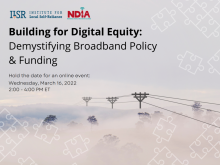
Event: Building for Digital Equity - Demystifying Broadband Policy and Funding
We're living through a time with an unprecedented level of broadband infrastructure funding, fueled not only by the American Rescue Plan, but the Consolidated Appropriations Act, the Coronavirus Capital Projects Fund, and the Infrastructure Investment and Jobs Act. Hundreds of community-driven projects are already underway, but finding solid footing amidst these programs, statutes, and evolving rules is difficult. 

To help, the Institute for Local Self-Reliance is teaming up with the National Digital Inclusion Alliance for a two-hour livestream event to demystify the landscape. On Wednesday, March 16th, from 2-4pm ET, we're hosting an online conversation to bring together local stakeholders, policy advocates, and funding experts in one place. We're calling it Building for Digital Equity: Demystifying Broadband Policy and Funding.

Image

But this isn't your average conference or webinar, with 45-minute panels that make your butt go numb and your eyes glaze over. Oh no. We're aiming for a fast-paced, fun, and most importantly interactive conversation between policy advocates, network builders, local officials, and anyone else interested in learning how we can ensure that the tens of billions in upcoming infrastructure funding goes to solving the connectivity crisis permanently rather than once again disappearing into the pockets of the monopoly Internet Service Providers (ISPs).


The Rural Digital Opportunity Fund Auction: One Year Later

The FCC’s Rural Digital Opportunity Fund (RDOF) Reverse Auction was completed a little more than a year ago to much fanfare and spilled ink, and though we’ve seen irregular updates over the last twelve months, we thought it worth the time to round up what we know so far in an effort to see where we’re at and determine what is likely to come.

The RDOF was built to award up to $20.4 billion in grants over 10 years using competitive reverse auctions generally won by the lowest bidder. The money comes from the Universal Service Fund fees affixed to consumers’ monthly telecom bills. The previous FCC announced $9.2 billion in auction winners in December of 2020. 

To date the FCC has announced five rounds of Authorized funding released, six rounds of applicants whose bids they have decided are Ready-to-Authorize, and three rounds of Default bids. In total, a little more than half of the $9.2 billion won during the auction has been handed out as of January 14th, 2022, with another $1.3 billion announced on January 28th as ready to be disbursed shortly.

It’s clear that the final picture is still taking shape, but looking at things a year later leaves us feeling a little better than we were immediately after the auction closed. To date, it appears the FCC is closely scrutinizing many of the bidders that most worried industry veterans and broadband advocates, while releasing funds for projects that will bring future-proof connectivity to hundreds of thousands of homes over the next ten years.

Moving Slowly on Problematic Awards

The biggest news so far is that of the top ten winners, seven look to have received no funds at all (see table below or high-resolution version here). That’s $4.1 billion worth of bids for almost 1.9 million locations, and includes LTD Broadband, SpaceX’s Starlink, AMG Technologies (NextLink), Frontier, Resound Networks, Starry (Connect Everyone), and CenturyLink. This is a big deal.

Treasury Simplifies, Improves Rules for Rescue Plan Aid for Broadband Networks

Communities across the United States got an unexpected gift from the Biden Administration last week in the form of additional flexibility to use Rescue Plan funds for needed broadband investments, particularly those focused on low-income neighborhoods in urban areas. 

When Congress developed and passed the American Rescue Plan Act, it tasked the Treasury Department with writing the rules for some key programs, including the State & Local Fiscal Recovery Funds (SLFRF). That program is distributing $350 billion to local and state governments, which can use it for a variety of purposes that include broadband infrastructure and digital inclusion efforts.

Treasury released an Interim Final Rule in May, 2021, detailing how local governments would be allowed to invest in broadband. I promptly freaked out, at the restrictions and complications that I (and others) feared would result in local governments backing away from needed broadband investments due to fears of being out of compliance with the rule. 

After we worked with numerous local leaders and the National League of Cities to explain the problems we saw in the proposed rule, Treasury released updated guidance in the form of a Q&A document to explain how local governments would be able to build and partner for needed networks. 

Given the many challenges the Biden Administration has had to deal with, we did not expect significant new changes to the Rescue Plan rules around the SLFRF. But after many months of deliberations, the Treasury Department has resolved all of the concerns that we identified as areas of concern in May. 

As we explain below, local governments have wide latitude to use SLFRF funds for a variety of needed broadband infrastructure investments, especially to resolve affordability challenges.

Summary and TL;DR


Report: Lack of Fiber in the United States is a Market Failure, and Open Access is the Solution

A new report by the Electronic Frontier Foundation argues that the general lack of fiber network coverage across the United States - with barely a third of homes able to choose a fiber option -  comes in large part from the domination of the broadband marketplace by incumbent providers who both own and operate the infrastructure that provides Internet access to the vast majority of Americans. It’s a classic market failure, authors Benoît Felten and Thomas Langer argue, where there’s a clear profitable business case for the existence of more fiber access that continues to go unaddressed. At its core, the failure is driven by the attitudes of monopoly Internet Service Providers (ISP) which prefer to reap the profits from existing legacy copper and cable infrastructure rather than invest in new build outs. As a result, a larger proportion of Americans than many other nations remain stuck on slower, more expensive connections.

The solution, the report shows, is relatively straightforward and economically viable for as many as 78 percent of all households across the country: the construction of a series of local or regional fiber networks operated on a wholesale basis, whereby any ISP that wants to can join an open, transparent marketplace, creating much more competition than exists in the current arena. 

“Wholesale Fiber is the Key to Broad US FTTP Coverage” offers an economic case for open access fiber in improving access, affordability, and driving competition. Comparing the potential of what it calls a Vertically Integrated Operators deployment (i.e. traditional incumbent broadband providers that build, own, and operate networks for end users) and Wholesale Network Operators deployment (an open access arrangement where the physical infrastructure is owned by one entity that invites providers to operate on the network and connect end users for a fee), the report finds that the Wholesale Network Operator model reduces the risk of capital investment, drives infrastructure expansion, and would lead to future-proof connectivity for hundreds of millions of Americans. 

New Treasury Rules: Good News for Community-Driven Broadband Solutions

The U.S. Department of Treasury, tasked with writing the rules on how state and local governments can spend various federal relief funds made available for broadband expansion by the American Rescue Plan, recently released the guidelines [pdf] governing the Capital Projects Fund (CPF) — a $10 billion pot of money available to states, territories, and Tribal governments [pdf] to confront the need for improved Internet connectivity exposed during the pandemic.

Compared to when Treasury released rules governing the State and Local Fiscal Recovery Funds earlier this year, this go ‘round brought cheers instead of jeers from community broadband advocates, as we are seeing federal broadband policy break new ground.

The flexibility the Capital Projects Fund gives state and local governments to decide how to spend the relief funds is what broadband advocates are most excited about. CPF applicants are able to use the money in creative ways to respond to critical needs in their community laid bare by the Covid-19 pandemic, as long as the resulting project directly enables remote work, education, and health monitoring. 

Watch This Webinar on 9/29 - Repairing Broken Broadband Policy: A Conversation with Dr. Christopher Ali

A week from today, the Schools, Health, and Libraries Broadband Coalition (SHLB) is hosting a fireside chat on Tuesday, September 29th at 12-12:30p ET with SHLB Executive Director John Windhausen and Christopher Ali.

Ali is an Associate Professor of Media Studies at the University of Virginia, and recently released a new book through MIT press called Farm Fresh Broadband: The Politics of Rural Connectivity.

From the description:

Before the pandemic-driven surge of public investment in broadband networks, the federal government had subsidized rural broadband by approximately $6 billion a year. So why does the rural-urban digital divide persist? Why are we looking to the new infrastructure bill to solve a problem that should have been solved a decade ago? Author of "Farm Fresh Broadband" Dr. Christopher Ali argues that rural broadband policy is both broken and incomplete, proposing a new national broadband plan. Join SHLB Coalition Executive Director John Windhausen for a virtual fireside chat with Dr. Ali, to pick his brain on where the U.S. is going wrong and how to course correct rural broadband policy moving forward. And of course, they’ll discuss where community anchor institutions fit into it all.

ILSR spoke with Ali on Episode 134 of the Building Local Power podcast, which you can listen to here.

Register for the event here.

Rethinking Rural Connectivity with Christopher Ali - Episode 473 of the Community Broadband Bits Podcast

This week, we are spotlighting episode 134 of Building Local Power, an ILSR podcast hosted by our Communication’s Manager, Jess Del Fiasco. On this episode, Jess is joined by the Community Broadband Networks Initiative’s Senior Researcher Ry Marcatillio-McCracken and Senior Reporter, Editor and Researcher Sean Gonsalves to interview Christopher Ali about his new book, Farm Fresh Broadband: The Politics of Rural Connectivity. 

Christopher Ali is an Associate Professor in the Department of Media Studies at the University of Virginia where he is currently focusing on broadband policy and deployment across the country. 

The four discuss Chistopher’s motivation for and methodology in writing the book, how better broadband access can spur economic development in rural areas, and how communities are finding solutions in situations where the federal government’s efforts to improve rural broadband infrastructure have fallen short. 

This show is 40 minutes long and can be played on this page or via Apple Podcasts or the tool of your choice using this feed

Transcript below. 

We want your feedback and suggestions for the show-please e-mail us or leave a comment below.

Listen to other episodes here or view all episodes in our index. See other podcasts from the Institute for Local Self-Reliance here.

Thanks to Arne Huseby for the music. The song is Warm Duck Shuffle and is licensed under a Creative Commons Attribution (3.0) license.

Crowdsourcing Data, Fighting for Competition and Digital Equity - Episode 467 of the Community Broadband Bits Podcast

On this week’s episode of the Community Broadband Bits podcast, Christopher Mitchell is joined by Sascha Meinrath, Palmer Chair in Telecommunications at Pennsylvania State University and Director of X-Labs.

The two discuss an exciting collaboration they are working on with Consumer Reports and other allied organizations that crowdsources monthly Internet bills from actual users. The aim of the project is to look at the differentials in the speeds and prices ISPs offer across a variety of geographical locations to see if there is a correlation around race, class, and location. The findings will hopefully clarify the problems and solutions around digital equity and steer policy-making, regulatory authority and consumer protection law conversations to improve Internet access for all.  

The two step back to talk about the bigger picture with current events, specifically the Biden Administrations most recent executive order encouraging the Federal Communications Commission and Federal Trade Commission to restore net neutrality.

This show is 32 minutes long and can be played on this page or via Apple Podcasts or the tool of your choice using this feed

Transcript below. 

We want your feedback and suggestions for the show-please e-mail us or leave a comment below.

Listen to other episodes here or view all episodes in our index. See other podcasts from the Institute for Local Self-Reliance here.

Thanks to Arne Huseby for the music. The song is Warm Duck Shuffle and is licensed under a Creative Commons Attribution (3.0) license.

U.S. Treasury Clarifies American Rescue Plan Broadband Funding

Today, the U.S. Treasury Department released an updated FAQ clarifying many of the concerns and questions raised by numerous community broadband advocates and members of Congress about the Interim Final Rules (IFR) on how Coronavirus relief funds in the American Rescue Plan Act (ARPA) could be spent on broadband infrastructure.

The day after the rules were first released in May we wrote about how it appeared the IFR, if finalized as is, would significantly limit local communities’ ability to invest in needed broadband infrastructure as the rules initially suggested communities were expected to focus on areas that do not have 25/3 Megabits per second (Mbps) wireline service “reliably available.” While broadband experts might have felt comfortable with that language, it would almost certainly confuse lawsuit-leery city attorneys that have to sign-off on projects in areas with widespread gigabit cable broadband access.

Clarification to Make Community Broadband Advocates Clap

What does the requirement that infrastructure “be designed to” provide service to unserved or underserved households and businesses mean?

The updated FAQ sticks to the 25/3 benchmark, stating: “Designing infrastructure investments to provide service to unserved or underserved households or businesses means prioritizing deployment of infrastructure that will bring service to households or businesses that are not currently serviced by a wireline connection that reliably delivers at least 25 Mbps download speed and 3 Mbps of upload speed.”

However, the FAQ goes on to say, “to meet this requirement, states and localities should use funds to deploy broadband infrastructure projects whose objective is to provide service to unserved or underserved households or businesses. These unserved or underserved households or businesses do not need to be the only ones in the service area funded by the project (emphasis added).”

Lawmakers Urge Treasury to Revise Spending Rules on Coronavirus Relief Funds

The day after the U.S. Treasury published the Interim Final Rules on how Coronavirus relief funds in the American Rescue Plan Act can be spent, we sounded the alarm because it appears the rules, if finalized as is, would significantly limit local communities’ ability to invest in needed broadband infrastructure.

Last week, Sen. Ron Wyden (D-Oregon) and eight other members of Congress joined the growing number of community broadband advocates who share those concerns.

On Tuesday, May 25, Sen. Wyden sent a letter to Treasury Secretary Janet Yellen urging her “to ensure any community with service that falls below (the Treasury’s) own standard of 100 (Megabits per second) Mbps upload and download speeds is eligible for funding.”

Two days later, U.S. Rep. Anna G. Eshoo (D-California) and Sen. Cory Booker (D-New Jersey) penned a similar letter that was also signed by Wyden and six other members of Congress (U.S. Reps. Raúl M. Grijalva, Mike Thompson, Jerry McNerney, Lori Trahan, Peter Welch, and Debbie Dingell). Eshoo and Booker have long led efforts to support local initiatives to expand Internet access with community solutions.

25/3 Not Sufficient  

Even as the Treasury acknowledges that families really need 100/100 Mbps service, as the Interim Rules are currently written it suggests communities are expected to focus on areas that do not have 25/3 Megabits per second (Mbps) wireline service “reliably available.” About 90 percent of Americans have 25/3 “available” to them by flawed federal estimates, although millions lack service because it is unaffordable or effectively unreliable. And there is no standard for reliability that communities can measure against.

The Eshoo/Booker letter is particularly salient on this point: