
California

Content tagged with "California"

Displaying 51 - 60 of 266

Inside CADE's Mission to Closing California's Digital Divide - Episode 611 of the Community Broadband Bits Podcast

In this episode of the podcast, Chris engages in a discussion with Lindsey Skolnik, Project Manager for the California Alliance for Digital Equity (CADE). They delve into the critical efforts of CADE to close the digital divide in California, highlighting legislative and regulatory priorities aimed at achieving digital equity.

Lindsey shares the origins and mission of CADE, formed in May 2022 to advocate for digital equity at the state level. They discuss key initiatives such as the Middle Mile and Last Mile projects, Senate Bill 156, and the strategic allocation of $6 billion towards broadband infrastructure.

The conversation also covers the groundbreaking digital discrimination legislation making its way through the California legislature, focusing on the disparate impact standard and the importance of addressing outcomes over intent. Lindsey explains the significant progress of Assembly Bill 239 and the collaborative efforts with various partners to combat digital discrimination.

Furthermore, they explore the impact of the Middle Mile Broadband Initiative, its budget challenges, and the latest updates on the project's progress. The discussion also touches on the Federal Funding Account's role in supporting new broadband investments, with insights into the application process and awarded projects.

Join us as we unpack the complexities and triumphs of advancing digital equity in California, aiming to create a future where all communities have access to fast, affordable, and reliable Internet.

This show is 35 minutes long and can be played on this page or via Apple Podcasts or the tool of your choice using this feed.

Transcript below.

We want your feedback and suggestions for the show-please e-mail us or leave a comment below.

Listen to other episodes or view all episodes in our index. See other podcasts from the Institute for Local Self-Reliance.

Thanks to Arne Huseby for the music. The song is Warm Duck Shuffle and is licensed under a Creative Commons Attribution (3.0) license

California Awards $86 million in Federal Funding Account Grants, Community Broadband Projects Big Winners

Imperial, Lassen, and Plumas Counties are among the first recipients of California’s $2 billion Last Mile Federal Funding Account Grant Program (FFA). The cities of Oakland, Fremont, and San Francisco have also been awarded significant state awards.

The FAA grants are part of California’s ambitious Broadband For All initiative, a $6 billion effort aimed at dramatically boosting broadband competition and access across the Golden State.

All told, the California Public Utilities Commission (CPUC) awarded 11 FFA grants totaling over $86.6 million. Prominent awardees from this first round include publicly-owned broadband projects: the Golden State Connect Authority (GSCA) – a joint-powers broadband authority comprising 40 rural California counties – and Plumas Sierra Telecommunications for projects across Imperial, Lassen, and Plumas Counties.

“These projects will build community-based, future-proof, and equity-focused broadband infrastructure across California,” said CPUC President Alice Reynolds. “The Federal Funding Account – and these projects – are a shining example of our state’s Broadband For All values and objectives.”

California and Massachusetts' Road to Digital Equity - Episode 609 of the Community Broadband Bits Podcast

In this episode of the podcast, Chris speaks again with Sean Gonsalves on recent developments in broadband infrastructure, focusing on efforts in California and Massachusetts to address digital equity and expand access to high-speed internet.

Sean and Chris discuss the California Public Utilities Commission's recent awards from the Federal Fund Account aimed at building last-mile fiber networks in cities like Oakland, San Francisco, and Fremont. These awards are significant for underserved communities and highlight the importance of public ownership in major cities. Sean provides insights into San Francisco's Fiber to Housing program, which aims to connect 30,000 affordable housing units to high-speed internet by leveraging the city's municipal fiber network.

The conversation also covers Massachusetts' broadband funding, including unexpected outcomes like substantial funding for Verizon and its implications for municipal broadband projects. They discuss the challenges cities face with the BEAD program and emphasize the need for creative public-private partnerships to solve connectivity issues.

This show is 39 minutes long and can be played on this page or via Apple Podcasts or the tool of your choice using this feed.

Transcript below.

We want your feedback and suggestions for the show-please e-mail us or leave a comment below.

Listen to other episodes or view all episodes in our index. See other podcasts from the Institute for Local Self-Reliance.

Thanks to Arne Huseby for the music. The song is Warm Duck Shuffle and is licensed under a Creative Commons Attribution (3.0) license

San Francisco Wins National Award For Providing Free High Speed Internet Service To Affordable Housing Residents

As the Affordable Connectivity Program (ACP) is now bankrupt and no longer helping low-income households pay for home Internet service, the City of San Francisco is being honored with the 2024 Community Broadband Project of the Year Award by the National Association of Telecommunications Officers and Advisors (NATOA) for its Fiber to Housing (FTH) program.

Built on the back of the city’s municipally-owned fiber optic network – which since 2002 has been used to connect city and public safety facilities, hospitals, libraries and street lights – California’s fourth most populous city is well on its way to extending the city-owned network to deliver free high-speed Internet service to 30,000 affordable housing units across the city.

Image
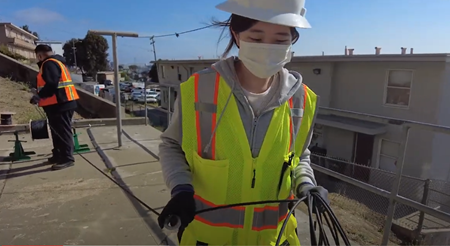
San Francisco technicians deploying fiber across roof

The program currently serves over 14,300 affordable housing units in the city, as well as 1,500 beds at homeless shelters across 115 sites, city officials say. An additional 10,000 residential units are expected to be connected in the coming fiscal year, with the aim of serving 30,000 units by July 2025.

According to the city’s website, the program has connected 52 public housing locations across the city to “fiber-optic and Ethernet cabling in every housing unit.” An additional 63 housing locations are getting free Internet through onsite Wi-Fi with download speeds ranging from 60 to 120 Mbps (Megabits per second), which exceeds the 50 Mbps service Comcast’s Internet Essentials offers.

Destination Crenshaw Breathes Life Into 'Open Air Museum' and Emerging ‘Digital Equity Zone’

On a map, the Crenshaw District is a 2.9 square-mile neighborhood in South Central Los Angeles, home to nearly 30,000 mostly black residents.

In the popular imagination, Crenshaw is the backdrop for the Oscar-nominated movie "Boyz In the Hood" – the real life neighborhood that cultivated the likes of former Los Angeles Mayor Thomas Bradley; rappers-turned-actors Ice Cube and Ice T; and the late rapper/entrepreneur Nipsey Hussle.

But on the streets of Crenshaw, a transformative vision is unfolding – an initiative local leaders describe as “a reparative development project.”

The idea is to inspire and empower neighborhood residents with strategic investments rather than displace them through gentrification. The effort is being led by Destination Crenshaw, a nonprofit community organization established in 2017 to celebrate the history and culture of Black Los Angeles.

The most visible part of the vision is to create the largest Black public art project in the nation along Crenshaw Boulevard, the 1.3 mile spine of the neighborhood – or what Destination Crenshaw describes as an “open air museum” centered around “pocket parks” and a “comprehensive streetscape design” that will feature commissioned murals and sculptures from local Black artists.

Paul Goodman on Advocacy, Accessibility, and Broadband Equity with C4AT - Building for Digital Equity Podcast Episode 20

Building for Digital Equity logo

In this episode of the Building for Digital Equity Podcast, Chris engages in a compelling discussion with Paul Goodman from the Center for Accessible Technology (C4AT). Paul, a seasoned advocate with over 12 years of experience, shares his journey from law school to championing broadband availability, affordability, and accessibility for people with disabilities. The conversation delves into the crucial work of C4AT, highlighting their policy advocacy, assistive technology solutions, and efforts to ensure web accessibility.

Paul explains the intricacies of working with the California Public Utilities Commission and the Federal Communications Commission, advocating for broadband access and the challenges of making websites and technologies accessible for all. He shares insights into the LA Digital Equity Coalition and the exciting developments in California's broadband deployment, including funding for state-owned middle-mile networks.

The episode also touches on the complexities of navigating regulatory processes and the importance of community input in driving effective change. Paul and Christopher concludes by discussing the need for strategic investments in fiber infrastructure over fixed wireless solutions to ensure long-term connectivity.

***Disclaimer: This interview was conducted over a year ago***

This show is 16 minutes long and can be played on this page or using the podcast app of your choice with this feed.

Transcript below. 

We want your feedback and suggestions for the show-please e-mail us or leave a comment below.

Listen to other episodes here or see other podcasts from the Institute for Local Self-Reliance here.

Thanks to Joseph McDade for the music. The song is On the Verge and is used per his Free-Use terms.

Net Neutrality Is Really A Debate Over Monopoly Power

With a 3-2 vote along partisan lines, the FCC has restored both net neutrality–and its Title II authority over Internet access providers. It’s just the latest chapter in a multi-decade quest to try and prevent national telecom monopolies from abusing their market power to undermine competitors while nickel and diming American consumers.

“Consumers have made clear to us they do not want their broadband provider cutting sweetheart deals, with fast lanes for some services and slow lanes for others,” FCC boss Jessica Rosenwocel said in a statement.

“They do not want their providers engaging in blocking, throttling, and paid prioritization. And if they have problems they expect the Nation’s expert authority on communications to be able to respond,” Rosenwocel added.

Smaller ISPs and municipalities worry that the new rules saddle them with burdensome regulations as a punishment for the sins of much larger companies. But the FCC, state leaders, and consumer groups insist the rules should be a net benefit all the same.

The final rules require that ISPs be transparent about any restrictions on consumer broadband lines. They also prohibit ISPs from extorting content and service companies looking to maintain high-quality performance on telecom networks, and prohibit telecoms from undermining online competition by creating pay-to-play “fast lanes.”

Untangling BEAD, Minnesota Repeals Preemption Law, and Open Access is Hard | Episode 95 of the Connect This! Show

Connect This! Show

Join us Friday, May 24th at 2pm ET for the latest episode of the Connect This! Show. Co-hosts Christopher Mitchell and Travis Carter will be joined by regular guests Kim McKinley (UTOPIA Fiber) and Doug Dawson (CCG Consulting) along with special guests Alexis Schrubbe (University of Chicago) and Brian Snider. They'll talk about how the devil's in the details with the BEAD program, movement in California surrounding digital discrimination, and Minnesota repealing its state preemption law.

Email us at broadband@communitynets.org with feedback and ideas for the show.

Subscribe to the show using this feed or find it on the Connect This! page, and watch on LinkedIn, on YouTube Live, on Facebook live, or below.

Remote video URL

Hoopa Valley PUD General Manager Honored As Connectivity Champion

With Linnea Jackson at the helm of the Hoopa Valley Tribe Public Utilities District (HVPUD), Hoopa has become a bellwether of a new wave of Tribally-owned and managed broadband networks.

Over four short years, the Tribe has stewarded a wireless license from the FCC, launched a sovereign wireless network for its people, and undertaken massive fiber infrastructure builds funded by a multi-million dollar grant from the federal government and a historic partnership with the state of California.

Linnea’s work has transformed a story of a digital divide fueled by the disinvestment of a massive monopoly telephone company into one of connectivity through Tribal sovereignty, community power, and local self-reliance.

In recognition of her contributions in the field of Tribal broadband, the Institute for Local Self-Reliance (ILSR) named Jackson the recipient of the Connectivity Champion award at our 50th Anniversary celebration last week, alongside inspiring leaders in community composting, energy democracy, independent business, and Internet access.

Image
Hoopa Valley PUD General Manager Linnea Jackson

“It’s been an absolute honor,” Jackson said as she accepted the award, “to help lead these infrastructure projects, which will build a legacy and help the next generation, not only with education, but telemedicine, communications… basic ways of life that are reliant on access to high speed Internet that is reliable and robust.”

RantanenTown Ranch Turns Into Broadband Playground For Tribal Broadband Bootcamp 11

TBB11 marked an exciting development for the Tribal Broadband Bootcamps.

For this latest and newest iteration, TBB co-founder Matt Rantanen graciously permitted TBB to make a permanent fiber ring installation on his property, RantanenTown Ranch, last month. While TBB will continue to host bootcamps in partnership with Tribes in different regions of North America, the launch of this permanent broadband practice arena allows TBB to chart a new path towards even more in-depth and hands-on training.

Here is a photo-filled look at the many days of prep and three days of immersive programming that went into making it happen.

“Just the fact that we saw the fiber model in its open aspect with all the drama and issues right in front of us; my friends is the best learning methodology!” – TBB 11 Attendee

Image
TBB 11 Photo Essay Matt Pull

Ready or Not

Of course, building an entire, operating fiber network across RantanenTown Ranch was a massive undertaking that involved a lot of prep work.

Image
TBB 11 Photo Essay Spencer Matt Tractor