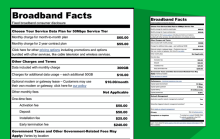


In late 2024 the Biden FCC implemented a new rule requiring that broadband providers include a “nutrition label for broadband,” making any fees, restrictions, usage caps, or other limits clear at the point of sale. The proposal was mandated by Congress as part of the 2021 bipartisan infrastructure law to try and ensure the quality of taxpayer-subsidized broadband.
The proposal was well-intentioned. It mandated a certain level of transparency on telecoms to ensure that consumers knew exactly what kind of broadband connection they were buying. The effort attempted to counter historically dodgy practices by bigger providers to jack up their advertised prices using sneaky and misleading below-the-line fees.
But four years after Congress proposed the idea, studies began making it clear that ISPs weren’t seriously adhering to the rules, and regulators weren’t really interested in enforcing them anyway.
This joint study out of York and Michigan State University found that out of 35 monitored ISPs, only sixteen properly placed labels at the point of sale as required. Not a single ISP received full marks for completely adhering to the FCC’s requirements. Only six ISPs received a full ten-star ranking for proper formatting.
“The average across the sample was 5.2/10 stars,” the authors noted. “Across the 15 large ISPs assessed the average score was 5.8/10. Across the 12 medium ISPs assessed the average was 5.4/10 stars, and the average across the eight small ISPs, the average score was 3.75/10 stars.”

A 2022 ILSR report showed that locally controlled providers like municipal networks and cooperatives were far better than the behemoth providers at offering transparent, simple, straightforward pricing.
More recently, a survey by Consumer Reports found that just 30 percent of consumers who had shopped for a broadband plan since the labels began remembered seeing them. Roughly three quarters of those who had seen the labels did find them helpful, and nearly all of those who did not see a label stated they believed such labels would have been helpful.
Not Seriously Enforced By A Trump Administration That Doesn’t Care
Much of the reporting surrounding these labels seems to skip over the fact that the U.S. government simply isn’t seriously interested in actually enforcing them.
Since creation there’s been zero meaningful intervention by U.S. regulators against ISPs that fail to adhere to the standards. And late last year the Trump FCC announced that it would be taking formal steps to significantly weaken the rules as part of the agency’s broad, frontal assault on consumer protections.
Among the key targets for the Trump FCC as it looks to weaken the broadband labels: any sort of meaningful breakdown of hidden fees embedded on consumer bills.
The Trump FCC at the direction of Brendan Carr can’t formally abandon the rules, given they were mandated by an act of Congress. But they can steadily weaken the rules, then make it clear they won’t be meaningfully enforced by an administration that has made it abundantly clear it has abandoned any interest in broadband equity and affordability.
Despite this abandonment of most broadband consumer protection standards, there remains a sort of ongoing pantomime that it’s business as usual in DC. That includes broad grumbling by industry interests still incensed at requirements they be more transparent about their broadband offerings at the point of sale.
Industry policy and trade groups representing telecoms have been filing comments with the FCC in support of the planned weakening of the rules. They’re particularly supportive of the push to eliminate disclosure requirements on sneaky, hidden fees.
“The broadband label was never intended to be an all-purpose disclosure requirement,” cable policy and lobbying group NCTA wrote in reply comments posted Wednesday spotted by Broadband Breakfast. “Rather, it is a relatively narrow tool that is intended to supplement the general transparency requirements by providing certain key pieces of information to a consumer in the familiar label format during the period of time when the consumer is shopping for a new plan.”
USTelecom agreed, calling efforts to ensure the labels are machine readable “unduly burdensome.”
Both claims are demonstrably disengenous. Tools to make text machine-readable are plentiful and cheap, and none of the providers appear to shrink at the burden of listing out the raft of fees they charge when they go to households to collect on those bills. And in a world where the largest ISPs regularly claim a preference for a functional marketplace that would allow for less government regulation, this push to veil basic information from consumers signals clearly their overwhelming desire to have their cake and eat it too.
Consumer Groups Say The Rules Are Essential For Transparency

Telecom consumer groups were quick to submit their own filings to the FCC, arguing that the rules are an integral part of transparency efforts.
“One of the FCC’s core responsibilities is to safeguard consumers’ access to clear, accurate information and meaningful choice,” the groups noted. “Consumers consistently demonstrate that they want transparency, accountability, and a real opportunity to select communications services that align with their needs and budgets.”
Consumer backlash on this front has been well warranted.
Providers like Centurylink have long abused their market dominance to impose errant surcharges like their “Internet cost recovery fee,” which serves no serious technical purpose outside of jacking up the cost of the advertised price, allowing the provider to dishonestly and falsely advertise a lower rate of monthly service. The ISP was sued by Washington state.
Other ISPs have taken to creating “regulatory recovery fees,” that attempt to blame higher costs hidden below the bills on governments, despite the fees not being government mandated. Many providers also charge “broadcast TV” and “regional sports fees” to, again, bury some of the cost of programming below the line allowing them to falsely advertise a lower rate.
Large telecoms have also routinely found themselves on the receiving end of criticism for their efforts to impose technically unnecessary usage caps and overage fees, similarly designed to drive up the cost of advertised service for users in captive, uncompetitive markets.
“The Commission’s proposal to no longer require itemized fee disclosures on the broadband labels is deeply troubling,” consumer groups wrote. “Consumers cannot meaningfully assess the true cost of service if charges are hidden without clear disclosure. Stripping away itemized fees would directly undermine the purpose of the broadband labels.”
It’s abundantly clear that the telecom lobby, with the help of the Trump administration, wants to water down the existing requirements to the point of uselessness. They’re keen to revert to an era where they could impose significant, errant surcharges on broadband access, allowing them to bury a large cost of service below the line.
“We believe that time and broader public awareness of the label could boost awareness of the label,” Consumer Reports wrote in its own comments to the FCC alongside its recent survey. “The results also raises the question of how easy it is for consumers to find the label, given that 29% of consumers shopping for broadband during the period when the label was active did not see the label.”

In many ways the nutrition labels were always a band-aid on a much bigger problem: a lack of competition in most U.S. broadband markets. Were the U.S. broadband market robustly competitive, telecoms would be more organically punished for misleading fees and high prices in the form of customer defections, pre-empting the need for regulatory hand holding.
But the larger coddling of U.S. monopoly power broadly ensures that countless U.S. markets aren’t competitive, resulting in all manner of side effects, from substandard service and privacy violations to misleading pricing and false advertising.
Regardless of whether the FCC maintains or weakens the rules, consumer groups say they remain ineffective if they’re not actually enforced.
“Maintaining the program as is, and ensuring that service providers make the label easily accessible to consumers in multiple places should be a priority,” Consumer Reports said.
Shopping for Broadband report image from the Institute for Local Self-Reliance
Anna Gomez at the October FCC Open Commission on the Broadband Nutrition Labels via YouTube