

state laws

Content tagged with "state laws"

Displaying 31 - 40 of 389

Idaho House Bill Threatens Funding Option for Community Network Investment

The open access network in Ammon, Idaho, has been celebrated as visionary and viewed as a potential model for other communities seeking competitive local Internet access markets. A bill in the state legislature, however, aims to restrict local communities' ability to reproduce the Ammon Model, or any other publicly owned network, by imposing new restrictions on local efforts.

Read the text of the bill here.

Removing a Local Funding Option

H 490, introduced by Rep. Ron Mendive from Coeur d'Alene, states specifically that local governments have the authority to take the necessary steps to develop Internet networks and to offer services to the general public. Provisions in the bill that dictate how projects are financed, operated, and managed, however, transform the bill into a "muni killer" says Bruce Patterson, Ammon's technology director.

In a recent Idaho Business Review article (subscription required), Patterson described the language of H 490:

“On its face, it claims to authorize cities to have the authority to finance, build, and operate a communications network and offer a communications service, but each of the restrictions that follow make it impossible for a city to actually do those things. It is like telling your child: ‘Sure, you can play outside, just don’t leave the house.'”


Predictions for 2020, Reviewing 2019 - Community Broadband Bits Podcast 388

It’s the end of the year once again, which means the Community Broadband Networks Initiative team at the Institute for Local Self-Reliance takes their place in front of the mic for the predictions show. In addition to offering our expectations for 2020, we review what happened this past year and compare it to the predictions we made at this time last year. Get ready for some opinions and laughs.

Once again, Communications Specialist Jess Del Fiacco and Research Associate Katie Kienbaum weigh in along with Christopher and Lisa. Our newest addition to the team, Michelle Andrews, joins for the first time this year; Michelle is our GIS and Data Visualization Researcher.

We review advancements from cooperatives, the growing interest in municipal projects and open access, and new approaches. We talk about realizations of models we anticipated and also some that took us by surprise. The crew discusses state and federal legislative changes and funding, partnerships, and Christopher even gives Comcast a break. You don’t want to miss this!

This show is 42 minutes long and can be played on this page or via Apple Podcasts or the tool of your choice using this feed

Transcript below. 

We want your feedback and suggestions for the show-please e-mail us or leave a comment below.

Listen to other episodes here or view all episodes in our index. See other podcasts from the Institute for Local Self-Reliance here.

Thanks to Arne Huseby for the music. The song is Warm Duck Shuffle and is licensed under a Creative Commons Attribution (3.0) license.

Image by Lisa Frideborg from Pixabay

Episode 4, "From Crops to Co-ops" Animated Video Series, When the Lobbyist Came to Town

The people of our imaginary community "Villageville" have gathered outside the library, inside the library, and on Grumpy Gary's lawn to talk about the problem of poor local Internet access. Now, they're making it official and letting town leaders know that they want change. It's time for Episode 4 of "From Crops to Co-ops: Small Towns Want Better Internet!"

For the past three weeks, we've seen the good folks of this fictional community grapple with the difficulties that many rural towns face. When local connectivity doesn't keep up with the needs of the community, small towns can't be competitive. In Villageville, entrepreneurs, parents, and people who just want better Internet access have been researching why connectivity in their town is so poor and what are some possible solutions. Now they're ready to take their concerns to local elected officials.

The setting in this episode is a bustling town council meeting, in which locals are gathered to discuss what to do about poor Internet access in Villageville. The special speaker tonight is an attorney from the incumbent Internet access company. Citizens are ready to ask him why, for corn's sake, his employer still hasn't updated the services they provide.

During this episode, we learn more about the influence of large corporations and their lobbyists on competition, or the lack of it. The people of Villageville have noticed some patterns in the way state laws get passed and they're ready to talk about it at the meeting. By the end of the evening, folks are inspired to do more than complain.

In addition to the educational value from this short video, you'll enjoy the campy style of the Very Amateur Acting Troupe of the Community Broadband Networks Initiative and a special guest star from the Insitute for Local Self-Reliance. We've had fun writing, acting, and editing these videos and it shows. As with all "masterpieces," artists have come and gone from the Initiative team, leaving their imprints on "From Crops to Co-ops: Small Towns Want Better Internet!"

If you haven't seen episodes 1 - 3, check them out below, read the backstories or view them all on our Videos page.

Brookings Institution Echoes Call for Local Broadband Authority

An increasing number of local governments around the country have started taking steps to improve broadband adoption and accessibility in their communities. A recent Brookings Institution article discusses the role of states in broadband deployment and adoption and how lawmakers are making efforts, but still have room for improvment.

Special Interest Lobbying Leaves an Imprint

A few states have explicitly banned municipal government from telecommunication services while others have confusing and hard-to-understand laws and regulations. Local governments have stepped up in the best interest of their residents but the imposed barriers have created tension between the local and state governments. Huge players influencing state legislation affecting broadband are the telecom lobbying interest groups. Due to their efforts, 19 states face barriers ranging from blocks to outright bans.

Brookings writes that states are a key factor in expanding high-quality Internet access to citizens and calls for a state-centered approach to improve the situation:

Instead of waiting for the stars to align in Washington, we should focus on states as an important middle ground. States have access to a range of tools and resources—independent of federal action—to promote broadband availability and adoption within their borders. The question is whether they will actually use them.

Specifically, Brookings recommends that states allow local communities to function with local telecommunications authority:

However, there is still more that states can do. Many should reconsider laws that block local efforts to expand broadband access, which limit opportunities to service populations that privately owned broadband networks will not.

Overbuilding Encourages Competition - Community Broadband Bits Podcast, North Carolina Bonus Episode One!

We're pleased to bring you the first episode from a special bonus series of the Community Broadband Bits Podcast titled "Why NC Broadband Matters." The series is a collaboration with the nonprofit NC Broadband Matters, whose focus is on facilitating the expansion of ubiquitous broadband coverage to local communities for residents and businesses. We'll be working with NC Broadband Matters on this series to develop nine more episodes that center around broadband in North Carolina.

"Overbuilding Means Providing Internet Choice: How One Small Company is Closing North Carolina's Digital Divide," is a conversation between host Christopher Mitchell and Alan Fitzpatrick of Open Broadband. The North Carolina company delivers high-quality Internet access to local communities. As Fitzpatrick notes in the interview, Open Broadband uses different types of technology, depending on what's most effective in each region. The goal is delivering quality Internet access.

logo-nc-hearts-gig.png Christopher and Alan talk about how the term "overbuilding" is now associated with waste, rather than with competition. They discuss the benefits of overbuilding and competition, problems with of lack of choice, and Alan reviews some potential long-term policy changes that could encourage investment. Alan and Christopher talk about local government involvement in promoting competition for better access to high-quality connectivity. They also touch on how lack of competition can increase the digital divide and how North Carolina could make changes to allow local governments to work with private providers in order to expand Internet access.


We want your feedback and suggestions for the show-please e-mail us or leave a comment below.

This show is 28 minutes long and can be played on this page or via Apple Podcasts or the tool of your choice using this feed, at the Community Broadband Bits page, or at the NC Broadband Matters page. We encourage you to check out other "Why NC Broadband Matters" content at the podcast feed so you don't miss future bonus content that may not appear in the Community Broadband Bits Podcast feed. 

Transcript below. 

We want your feedback and suggestions for the show-please e-mail us or leave a comment below.

Listen to other episodes here or view all episodes in our index. See other podcasts from the Institute for Local Self-Reliance here.

Thanks to Shane Ivers for the Music: What's The Angle? by Shane Ivers - https://www.silvermansound.com a Creative Commons Attribution (4.0) license.

The American Conservative Addresses Preemption, Local Authority, Better Connectivity

On October 21, 2019, The American Conservative published an article by the Institute for Local Self-Reliance's Christopher Mitchell. The article delves into how preemption affected the municipal broadband project in Lafayette, Louisiana. Christopher addresses the fact that many communities that have invested in local Internet networks have done so to fill a void in a manner that is based in self-determination. He also discusses the ways local government strengths lend themselves to the success of municipal networks and how somes states are making changes that may signal a shift in perspective.

We've reproduced the article in full here: 

Fleeced by the Telecoms and Your State is Blessing It

You may live in a place where the monopolies' lobbyists have more authority than your local government.

Joey Durel was not an obvious champion for building a municipal broadband network in his city. He owned multiple private businesses and was the head of the local chamber of commerce prior to becoming mayor of Lafayette, Louisiana, one of the most conservative urban centers in America.

In the early 2000s, like today, the big telephone and cable companies were extremely unpopular. DSL and cable Internet access were growing, but smaller markets like Lafayette always had to wait to get the speed upgrades they saw the larger cities getting. However, Bellsouth (now AT&T) and Cox were not slow to increase prices, which led to obvious customer frustration.

When first presented with the idea of a city-run network, Durel was skeptical but open minded. He looked toward the Lafayette Utility System, which already handled electricity, water, and wastewater for the community—and had a much better reputation than the cable and telephone monopolies—to make an assessment.

Durel soon determined that a city-run broadband network would provide better services at lower prices than Bellsouth or Cox, but he was under no illusion those companies would go quietly into the night. However, he probably didn’t expect such a challenge to his authority—a challenge that went right up to the state legislature to stop him. This was preemption, and Durel was about to get one heck of an education in how monopolies use the levers of government to get what they want.

Georgia Developing Maps for Better Broadband Coverage Data

Federal Communications Commission (FCC) mapping has long been criticized for inaccuracies. Now, state and local initiatives are taking up the challenge of poor broadband mapping and developing ways to create their own maps that better reflect the reality of broadband coverage in their communities. The Georgia Broadband Deployment Initiative (GBDI) recently showcased several county-level maps they’ve developed that provide the detail that FCC maps lack.

Therein the Problem Lies

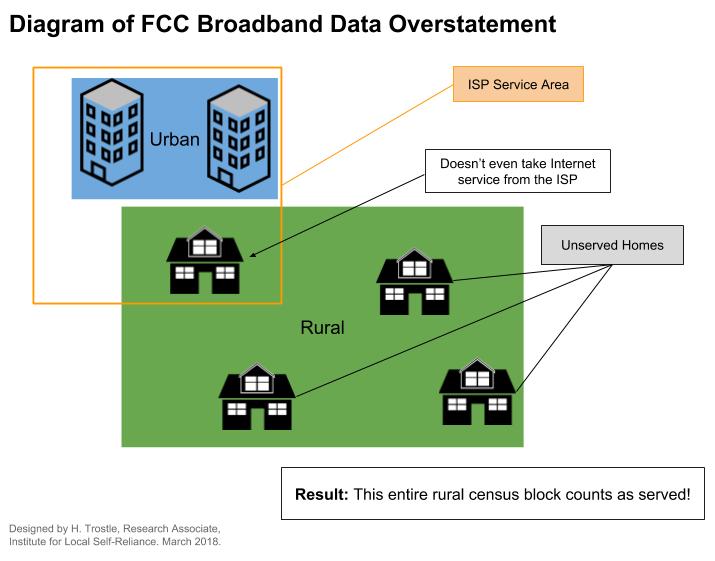
As experts have noted, FCC data on which maps are based are inadequate because their foundation is based on census blocks. If one premise in a census block can be served by an Internet access provider, that provider will report on the Form 477 that the entire census block is served. In rural areas where census blocks can be very large tracts of land, this can leave many premises indicated as served but actually unserved. 

We developed this graphic to illustrate the issue:

diagram-census-blocks-2018.jpg

When local communities apply for funding that’s based on the need to connect unserved and underserved premises, they can be disqualified due to incorrect mapping data. For local leaders who need to get their communities connected and expect to apply for grants and loans, FCC mapping can derail their funding and delay or end a proposed project.

This past August, the FCC announced that they will finally take steps to improve mapping and began seeking comments on the new Digital Opportunity Data Collection. Read the announcement [PDF].

Fixing the Maps

In Georgia, the GBDI sought to obtain information on a more granular level to obtain an accurate representation of where residents and businesses need to be connected and where they lack the kind of connectivity they need. 

Pew Puts State Broadband Policy in One Place - Community Broadband Bits Podcast 372

For community leaders, advocates, and researchers who follow broadband policy, trying to stay up-to-date on the many variations of state policy across the U.S. is a daunting task. As approaches change, the work becomes more complicated. Now, the Pew Charitable Trusts has launched a new tool that helps keep all that information sorted and accessible — the State Broadband Policy Explorer. Manager of the Broadband Research Initiative at Pew Charitable Trusts Kathryn de Wit sits down with Christopher to talk about the tool for this week's podcast.

Kathryn describes some of the challenges and discoveries her team encountered while developing the tool. She talks about the wide variations her team documented, especially in definitions, and their determination that those variations rely on who in each state determines which definitions will be used.

While working on the State Broadband Policy Explorer, Kathryn and her team were surprised to learn that, contrary to popular reporting, not as many states have established official offices of broadband deployment as they had expected.  She shares commonalities between states that they found surprising while she and Christopher ponder some of the many ways the tool may be used moving forward.

We've already bookmarked this valuable tool.

Check out the State Broadband Policy Explorer for yourself here.

This show is 27 minutes long and can be played on this page or via Apple Podcasts or the tool of your choice using this feed

Transcript below. 

We want your feedback and suggestions for the show-please e-mail us or leave a comment below.

Listen to other episodes here or view all episodes in our index. See other podcasts from the Institute for Local Self-Reliance here.

Thanks to Arne Huseby for the music. The song is Warm Duck Shuffle and is licensed under a Creative Commons Attribution (3.0) license.

Realtors a Voice for Property Owners as Colorado Advances Broadband - Community Broadband Bits Podcast 370

Multiple studies in recent years indicate that properties with fast, reliable Internet access sell faster, bring in a higher price, and are in demand by potential buyers. Properties with slow or no Internet access languish. In Colorado, where the market is competitive and broadband is available in a good portion of the state, organizations like the Colorado Association of Realtors play an important role in protecting property owners rights. This week, Vice President of Government Affairs from the Association Elizabeth Peetz stops in to talk with Christopher.

Colorado is taking positive approaches toward expanding broadband in both funding and in policies that encourage deployment. Liz talks about how the Association has become involved in legislative advocacy and how broadband has become one of their priorities. She describes how the Association has weighed in on policy changes to help ensure the rights of property owners. Liz discusses collaboration at the Capitol to reach a common goal and Colorado’s investment in funding, especially in rural areas.

Christopher and Liz also talk about what people can do to let their elected officials and community leaders see the strong link between real estate and broadband policy. Allowing the market to function as it should can make a huge difference.

Learn more about the Colorado Association of Realtors at coloradorealtors.com.

This show is 24 minutes long and can be played on this page or via Apple Podcasts or the tool of your choice using this feed

Transcript below. 

We want your feedback and suggestions for the show-please e-mail us or leave a comment below.

Listen to other episodes here or view all episodes in our index. See other podcasts from the Institute for Local Self-Reliance here.

Thanks to Arne Huseby for the music. The song is Warm Duck Shuffle and is licensed under a Creative Commons Attribution (3.0) license.

Preemption Detente: Municipal Broadband Networks Face Barriers in 19 States

Update: As of May 25, 2021, only 17 states retained their municipal barriers. Arkansas and Washington have removed theirs.

Municipal broadband networks already serve more than 500 communities across the country, but some states are trying to keep that number from growing. Nineteen states have established legal barriers or even outright bans on publicly owned networks, according to well-respected communications law firm Baller Stokes & Lide.

These state laws, often enacted at the behest of large telecom monopolies, slow the development of community owned connectivity in various ways. From Alabama to Wisconsin, states have implemented everything from direct prohibitions on municipal networks to oppressive restrictions and requirements that limit competition.

The outlook for municipal connectivity may be starting to improve though, despite incorrect reports that state-level broadband preemption increased over the past year. Baller Stoke & Lide’s list of states with restrictions on municipal broadband investment actually shrunk this year from 20 states to 19 — a result of downgrading Colorado’s SB 152 from bonafide barrier to mere annoyance. Still, barriers to community networks remain in more than a third of all states, leaving millions of Americans unconnected and tens of millions more without local Internet choice.

Bans, Blocks, and Burdens

Common approaches to preempting municipal broadband networks range from straightforward bans to confusing financial restrictions and complicated legal requirements. While some states have established one main barrier to community broadband, many more have adopted a bird’s nest of regulations that kill any possibility of municipal connectivity, if only because of the legal uncertainty created by complex and vague laws.