
public private partnerships

Content tagged with "public private partnerships"

Displaying 41 - 50 of 60

Scranton, PA Issues RFQ For Citywide Gigabit Fiber Network

The city of Scranton, Pennsylvania has issued a request for qualifications (RFQ) for vendors that may be tasked with constructing an affordable citywide fiber network. City leaders say the RFQ is the opening chapter in a bid to bring affordable broadband access to city residents long neglected by dominant regional monopolies.

According to the full RFQ, officials are looking for partner companies capable of building a citywide network capable of providing 1 Gbps (gigabit per second) download and upload speeds to all premises in the City of Scranton, as well as expanded fiber access for city municipal services and key anchor institutions.

“The City does not require municipal ownership of the fiber or a City operational role,” the RFQ states. “However, the City does request connectivity to certain City sites, a 40-year indefeasible right of use (IRU) for 12 strands of fiber for municipal noncommercial purposes throughout the network, and an access and maintenance agreement governing these strands.”

Image
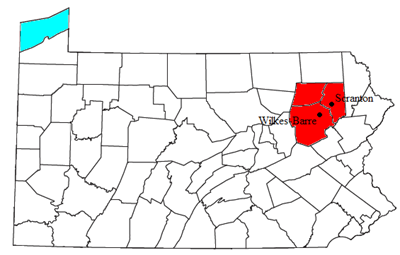
Scranton Pa map

As with so many U.S. markets, broadband competition in Scranton is hard to come by. The market is largely dominated by either Comcast Xfinity or Verizon, the latter of which has been heavily criticized by unions and consumer groups for failing to uniformly upgrade its aging DSL network to fiber, and failing to repair aging lines on a timely basis.

This lack of meaningful competition results in slow broadband speeds, spotty coverage, substandard customer service, and significantly higher prices. Even then, the city hasn’t been without signs of life in the marketplace.

West Des Moines, Iowa is a Model for Open Access Conduit Networks - Episode 573 of the Community Broadband Bits Podcast

A little more than three years ago, the city of West Des Moines, Iowa announced that it would build a citywide open access conduit system to lower the cost of new broadband deployment to facilitate better connections at lower costs for residents. GFiber (formerly Google Fiber), Mediacom, Lumen (formerly CenturyLink), and local ISP Mi-Fiber have since signed on as providers. 

This week on the podcast, Deputy City Manager Jamie Letzring and city Innovations Consultant Dave Lyons join Christopher to talk about overcoming design and legal challenges of building an infrastructure system that remains relatively unique, and the commitment the city has made to reach economically disadvantaged households to make sure everyone has a quality and affordable connection. Finally, they share a little about how the city has been taking steps to use the new conduit system to supplement its already-robust fiber network for government facilities, smart-city initiatives, and more.

This show is 36 minutes long and can be played on this page or via Apple Podcasts or the tool of your choice using this feed

Transcript below.

We want your feedback and suggestions for the show-please e-mail us or leave a comment below.

Listen to other episodes here or view all episodes in our index. See other podcasts from the Institute for Local Self-Reliance here.

Thanks to Arne Huseby for the music. The song is Warm Duck Shuffle and is licensed under a Creative Commons Attribution (3.0) license.

Lancaster PA Revives Public Private Partnership Plans With Shentel’s Glo Fiber

Lancaster, Pennsylvania has revitalized the city’s long percolating plan for a municipal broadband network, this time via a public-private partnership (PPP) with Shenandoah Telecommunications Company (Shentel). The city’s quest for more affordable, reliable broadband is a quest that’s taken the better part of a decade to finally come to fruition.

Lancaster city officials recently announced that they’d selected Shentel with an eye on ensuring uniform broadband availability to the city of 57,000.

“In 2022, the City issued an RFP for a partner to achieve stated goals, which received five responses, and led to the selection of Shentel,” the city said. “The contract will result in Shentel installing fiber at its sole cost to provide service to 100% of the city’s residents. Shentel plans to commence design and construction immediately upon execution of the final agreement.”

According to Lancaster officials, the city hired CTC Technology & Energy Engineering & Business Consulting to evaluate the city’s needs. The determination to proceed with a PPP with Shental was driven, in part, by the historic broadband grant opportunities being created thanks to the 2021 Infrastructure Investment and Jobs Act (IIJA), and the American Rescue Plan Act, the latter of which provided $39.5 million to the city.

Berthoud, Colorado Eyes Community Broadband Options

Berthoud, Colorado, population 11,717, is the latest Colorado community to explore community broadband alternatives to expand public access to affordable fiber. Currently in the process of crafting a request for quote (RFQ), the city tells ILSR it hopes to make its final determination by November and have a preliminary plan in place by the end of the year.

Originally, Berthoud had planned on forming a coalition with three neighboring Colorado towns (Johnstown, Mead and Milliken) in a bid to expand access. That plan involved striking a memorandum of understanding (MOU) with Lincoln, Nebraska based Allo Communications, to deliver fiber to every address within three years.

But city leaders say the original plan wasn’t meant to be.

“The four communities did not strike a deal with Allo,” Berthoud Business Development Manager Walt Elish told ILSR. “We could not come to terms. Since then, we have looked at other options, including a town-owned network.”

Image
Berthoud Welcome Sign

As with many towns and counties, the high cost of a municipally owned broadband network has the city examining different options, including a potential public private partnership (PPP) with existing providers. PPPs are increasingly common but can have their downsides, including less municipal control over pricing or the potential trajectory of the finished network.

Decorah, Iowa Inches Closer To City-Owned Fiber Build With Plan To Reach Finish Line

Decorah, Iowa is moving forward on a long-percolating plan to expand the city’s core fiber ring to provide affordable broadband access to long-neglected residents and businesses.

While the project has been discussed for years, local officials tell ISLR the project gained renewed momentum during peak COVID, and is creeping closer to launch.

Contracts are still being finalized as the city hopes to spend somewhere around $12 to $15 million to deliver fiber to all 3,000 potential subscriber locations. The full project would take about three years to deliver fiber to all 7,740 city residents, with the first subscribers potentially coming online this fall.

Image
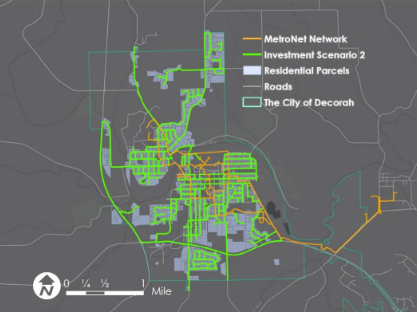
Decorah Metronet fiber map

“Decorah has been in pursuit of fiber to the premises for the last 8 to 9 plus years and we finally have broken through some of our challenges on how to get to the finish line,” Chopper Albert, Decorah IT Director told ISLR.

According to Albert, Decorah’s recent progress is thanks in part to new City Manager Travis Goedken, who has long advocated for expanding the city’s existing fiber network to drive affordable fiber access citywide.

New City Management Team Pushes Forward  

Since 2013 the city has owned an 11-mile core fiber network, dubbed the Decorah MetroNet. MetroNet was born out of frustration after a major flood in 2008 across much of Iowa resulted in prolonged communications network outages.

MetroNet (not to be confused with the Indiana-based ISP that goes by the same name) currently provides access to Luther College and 18 additional government buildings and anchor institutions.

Dublin, Ohio, altafiber Strike Public Private Partnership For Citywide Fiber Network

The city of Dublin, Ohio has struck a public private partnership with altafiber (formerly known as Cincinnati Bell) to build a new citywide fiber network city leaders hope will finally deliver the kind of affordable, next-generation broadband access Dublin’s 50,000 residents have long been clamoring for.

In 2022 the city issued a request for proposal (RFP) looking for a partner on a citywide network build. At a June 26 meeting, the Dublin city council voted unanimously to select altafiber from a roster of seven potential applicants.

According to the arrangement, construction of the city network is expected to begin in Spring of 2024, with every premise in Dublin passed by a 10 gigabit per second (Gbps) capable network within three years. A select number of undetermined customers are expected to be brought online sometime in the latter part of next year, officials tell ILSR.

A city press release notes that altafiber will invest $35 million in the fiber network, as well as potentially providing the infrastructure necessary to help the city support either public Wi-Fi initiatives or a City Innovation Center. The city says it will pay about $6 million to bury the necessary fiber infrastructure citywide.

Mountain Connect 2023 Climbs Into The BEAD Era and Beyond

Just as the BEAD program becomes a major driving force in the ongoing broadband-ification of America, hundreds of local network builders, operators, thought-leaders, and policy-makers will descend on Denver, Colorado for Mountain Connect 2023 early next month.

Themed this year as “Collaborate, Integrate, Innovate,” the agenda is packed with plenty of BEAD-centered panels but also offers a buffet of other focused forums that will cover emerging technologies, local network case studies, and larger community development concerns.

Spots for the conference, which will be held August 7-9 at the Denver Sheraton, are filling up fast. But, would-be attendees can still register here.  

As with the previous eight annual Mountain Connect conferences, this year’s three-day conference in the Mile High City will bring together a veritable who’s-who of people working in the trenches of a national effort to bring high-speed Internet access to the tens of millions unserved and underserved households and businesses across the U.S.

Among the conference participants will be representatives from 15 state broadband offices, which accounts for more than $15 of the $42.5 billion in BEAD funds that will be allocated by states in the form of competitive state grants.

ILSR Community Broadband Networks Initiative Statement on BEAD Allocations Announcement

Today, the National Telecommunications and Information Administration (NTIA) announced how it will allocate $42.5 billion in BEAD funds to all 50 states, the District of Columbia, and five territories.

At an “Investing in America” event today at the White House, President Biden noted that this “biggest investment in high-speed Internet ever” was noteworthy “because for today’s economy to work for everyone, Internet access is just as important as electricity was, or water or other basic services.”

And in a press statement, Assistant Secretary of Commerce for Communication and Information Alan Davidson, who is overseeing the NTIA program, added: “This is a watershed moment for millions of people across America who lack access to a high-speed Internet connection. Access to Internet service is necessary for work, education, healthcare, and more. States can now plan their Internet access grant programs with confidence and engage with communities to ensure this money is spent where it is most needed.” 

Our initial reaction is as follows:

"The BEAD allocations amount to the largest ever single federal investment to deploy needed Internet infrastructure across the United States. The question now is: how many states will maximize the moment and be inclusive of municipal broadband, public-private partnerships, and community-driven initiatives vs. those states who will simply dole out the funds to the big monopoly providers and hope for the best?”

Massachusetts Broadband Coalition Is Formed With Focus on Public Private Partnerships

Representing 26 towns across Massachusetts, from Cape Cod to Chelsea, an informal group of mostly town officials have formed the Massachusetts Broadband Coalition in search of a way out of a broken broadband market to ensure everyone in their individual communities has access to high-speed Internet.

The newly-formed coalition has recently started to meet monthly to share information about what kind of alternatives there might be, or could be, to the big cable monopoly provider in their towns.

Questioning Monopoly Rules Without Reinventing the Wheel

The coalition, which held its first meeting in January, was convened by Robert Espindola, Fairhaven Selectmen and the board’s liaison to the town’s broadband study committee. And though the coalition is “in its infant stages,” as Espindola recently shared with ILSR, one common theme has emerged from each participating member.

“No doubt the common theme is: there’s no competition,” he said. “That’s how it started in Fairhaven for us. When we were negotiating our (franchise) agreement with Comcast, people in the community were asking: ‘why can’t we get competition?’”

When we first came together it was really more just to learn from each other, what each community was doing. And we wanted to see if we could find ways to work more efficiently and not reinvent the wheel.

Indeed, communities across the nation have set out to tackle local connectivity challenges head-on with a community broadband approach without having to reinvent the wheel. Some have built, or are building locally-controlled, publicly-owned open-access fiber networks to create the conditions for competition. Other cities and towns are building, maintaining, and operating their own successful municipal broadband networks. While still others have opted to enter into a public-private partnership with an independent ISP to build out a community-wide network.

Public-Private Partnerships Come into Focus

Boulder, Colorado Gets Ready to Roll on Citywide Fiber Network

With the construction of its 65-mile dark fiber backbone nearly complete, city officials in Boulder, Colorado are now ready to move into the next phase of their plan: test the waters for a partnership with private or nonprofit Internet service providers (ISPs) to build out a citywide fiber network to deliver last mile service to the city’s 104,000 residents and businesses.

Last week, the city issued a Request for Information (RFI) “to gauge the interest of for-profit and nonprofit entities in forming a public–private partnership (PPP) with the city to make Gigabit per second-class bandwidth available to all Boulder homes and businesses.”

“As we prepare for further City Council discussion on a future community broadband operating model, it is imperative that we understand the market potential for a PPP (public-private partnership) to meet the city’s goals related to connectivity. We look forward to responses that consider a variety of business models to share technological and operational responsibilities and financial risk with the city in innovative ways,” Innovation and Technology Deputy Director Mike Giansanti said in a press statement when the RFI was issued.

The city is looking for a partner or partners that will come to table with new ideas, create competition, and either fully fund or share costs.

Having prioritized a city-wide fiber-to-the-home (FTTH) build, city officials have identified two main goals: serve the growing demand for “affordable, reliable, and sophisticated broadband technology; and support a thriving business environment.”

Responses to the RFI are due by May 19 at 4 pm MDT.

City officials say they will consider a range of construction and operation designs as well as a variety of ownership models as the City Council will likely vote on the path forward and the execution of a contract sometime this year.