lobbying

Content tagged with "lobbying"

Related Topics
Displaying 141 - 150 of 166

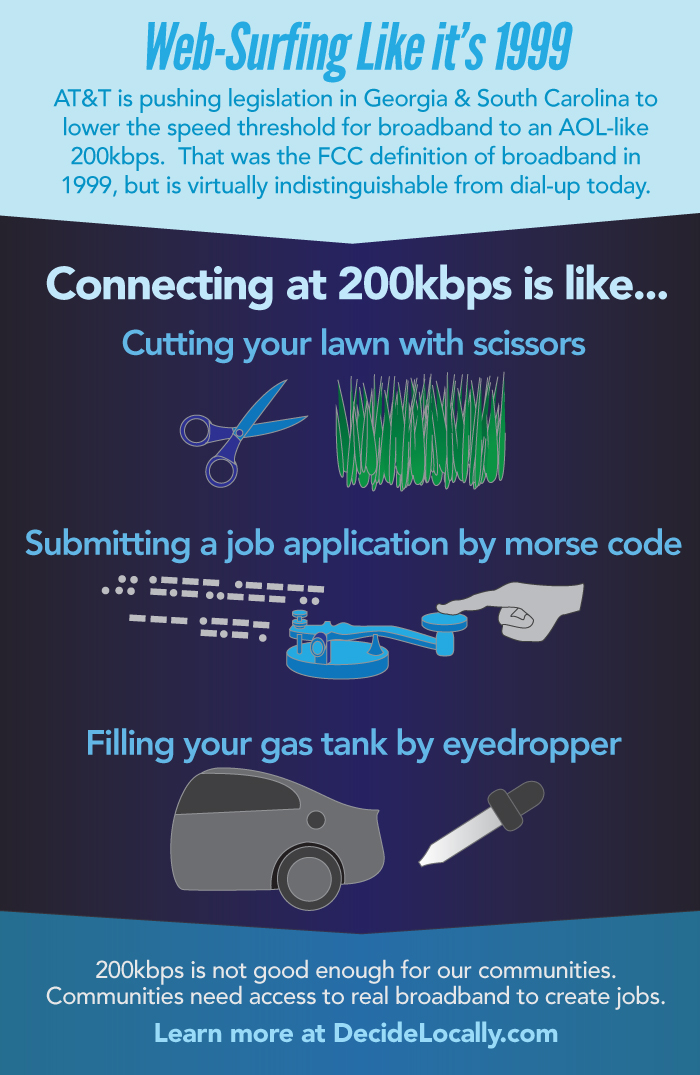
Media Coverage Roundup: Georgia AT&T Bill to Kill Community Broadband

In the wake of a bill in Georgia to revoke local authority and substitute it with state say-so over whether a community can build a broadband network, multiple outlets have covered the situation. As usual, Stop the Cap! was quick on the ball, offering original in-depth commentary. Phil digs into the campaign cash history to find the real motivations behind this bill:
Rogers’ legislation is exceptionally friendly to the state’s incumbent phone and cable companies, and they have returned the favor with a sudden interest in financing Rogers’ 2012 re-election bid. In the last quarter alone, Georgia’s largest cable and phone companies have sent some big thank-you checks to the senator’s campaign:
  • Cable Television Association of Georgia ($500)
  • Verizon ($500)
  • Charter Communications ($500)
  • Comcast ($1,000)
  • AT&T ($1,500)
A review of the senator’s earlier campaign contributions showed no interest among large telecommunications companies operating in Georgia. That all changed, however, when the senator announced he was getting into the community broadband over-regulation business.
Phil also refutes the supposed failures cited by those pushing the bill. Not only do such stories misrepresent what really happened, some actually cite EPB's incredible 1Gbps service as demonstrating that munis are out of touch. What else would you expect from the Heartland Institute, which made its name fighting against the radical claim that cigarettes are linked to cancer? Government Technology's Brian Heaton also covered the story in "Georgia Community Broaband in Legislative Crosshairs."
In addition, Mitchell [me] said that SB 313’s requirement of the public entity paying the same taxes or the same cost of capital as the private sector is another red herring.

Georgia Legislature to Revoke Local Authority to Build Networks

The Georgia Senate is considering SB 313, a bill that would overrule local decision-making authority in matters of broadband. Even as connections to the Internet have become essential for communities, the Georgia Legislature is poised to make it harder for communities to get the networks they need. We saw very similar language in North Carolina pass last year after many years of lobbying by Time Warner Cable and CenturyLink. These massive companies use their lobbying clout to stop any form of competition they could face, and they are presently threatened by the examples of many communities that have built incredible next-generation networks. For instance, see the thousands of new jobs in Chattanooga that are credited to its community fiber network. Community networks spur competition -- it is why Chattanooga got Comcast's xfinity service before Atlanta, despite Atlanta having long been prioritized over Chattanooga previously. It is why Cox Cable, which is headquartered in Atlanta, launched its upgrades in Lafayette, Louisiana -- they felt the competition pressure from a community fiber network. Bill supporters are already claiming that this is just an attempt to level the playing field:
"The private sector is handling this exceptionally well," Rogers said. "What they don't need is for a governmental entity to come in and compete with them where these types of services already exist.

Legislation Alert: Washington Considers Community Broadband Bill

Last year we noted that a bill to expand local authority to invest in publicly owned broadband networks would return in 2012. HB 1711 is in Committee and causing a bit of a stir. "A bit of a stir" is good -- such a reaction means it has a chance at passing and giving Washington's residents a greater opportunity to have fast, affordable, and reliable access to the Internet. Washington's law presently allows Public Utility Districts to build fiber-optic networks but they cannot offer retail services. They are limited to providing wholesale services only -- working with independent service providers to bring telecom services to the public. Unfortunately, this approach can be financially debilitating, particularly in rural areas. Building next generation networks in very low density areas is hard enough without being forced to split the revenues with third parties. Last year, House Bill 2601 created a study to examine telecommunications reform, including the possibilty of municipality and public utility district provisioning. The University of Washington School of Law examined the issues and released a report [pdf] that recognizes the important role public sector investments can play: U Washington Law School
Broadband infrastructure is this century’s interstate highway system: a public investment in an infrastructure that will rapidly connect Washington’s citizens statewide, nationally, and internationally; fuelling growth, competition, and innovation. Like highway access, the path to universal broadband access varies with the needs of the local community. Our primary goal is to expand broadband access. We believe allowing municipalities and PUDs to provide broadband services addresses the most significant hurdles to broadband expansion: the high cost of infrastructure. In conjunction with a state USF, PUDs and municipalities are well placed to address the needs of their consumers. A secondary goal is to promote a competitive marketplace.

DC Revolving Door, Comcast, and Campaign Finance Reform

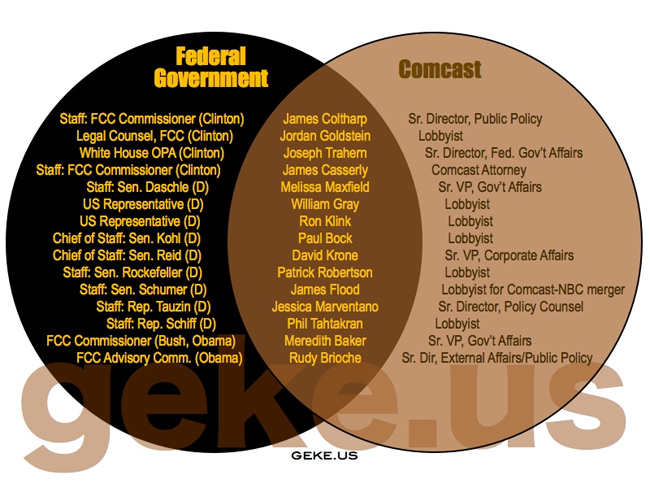
One of the reasons community broadband networks face so many unique hurdles (often created deliberately by states in response to cable/dsl lobbying) is because of the many ways in which campaign finance corrupts our national and state governments. Community broadband networks are focused on meeting community needs, not sending lobbyist armies into Washington, DC, and state capitals (though one of things we do at the Institute for Local Self-Reliance is offer help to those that do push pro-community agendas in these areas). To understand why DC is so focused on furthering the corporate agendas of AT&T, Comcast, Time Warner Cable, and others, is to understand the revolving door. (Also, understanding capture -- which we have explained previously.) In short, many of the people who make decisions about telecommunications policy in DC have worked, will work, or are presently working for the massive companies that effectively control access to the Internet in most of America's communities. The good folks at Geke.US have created the following Comcast Venn Diagram illustrating a small piece of the DC revolving door. Comcast and DC's revolving door Venn Diagram Reforming this system is a deep, seemingly intractable problem. But for those looking for answers, a good place to start is with the work of Lawrence Lessig. I just finished his Republic, Lost, which offers a grand tour of the problems resulting from the present system of campaign finance. You can also see a number of his presentations here. His organization, the Rootstrikers aim to get to the root of problems rather than being distracted by trying to fix symptoms of deeper problems. This is precisely what we do with our focus on community networks. Many focus solely on resolving digital divide issues, improving rural access to the Internet, lowering the cost of broadband, or the various other problems that result from narrowly-focused private corporations owning and controlling essential communications infrastructure with inadequate regulations.


New Year, Same Lame Cable and DSL Monopolies

It's a new year, but most of us are still stuck with the same old DSL and cable monopolies. Though many communities have built their own networks to create competition and numerous other benefits, nearly half of the 50 states have enacted legislation to make it harder for communities to build their own networks. Fortunately, this practice has increasingly come under scrutiny. Unfortunately, we expect to see massive cable and telephone corporations use their unrivaled lobbying power to pass more laws in 2012 like the North Carolina law pushed by Time Warner Cable to essentially stop new community broadband networks. The FCC's National Broadband Plan calls for all local governments to be free of state barriers (created by big cable and phone companies trying to limit competition). Recommendation 8.19: Congress should make clear that Tribal, state, regional and local governments can build broadband networks. But modern day railroad barons like Time Warner Cable, AT&T, etc., have a stranglehold on a Congress that depends on their campaign contributions and a national capital built on the lobbying largesse of dominant industries that want to throttle any threats to their businesses. (Hat tip to the Rootstrikers that are trying to fix that mess.) We occasionally put together a list of notable achievements of these few companies that dominate access to the Internet across the United States. The last one is available here. FCC Logo As you read this, remember that the FCC's National Broadband Plan largely places the future of Internet access in the hands of these corporations.

AT&T's Lobbying Power

A deep thank you to Public Knowledge for their throwing back the curtain on AT&T's lobbying operation in the attempted takeover of T-Mobile. Whenever the discussion of public v. private arises, the focus is inevitably on the advantages that the public sector supposedly has over the private providers. We have documented these "level playing field" claims and refuted them. When I recently visited Lafayette, the head of the public utility told me that in fighting the Local Government "Fair" Competition Act in 2005 (meant to prohibit competition against incumbent cable and phone companies) Lafayette hired one lobbyists and the incumbents hired all the rest. In Tennessee, Chattanooga hires one lobbyist to defend itself from many lobbyists -- in October I learned that AT&T has already registered 26 lobbyists for the 2012 session in Tennessee. Not only do major national companies like AT&T already have most of the advantages in the marketplace, they spend mightily on lobbyists and campaign contributions to make sure it stays that way. One of the reasons I am an enthusiastic supporters of Larry Lessig's Rootstrikers campaign is because the power of big telephone and cable companies likes in their ability to influence policy and elections, not in the quality of their services in the marketplace. Back to Public Knowledge -- they researched AT&T's push for th T-Mobile merger and found AT&T hired three former US Senators, four former House members, dozens of staffers from both parties, and spent over $40 million in advertising to push its bid to reduce competition in the wireless market.
“This information gives us a more complete picture of the vast lobbying and advertising resources AT&T has dedicated to trying to ram through this takeover,” said Harold Feld, legal director of Public Knowledge. “It is even more impressive that while many members of Congress have ignored the facts and are backing this takeover, the Justice Department and the Federal Communications Commission have not. It is clear that the data the DoJ and FCC have compiled on this deal will negate all of the money AT&T has spent to mislead policymakers and the public.”

How the FCC Killed Broadband Competition

Dane Jasper, the CEO of Sonic.net, one of the few ISPs to survive the death of broadband competition over the past ten years, wrote about "America's Intentional Broadband Duopoly."  It is a short history of how the FCC's flawed analysis (helped along by incredible amounts of lobbying dollars, no doubt).

He starts by asking when the last time anyone offered to sell you broadband over power lines (BPL).  The FCC decided that cable and telephone companies shouldn't have to share their wires (which are a natural monopoly) with competitors (creating an actual marketplace for services) because BPL, satellite, and wireless would put so much competitive pressure on DSL and cable.  FAIL.

Then, in the Brand X decision, they ruled that Cable would not be required to allow competitors to lease their lines either. The FCC did this by reclassifying broadband Internet access as an “information service”, rather than a “telecommunications service”. As a result, common carriage rules could be set aside, allowing for an incumbent Cable monopoly. This decision was challenged all the way to the supreme court, who ruled in 2005 that the FCC had the jurisdiction to make this decision. To close out Powell’s near-complete dismantling of competitive services in the U.S., the FCC took up the issue of ISPs resale of DSL using the incumbent’s equipment, also known as wholesale “bitstream” access. If Cable is an information service under Brand X, why shouldn’t Telco have the same “regulatory relief”? The result: the FCC granted forbearance (in other words, declined to enforce its rules) from the common carriage requirements for telco DSL services.
For those who are thinking that wireless is finally competitive with cable and DSL, don't forget that while 4G appears much faster (because so few people are using it presently), it still comes with a 2GB monthly cap. So if you want to do something with your connection aside from watching one movie a month, 4G is not competitive with a landline connection.

Senate to Vote on Giving Internet Governance to Comcast, AT&T

Update: The Senate voted against turning the Internet over to Comcast, AT&T, and other major carriers. How did your Senators vote? The US Senate began debating network neutrality yesterday - the historic governing principle of the Internet that ISPs should not be allowed to tell their users where they may or may not go and should not prioritize some connections over others merely because it generates more revenue for the ISP. As Al Franken has said several times, this is the 1st amendment for the Internet - protecting everyone's speech. It prevents a few massive companies (or even local governments where they offer access to the Internet) from exerting too much influence over what subscribers are able to do on the Internet. Unfortunately, many Senators are campaigning against this principle, in part because they have been misinformed as to what it means and in part because they are getting a ton of campaign cash from corporations that recognize how much more profitable they would be if they could charge users extra to go to YouTube. There will be a vote today on a resolution of disapproval for the mild network neutrality rules proposed by the FCC last December (which the FCC Chairman chose to water down in part because he thought it would be less controversial -- FAIL). We would like to recognize some of those who have stood up to protect the open Internet, starting with Free Press. The American Sustainable Business Council authored an op-ed:
The truth is that if we want to make sure small businesses can grow with the assistance of broadband, the Internet must remain open.

Visiting Elected Officials Makes a Difference

Before Josh Levy and five other activists met with Yvette Clarke (D-NY), she had signed a letter of support for the AT&T merger with T-Mobile. After a one hour meeting, just after the Justice Department came out against the merger as anti-competitive, she agreed "This deal must be stopped." This is a great story that goes far beyond AT&T's attempt to monopolize the airwaves. It is a refreshing story for those of us who have been watching in despair, wondering if the vast funds of big companies will doom our democracy. It is a reminder that we cannot give up but have to make sure we are still reaching out to elected officials to ensure they hear from real constituents rather than only from inside-the-beltway lobbyists. On our key issue, community networks, elected officials too rarely hear from constituents. It is a technical issue that intimidates many. But we must take some time to reach out, educate, and make sure they know how impmortant it is to all of us that local communities maintain self-determination in the digital age. We cannot wait to reach out until the bad bills are pushed into the light of day -- we need to contact elected officials early in order to build relationships and being the education process. Elected officials are also intimidated by the technology, something that lobbyists use with their "just trust us" approach while bad-mouthing any alternative. Take heart, write in, talk to your reps, and if you are so bold, set up face to face meetings. Feel free to ask us for advice if you want -- and if you are in Minnesota, feel free to invite us along.