
federal funding

Content tagged with "federal funding"

Related Topics
Displaying 41 - 50 of 132

Join Us Thursday at 5pm ET for Episode 29 of the Connect This! - New Year, New Rules

In this episode of the Connect This! Show, co-hosts Christopher and Travis Carter (USI Fiber) are joined by Kim McKinley (UTOPIA Fiber) and Doug Dawson (CCG Consulting) to kick off the new year.

The panel will dig into the recently released Final Rules released by the Treasury on use of the Rescue Plan dollars, before diving into some regional developments in New York and Los Angeles. They'll end by sharing some thoughts about how the broadband landscape is likely to shape up during the coming year.

Subscribe to the show using this feed on YouTube Live or here on Facebook Live, or visit ConnectThisShow.com

Email us broadband@muninetworks.org with feedback and ideas for the show.

Watch here, or below.

What Does All This Money Mean? - Bonus Episode 15 of the Community Broadband Bits Podcast

For episode 15 of our bonus series, “Why NC Broadband Matters,” Christopher Mitchell is joined by Catharine Rice (Co-founder of NC Broadband Matters and  Project Manager at the Coalition for Local Internet Choice) and Doug Dawson (Owner and President of CCG Consulting) dig into what all these different pots of federal funding mean communities across the country. They talk about the communities that have already announced plans to use the funds for municipal networks. They offer advice and direct communities in the early stages of planning to resources on how to use the funds effectively.  

This show is 38 minutes long and can be played on this page or via Apple Podcasts or the tool of your choice using this feed, or at the NC Broadband Matters page. We encourage you to check out other "Why NC Broadband Matters" content at the podcast feed so you don't miss future bonus content that may not appear in the Community Broadband Bits Podcast feed.

Transcript below. 

We want your feedback and suggestions for the show-please e-mail us or leave a comment below.

Listen to other episodes here or view all episodes in our index. See other podcasts from the Institute for Local Self-Reliance here.

Thanks to Arne Huseby for the music. The song is Warm Duck Shuffle and is licensed under a Creative Commons Attribution (3.0) license.


A Look Back on the Biggest Broadband Stories of 2021 - Episode 486 of the Community Broadband Bits Podcast

On this week’s episode of the Community Broadband Bits Podcast, Christopher Mitchell invites the Community Broadband Networks Initiative staff onto the show to talk about what they believe were some of the biggest broadband stories of 2021. The group reminisces about what has been one of the most pivotal years for broadband infrastructure investment and community-led solutions to the digital divide, and ruminates on what’s to come in 2022.

This show is 60 minutes long and can be played on this page or via Apple Podcasts or the tool of your choice using this feed

Transcript below. 

We want your feedback and suggestions for the show-please e-mail us or leave a comment below.

Listen to other episodes here or view all episodes in our index. See other podcasts from the Institute for Local Self-Reliance here.

Thanks to Arne Huseby for the music. The song is Warm Duck Shuffle and is licensed under a Creative Commons Attribution (3.0) license.

Benton Institute Releases Report on Community-Led Projects Aiming To Bridge the Digital Divide

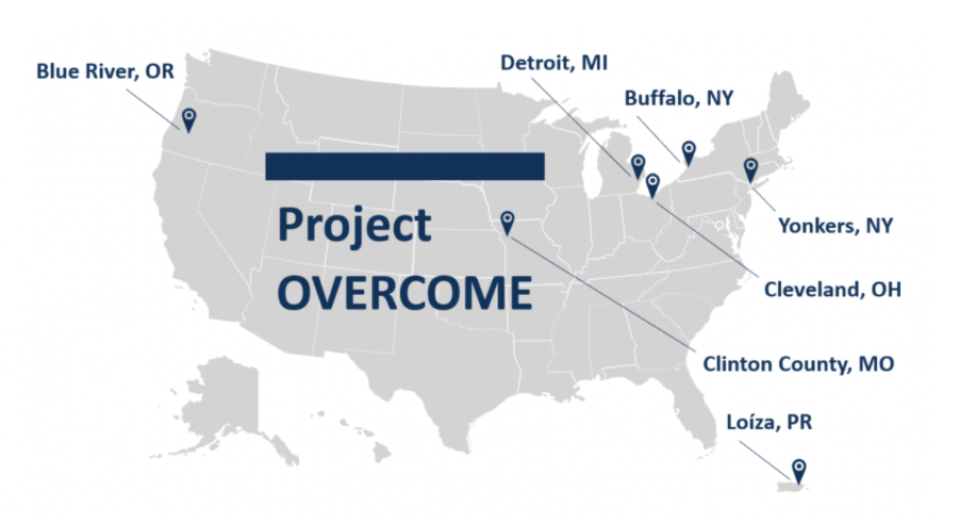
In an effort to facilitate the deployment of innovative broadband solutions in underserved areas - both urban and rural - the nonprofit organization US Ignite recently partnered with National Science Foundation (NSF) and Schmidt Futures to launch ProjectOVERCOME. 

The Benton Institute released a report in November naming the seven communities that the project will focus on: Blue River, OR; Buffalo, NY; Cleveland, OH; Clinton City, MO; Detroit, MI;Loiza, Puerto Rico; and Yonkers, NY.

Image

In the report that was released, Benton spotlights each community and the technologies they will use. The technologies include Citizens Broadband Radio Service (CBRS), fiber, fixed wireless and hotspots. 

According to the initiative's guidelines, these communities were chosen because of how they vary in population, demographics, regions of the country, housing, and industry. The program will work with these communities to experiment in deploying innovative Internet connectivity solutions on a 12-month timeline. 

The projects will collectively result in not only education, outreach, and local broadband organizing development efforts, but provide direct connectivity to more than 700 households.

For example, in a CBRS deployment in New York,

USDA ReConnect Round 3 Rewards High-Speed, Open Access, Locally Driven Networks

The USDA’s ReConnect program has disbursed more than $1.5 billion since its inception in December 2018. On the whole, the USDA seems to have done a better job than the FCC of leading to new broadband infrastructure which is fast, affordable, and locally controlled. Much of the money it has given out has gone to community-driven solutions, with Tribes, electric and telephone cooperatives, and local governments applying for and winning awards. The program has also seen partnerships between counties and other public as well as private entities. 

But there’s a lot to like about the newest round of funding, totaling $1.2 billion more (representing a full 80 percent of all money given out so far). The application process for Round 3 began at the end of November, with applications due by February 22, 2022.

Announced at the end of October, the new scoring metric represents a significant step in the right direction, increasing speed definitions on both sides of the application. But there are other things to like here as well. 

Collaboration Across the Commonwealth Advances State Broadband Goals

Across the Commonwealth of Virginia, local governments, county broadband authorities, cooperatives, and private Internet Service Providers are leveraging the influx of American Rescue Plan funds to reach the state’s goal of achieving universal access to high-speed Internet connectivity by 2024.

With $850 million in state appropriations for broadband connectivity and $1.15 billion in local government and private service providers’ funding matches, the state is on track to invest $2 billion dollars toward broadband expansion in the coming years, and is currently investing in broadband expansion projects at record levels.

In August, Gov. Ralph Northam and the Virginia State Legislature agreed to devote $700 million of the state’s $4.3 billion in American Rescue Plan funds to expand access to broadband. The $850 million investment the state has announced will consist mostly of American Rescue Plan aid. The funds will be administered by the Virginia Telecommunication Initiative (VATI), which distributes grants to public-private partnerships to extend broadband service to unserved regions of the state, or areas that lack access to Internet service delivering connection speeds of at least 25/3 Megabits per second (Mbps).

Public-Private Partnerships Deep in the Heart of Virginia

From the marsh grasslands making up Virginia’s Eastern Shore, across the three peninsulas carved out by the Chesapeake Bay, all the way to the Shenandoah Valley in the West, a diverse array of regional partnerships have formed between Virginia’s local governments, electric and telephone cooperatives, and private ISPs as broadband expansion efforts continue to advance in 2022.

Cheers for Madison County Effort to Bring Fiber to the Farm and Beyond

Situated in rural Central New York, Madison County (pop. 71,000) was named in honor of America’s fourth President, James Madison. But it was the region’s history of growing hops for beer that really put the county on the map. By 1859, New York state produced 80 percent of all hops grown in the U.S., thanks in no small measure to the crops in Madison County.

Today, while the community still celebrates this history at the annual HopFest, county leaders are now focused on the future and how to ensure the region does not get left in the dust by missing out on an essential economic development ingredient: high-speed Internet connectivity. In a modern economy, broadband infrastructure is indispensable in general terms and specifically for the efficient operation of precision agriculture

With a focus now on the digital landscape, Madison County planners have embarked on a project to bring fiber to the farm as well as thousands of other other residents and businesses across the region.

What really got things off the ground, or rather into the ground, was the county being awarded a USDA ReConnect grant last year. Madison is the only county in United States to directly receive ReConnect grant funding in FY 2020.

In July, the USDA announced it would grant $10.1 million in ReConnect funds in support of the project to deploy a fiber-to-the-premises network that will connect 2,170 people, 50 farms and 30 businesses to high-speed broadband in Madison County as part of a larger countywide project. The county will work with private Internet Service provider (ISP) Empire Access to eventually bring fiber connectivity to nearly 7,600 households in the region.

A Fertile Land For Fiber

Two years ago, Madison County officials decided to make broadband a top priority. The most underserved area of Madison is in the southern part of the county, where DSL and satellite were primarily offered, with limited addresses eligible for cable access. 

Join Us Live on Thursday at 5pm ET To Talk About Treasury Infrastructure Rules, Digital Redlining, and Microtrenching - Episode 20 of Connect This!

On Episode 20 of the Connect This! Show, co-hosts Christopher and Travis Carter (USI Fiber) will be joined by Doug Dawson (CCG Consulting) and Kim McKinley (UTOPIA Fiber) live on both YouTube and Facebook to talk about a grab-bag of issues including the new Treasury rules for the $10 billion in broadband infrastructure funding, digital redlining, and microtrenching. 

Join us for the live show Thursday, September 30th, at 5pm ET. 

Subscribe to the show using this feed, or visit ConnectThisShow.com

Email us broadband@muninetworks.org with feedback, ideas for the show, or your pictures of weird wireless infrastructure to stump Travis.

Watch here on YouTube (or below), or here on Facebook Live.


A Community Guide to Federal Broadband Funding Opportunities
Update, 1/22/22: Common Sense Media has released an easy-to-read, comprehensive guide to federal broadband funding opportunities. Read it here.

In response to the Covid-19 pandemic, Congress and the Biden Administration passed two federal stimulus relief packages with historic levels of funding for programs devoted to advancing digital equity – the American Rescue Plan Act (ARPA) and the Consolidated Appropriations Act (CAA). 

In early August, legislators in the U.S. Senate passed the Infrastructure Investment and Jobs Act, a $1.2 trillion infrastructure package which continues many of the federal programs started by previous relief packages and includes $65 billion more for expanding high-speed Internet infrastructure and connectivity. Members of Congress returned from their summer break on September 20th and U.S. House Representatives are expected to vote on the infrastructure relief bill, which enjoys bipartisan support, on September 30th.

This guide consolidates the different funding opportunities made available through various relief packages to assist communities interested in accessing federal funds to expand broadband infrastructure and digital inclusion services. It updates ILSR’s Community Guide to Broadband Funding released in April of 2021, which describes programs established under ARPA and CAA in more detail, provides additional resources and answers FAQs.

Important upcoming deadlines are bolded throughout this guide. 

Infrastructure Investment and Jobs Act – Pending