
affordability

Content tagged with "affordability"

Related Topics
Displaying 171 - 180 of 267

Decorah, Iowa Inches Closer To City-Owned Fiber Build With Plan To Reach Finish Line

Decorah, Iowa is moving forward on a long-percolating plan to expand the city’s core fiber ring to provide affordable broadband access to long-neglected residents and businesses.

While the project has been discussed for years, local officials tell ISLR the project gained renewed momentum during peak COVID, and is creeping closer to launch.

Contracts are still being finalized as the city hopes to spend somewhere around $12 to $15 million to deliver fiber to all 3,000 potential subscriber locations. The full project would take about three years to deliver fiber to all 7,740 city residents, with the first subscribers potentially coming online this fall.

Image
Decorah Metronet fiber map

“Decorah has been in pursuit of fiber to the premises for the last 8 to 9 plus years and we finally have broken through some of our challenges on how to get to the finish line,” Chopper Albert, Decorah IT Director told ISLR.

According to Albert, Decorah’s recent progress is thanks in part to new City Manager Travis Goedken, who has long advocated for expanding the city’s existing fiber network to drive affordable fiber access citywide.

New City Management Team Pushes Forward  

Since 2013 the city has owned an 11-mile core fiber network, dubbed the Decorah MetroNet. MetroNet was born out of frustration after a major flood in 2008 across much of Iowa resulted in prolonged communications network outages.

MetroNet (not to be confused with the Indiana-based ISP that goes by the same name) currently provides access to Luther College and 18 additional government buildings and anchor institutions.

After Decades Of Talk, Palo Alto Drives Forward On Municipal Fiber Build

For over 20 years, the city of Palo Alto, the "Birthplace of Silicon Valley,” has flirted with the idea of building a city-owned municipal fiber network. Now after years of debate, numerous studies, several false starts, and many unfulfilled RFPs, city officials say they’re finally moving forward with a city-owned fiber network they hope will transform affordable broadband connectivity citywide.

Palo Alto officials tell ILSR that the project will be spearheaded by the city-utility, and deployed in coordination with a major upgrade of the city’s electrical systems. Phase One of the city’s planned fiber deployment should begin later this year, delivering fiber access to around 20 percent of the city–or 6,500 homes and businesses.

Phase One will be funded entirely from the utility’s existing cash reserves. Profits from that deployment will then be used to expand affordable, multi-gigabit fiber access to all of the city’s 63,210 residents. Though no shortage of challenges remain.

A Long Time Coming

That Palo Alto residents have been clamoring for better, more affordable alternatives to regional telecom monopolies for 25 straight years speaks for itself. The high costs, slow speeds, and abysmal customer service of regional telecom giants AT&T and Comcast have long driven the public’s unflagging interest in better, cheaper connectivity options.

Waterloo, Iowa Unveils Affordable Pricing For City-Owned Fiber Build

After years of strategizing, Waterloo, Iowa officials announced in February that they were moving forward with their plan to create a new utility aimed at delivering affordable fiber to every last city resident. While the resulting network is still very much in the planning and construction phase, officials this month released a new website for the project revealing service pricing.

According to the Waterloo telecommunications board, locals will have access to symmetrical 300 megabit per second (Mbps) service, symmetrical 1 gigabit per second (Gbps) service, and symmetrical 10 Gbps service for $50 a month, $70 a month, and $110 a month, respectively. The offerings will see no long-term contracts or usage caps.

Image
Waterloo Fiber logo

Unlike many municipalities, Waterloo is also offering both phone and television bundles. Phone and TV service bundled with 1 Gbps service will cost locals $180 per month, while phone and TV service bundled with 10 Gbps service will be $224 per month.

Andy Van Fleet, chairperson of the board of trustees, tells the Waterloo Cedar Falls Courier that the pricing is notably lower than the prices charged by regional cable monopoly Mediacom. Van Fleet told the paper that Mediacom currently charges him $129 a month for 300 Mbps service, plus the added costs incurred by technically unnecessary usage caps and overage fees.

Edison, New Jersey Nabs $2 Million For City-Owned Fiber Network

Edison, New Jersey is proceeding with the construction of an affordable, gigabit-capable fiber network after receiving $2 million cash infusion from state leaders. The resulting network will be built on the back of decades’ worth of local frustration with the high prices, spotty availability, and slow broadband speeds provided by regional monopolies. 

The city spent $36,750 on a feasibility study in 2022 to determine the plausibility of building a citywide fiber network. The resulting study by Matrix Design Group found that 87 percent of Edison locals would likely switch to a city-owned and operated fiber network if the option existed.

Edison’s network is in the early stages of planning, and city leaders are only just starting to field competing bids from consulting vendors who’ll then draft a more comprehensive business plan.

Image
Edison Survey Results

In the interim, the city has received $2 million as part of the New Jersey fiscal year 2024 budget to help get the proposal off the ground.

"Access to the Internet is no longer a luxury, it’s a necessity,” State Senator Patrick Diegnan, Assemblyman Robert Karabinchak and Assemblyman Sterley Stanley said of the funding. “We commend Mayor Sam Joshi for making high-speed municipal broadband a priority for Edison."

In a post last year made to social media, Joshi detailed the city’s longstanding frustration with regional telecom monopoly Optimum, owned by French telecom giant Altice.  

Activists Say Time Is Right To Renew Fight For Community Broadband In Portland

Portland activists are renewing their calls to prioritize the construction of a municipally owned broadband network in the Oregon city of 635,000. With an historic infusion of federal subsidies and a looming shakeup of city politics, advocates for community-owned broadband say the time is right to finally revolutionize city telecom infrastructure with an eye on affordability.

“Ten years ago was a perfect time to embrace community broadband and nothing has changed,” Russell Senior, President of Personal Telco, a nonprofit wireless network, and Municipal Broadband PDX, a nonprofit advocating for publicly-owned fiber networks in Multnomah County, Oregon told ILSR.

“ISPs continue to exercise monopoly power and have their boot on the neck of subscribers,” he said. “The most practical and effective way to get out from under that boot, in light of persistent federal complicity, is local public ownership of the infrastructure that gives them that power.”

Image
Municipal Broadband PDX logo

Portland has historically been at the very center of the debate over monopoly power and competitive broadband access, and city officials have been contemplating a publicly-owned broadband network for more than 20 years. It’s a concept other Oregon cities, like nearby Hillsboro, adopted years earlier.  

Superior, Wisconsin Greenlights Open Access Fiber Pilot

Superior, Wisconsin officials have given the green light to the first pilot area for Superior’s new city-owned fiber network. Dubbed Connect Superior, the open access fiber network aims to deliver affordable gigabit access to every resident, community anchor institution and business in the city of nearly 27,000.

On July 5, the Superior City Council voted 8-1 to approve deployment in the project’s first pilot area: a swath of around 821 homes and businesses lodged between Tower Avenue, Belknap Street, and North 21st streets. The vote lets the city now begin issuing RFPs for network construction and negotiate with potential network tenants.

In 2020 the city passed a resolution declaring fiber essential infrastructure. In 2021, the city council voted overwhelmingly to move forward on a deployment master plan developed for the city by EntryPoint Networks. The initial $2.26 million cost of the pilot will be paid for with the help of $5 million from the city’s $17 million allocation from the American Rescue Plan Act funding.

Image
Superior Wisconsin Fiber map

A citywide deployment, should the city pursue it, is expected to cost somewhere around $31 million. The city remains hopeful that much of the cost can be offset by what it hopes will be a 40 percent take rate among local residents and businesses.

Municipal Broadband Opposition Campaign in Bountiful, Utah Fails

Bountiful, Utah officials and community broadband advocates are breathing a sigh of relief as the Utah Taxpayers Association’s “Gather Utah” petition to stop the city from building an open-access network in partnership with UTOPIA Fiber fell short.

Image
Bountiful city seal

This past Friday was the deadline for “Gather Utah” to collect enough signatures for a petition that would have forced a citywide vote on the $48 million in revenue bonds authorized in May by city councilors to fund network construction.

In a press statement, City Manager Gary Hill said: “hired signature gatherers ultimately failed to collect enough signatures from registered voters to advance the opposition campaign.”

Bountiful Mayor Kendalyn Harris added:

“Bountiful is a unique city. Our residents started this process. They organized a ‘Fiber for Bountiful’ campaign that led to a thorough consideration of many options. We now look forward to offering a vital service to residents and businesses in an increasingly digital world.”

Now, after three years of study and more than two dozen public meetings, Bountiful Fiber will begin construction next month. As we previously reported, the city-owned fiber optic network will provide gigabit speeds to residents and businesses who subscribe for service.

Earlier this month American Association for Public Broadband (AAPB) President Gigi Sohn wrote an op-ed in the Salt Lake Tribune about how the “Gather Utah” campaign (backed by the cable industry) tried to derail the city’s project. After news of the petition failure, Sohn said:

Fort Pierce, Florida Making Progress On Utility-Backed Fiber Build

Fort Piece, Florida officials say the city continues to make steady progress with its plan to expand access to affordable fiber to all 45,000 Fort Pierce residents with the help of the city-owned utility. The network, inspired by similar utility-backed efforts in cities like Chattanooga, promises to deliver multi-gigabit speeds at prices notably lower than regional monopolies.

Since 1972, the Fort Pierce Utilities Authority (FPUA) has provided gas, electric, water, and natural gas services to city residents. Since the early 2000s, FPUA has deployed 110 miles of optical fiber via its FPUAnet Communications division. In 2018, the city, frustrated by limited broadband competition, decided to expand network access to the public.

“Our network is moving along well,” Jason Mittler, FPUAnet manager told ILSR. “We have passed about 1000 parcels and will pass another 1000 next year.”

The full deployment is expected to take somewhere between five to ten years to finish, and is funded by bonds held by FPUAnet. The network is utilizing GPON fiber technology capable of 2.5 Gigabits per second (Gbps) downstream and 1.25 Gbps upstream in some areas, and XGS-PON-based fiber capable of symmetrical 10 Gbps speeds in others.

Image
Fort Pierce FPUAnet logo

Mittler notes that the finished product should result in both last-mile speeds and pricing that regional telecom monopolies, predominantly AT&T and Comcast, are both unable and unwilling to offer. Especially on the upstream side of the equation.

Mittler says the plan remains to provide all locals with access to symmetrical 100 Mbps for $49 a month; symmetrical 200 Mbps for $69 a month; symmetrical 200 Mbps service for $69 a month, symmetrical 500 Mbps for $79 per month; and symmetrical gigabit for $99 a month.

More than Just a Coupon: The ACP Could Promote Infrastructure Investment in Low-Income and Rural Communities

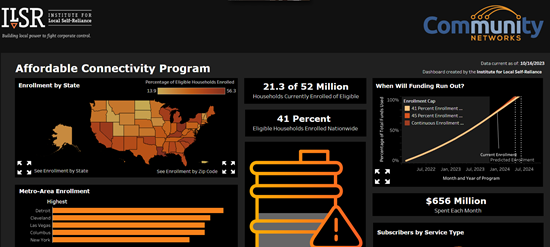
As digital equity advocates push Congress to replenish the rapidly diminishing funds that support the Affordable Connectivity Program (ACP), a recently published report should help bolster the case that the program – which subsidizes the cost of monthly Internet service for income-eligible households – won’t just help more Americans get broadband access, it can also incent Internet service providers (ISPs) to make infrastructure investments in unserved and underserved areas.

The report, titled "Closing the Digital Divide Benefits Everyone, Not Just the Disconnected" – published by Common Sense and the Boston Consulting Group (BCG) – emphasizes the benefits of universal Internet access across education, health care, government services, and employment. It makes the case that universal connectivity would allow institutions to “integrate Internet-based technologies into their services, improving them for the benefit of all.”

Most notably, the report advocates for increased ACP enrollment, arguing that in addition to providing low-income households some short-term relief from pricey Internet bills, the program can provide an economic incentive for ISPs to invest in unserved and underserved communities by increasing the return on investment (ROI) in areas that have previously been considered unprofitable.

The referenced media source is missing and needs to be re-embedded.

The Affordable Connectivity Program has been considered by some to be a “coupon” solution to the broadband affordability problem, and ILSR has long believed that while the ACP is critical to ensuring low-income customers can afford Internet access right now, more structural solutions are needed to make connectivity affordable to everyone over the long term.

Harlingen, Texas Pauses Municipal Broadband Plan Citing High Costs

Officials in the South Texas town of Harlingen say they’ve put their plan to deploy a municipal broadband network on hold after projected costs ballooned well beyond original estimates.

Originally, Harlingen officials had hoped to construct a $4 million fiber network to shore up broadband access to the city’s unserved and under-served populace, using a portion of the city’s $22 million share of the American Rescue Plan Act (ARPA).

But a $100,000 study conducted by Houston-based consultants Cobb Fendley and Associates suggested a more realistic price tag would be closer to $10 million, forcing city officials to reconsider their plan.

"We were hoping to get it rolling but we ran into a few hurdles along the way," City Commissioner Ford Kinsley recently told GovTech. "We're looking for some sources other than what we originally thought."

A 2019 census survey found that nearly 35 percent of Harlingen’s households (7,887 of 22,901) lacked any broadband access whatsoever, positioning the city as second worst in the state behind Pharr, Texas, which recently built a municipal fiber network to bring affordable connectivity to its city residents. Harlingen school district officials also say they found that 900 students' homes lacked Internet access as of 2020, hampering city education standards.

Image
Harlingen students

The majority of the rest of the city’s residents are served by one or two providers, resulting in spotty access, high prices, and sluggish speeds. As with so many U.S. markets, the Covid home education and telecommuting boom drove home the need for the kind of affordable, uniform broadband access regional monopolies long failed to deliver.