
5G

Content tagged with "5G"

Related Topics
Displaying 11 - 20 of 33

U.S. Mayors Face Uphill Battle to Preserve Local Control Of 5G Deployment
As Mayors must concern themselves with everything from public safety and health to the development of the local economy and the provision of essential municipal services, they tend to have a particular focus on the infrastructure necessary to support it all, amid a cacophony of competing interests.

Over the summer, having reached consensus on the fundamental importance of “the digital infrastructure of tomorrow,” a particular focus of the United States Conference of Mayors 88th National Annual Meeting was to issue a resolution declaring the necessity of “Preserving Local Public Rights-of-Way and Regulatory Authority to Most Effectively Deploy 5G Broadband Access and Bridge the Digital Divide during the COVID-19 Pandemic.”

Image

The Mayors’ resolution comes in response to the Federal Communications Commission’s (FCC's) 2018 preemption of local governments’ authority to regulate 5G infrastructure in their cities. 

At the heart of the regulatory debate: local governments’ ability to determine the amount of fees to charge mobile carriers that want to place 5G equipment in Rights-of-Way. In addition to putting limits on those fees, the FCC Order also sets strict timelines by which cities and towns must respond to carrier applications. The FCC decision, issued over the objections of industry observers and policy experts, essentially eliminates local communities’ ability to negotiate in order to protect their own Rights-of-Way and the poles, traffic lights, and other potential structures within those Rights-of-Way.

Preempting Local Authority

Kaysville, Denver, Chicago, Among Cities Voting on Broadband

In the fall of 2019, when the Kaysville City Council was poised to move forward on a $26 million, 30-year bond to build a municipal-owned fiber optic network, the COVID-19 pandemic had not yet turned life upside down.

Although city officials and advisors had spent 18 months thoroughly exploring options in a planning process City Councilwoman Michelle Barber called “one of the most vetted and open projects that we’ve worked on,” a group known as the Coalition for Responsible Kaysville Fiber created enough pushback to convince the City Council to shelve the plan and defer to a citizen-led ballot initiative.

On Tuesday, Nov. 3, Kaysville voters, in this city of approximately 32,000, will not only cast their ballots in the Presidential election, they will also be asked if they want the city to move forward with Kaysville Fiber. If the ballot initiative passes, it will allow the city to deploy a Fiber-To-The-Home (FTTH) network. 

Image

Currently, Comcast and CenturyLink are the Internet Service Providers (ISP) for most of Kaysville with some areas near the city relying on satellite Internet access. As has been the case in hundreds of communities across the nation that have built out fiber networks, Kaysville city leaders are looking to build a “last mile” fiber network to lower prices and improve services by creating an environment for increased competition.

Proponents are hoping the new “normal” in the face of the on-going pandemic — with the massive rise in virtual classrooms, remote work from home, telemedicine, and online commerce — will help voters see Kaysville Fiber as necessary infrastructure. 

Something for Everyone at Broadband Communities' 2020 Annual Summit

Another year of the Broadband Communities annual summit is behind us, and it’s worth revisiting the most salient moments from the panels that touched on the wealth and variety of issues related to community broadband regulation, financing, and expansion today and in the future. We weren’t able to make it to every panel, but read on for the highlights.

Last Mile Infrastructure and the Limits of CARES Funding

The first day of the program saw some heavyweight sessions from Coalition for Local Internet Choice (CLIC) on last mile digital infrastructure. For communities at all stages of broadband exploration and investment — whether exploring an initial feasibility study, putting together an RFP, or already planning for the future by laying conduit as part of other projects — partnerships dominated the discussion, with timing and debt also serving as common themes. 

ILSR’s Christopher Mitchel helped kick off the conference by moderating the first panel in the Rural/Editor's Choice track, and was joined by Peggy Schaffer from Maine's Broadband Office (ConnectME), Monica Webb from Internet Service Provider (ISP) Ting, and Roger Timmerman, CEO of Utah middle-mile network UTOPIA Fiber

The group discussed the open access models to start, and the benefits that could be realized from two- or three-layer systems. UTOPIA Fiber has seen some explosive growth and spearheaded significant innovation recently as it continues to provide wholesale service to ISPs that want to deliver retail service on the network. Ting, which recently signed on to be one of two providers on SiFi Network’s first FiberCity in Fullerton, California, also acts as an example of what can happen when we break away from thinking about infrastructure investment and Internet access as one-entity-doing-it-all.

New 5G Rules Showing Impact in Milwaukee County, Wisconsin

Milwaukee County, Wisconsin, is currently experiencing firsthand the consequences of the Federal Communications Commission’s (FCC's) 2018 preemption of local governments’ authority to regulate 5G infrastructure in their cities. With its initial handful of applications for new small cell transmitters just submitted to the county board by Verizon under the new rules, local officials are grappling with a host of limitations — including fee caps, shorter timing windows, and right of way exemptions — which outline clearly a problem more and more communities will face in the coming months and years.

Less Say, Less Money

We pointed out when the FCC handed down the order in the fall of 2018 that it represented a significant giveaway to wireless carriers while placing additional restrictions and financial burdens on local regulators, most of which are county boards and city departments. Among the most troublesome of the order’s provisions are new 60- and 90-day approval windows for the installation of infrastructure on existing and new wireless facilities, a limitation to annual fee scales for small cell sites set between $100-250, a right now enjoyed by wireless providers to place infrastructure on municipally owned poles and traffic lights, and a rule that says if regulating authorities don’t get to an application within 60 days it automatically becomes approved. The 9th U.S. Circuit Court of Appeals upheld the fee cap in a ruling last Wednesday.

Think Local, Connect Global with Smart Wireless Policy - Community Broadband Bits Episode 403

This week on the Community Broadband Bits podcast, Christopher speaks with Steve Song, a fellow at Mozilla who works to connect unserved communities across the globe.

Steve shares his background starting out at a nonprofit Internet service provider in 1990s South Africa, and they discuss the negative but mostly positive effects of widespread Internet access. While acknowledging the limitations of mobile connectivity, Steve describes the essential role wireless technologies have played in connecting people worldwide. To get everyone online, Steve argues that we need a mixture of models, including wireless providers.

Christopher and Steve also talk about how the potential impact of 5G is being diluted by focusing on high speeds instead of affordable, rural Internet access. At the same time, Steve explains that the U.S. has been a global leader in terms of opening up wireless spectrum for many uses. For better rural connectivity, Steve points to cooperatives as an exemplary model to follow, and he speaks to the need to treat spectrum differently in rural areas.

Talk to us! Would you like to hear shorter, more frequent episodes instead of our usual weekly episodes to keep up with the ever-changing times? Let us know by commenting below, sending an email to podcast@muninetworks.org, or connecting with us on social media.

This show is 29 minutes long and can be played on this page or via Apple Podcasts or the tool of your choice using this feed

Transcript below. 

We want your feedback and suggestions for the show-please e-mail us or leave a comment below.

Listen to other episodes here or view all episodes in our index. See other podcasts from the Institute for Local Self-Reliance here.

Thanks to Arne Huseby for the music. The song is Warm Duck Shuffle and is licensed under a Creative Commons Attribution (3.0) license.

Orlando Sentinel Op-Ed: Big Wireless Providers’ Growth Limits Local Choice

Katie Kienbaum, Research Associate at ILSR, wrote an op-ed that the Orlando Sentinel published on March 5, 2020. Katie wrote about how lobbying from the big wireless companies at the state legislature restricts local communities from making their own decisions. She also touched on the importance of protecting local authority to allow communities to have their own right to make decisions.

Here is the full piece: 

Imagine moving into a new home. One of the reasons you chose this house was the view from your daughter’s bedroom of the park across the street, a nice change from the alleyway her room overlooked in your old apartment.

Then, days after unpacking the last pair of socks, a set of ugly, bulky boxes appear on the street light right in front of your daughter’s window, blocking the view almost entirely. You contact your council representative only to find out that it’s a new wireless “small” cell and despite being on city property, state law prevents them from doing anything. Their hands, you’re informed, are tied.

This story is playing out again and again in communities across Florida as companies like AT&T, Verizon, and T-Mobile stumble over each other to build out next generation 5G wireless infrastructure. In their haste, wireless providers are slapping up poles and equipment often without concern for the impact on local communities, affecting aesthetics and straining city resources.

A municipality typically has the authority to prevent or at least address this kind of local nuisance. But in Florida, there’s little recourse for the communities and families harmed by indiscriminate 5G construction. As a result of lobbying from the big wireless companies, state law limits the ability of local governments to collaborate with wireless providers over the placement and appearance of small cell wireless facilities. It also shortens the permitting process for new wireless installations and caps or eliminates the fees that cities can charge companies like AT&T to use public property.

These industry-backed blanket regulations ignore the unique needs and values of different communities, limiting local control over neighborhood appearance, undermining digital equity efforts, and threatening public accountability.

Tech Reporter Seeks 5G, Describes "Painful" Experience

When his Twitter feed announced the “arrival of 5G” last December, tech reporter Chris Matyszczyk made a beeline for the nearest T-Mobile store and asked, “Can I have some of this 5G, please? I will become a much more desirable, admirable person if I have 5G!” From there, it was all downhill.

The Pain of the Hype 

We aren’t the only ones who have pointed out the hype around 5G as telecom companies rush to outdo each other. In another case of marketing mayhem overtaking technical truth, Matyszczyk shares his rain soaked pursuit in the Bay Area. Expecting fanfare, he was met with a surprisingly subdued store:

I wandered into a T-Mobile store that was emptier than a politician's tweet.

Oddly, there weren't 99 pink balloons hanging from the ceiling to celebrate 5G. There weren't even five.

He goes on to describe how the less-than-enthusiastic salespeople didn’t seem very well informed about when, where, or why 5G isn’t available to him when the company indicated that it arrived nationwide:

"But isn't it a bit annoying to be told there's this incredibly exciting 5G when you can't get it for at least another six months?"

They seemed neither to agree or disagree. They seemed like they were annoyed it was raining and that I was there, dripping.

Read the full article, "I went to T-Mobile to ask about 5G. The response was painful" here. You can also watch an interview with Matyszczyk.

He expressed sympathy for the salespeople. After all, he says, “it’s hard for them to present something they can’t actually sell you.”

Marketplace spoke with experts, including Gigi Sohn and our Christopher Mitchell, about the hype surrounding 5G. Sohn said, "5G is 80% marketing and 20% technology. The hype around this technology is enormous, and also the hype around needing to win a so-called race around 5G."

Listen to the story here:

Deep Dive Into 5G with PCMag Mobile Expert - Community Broadband Bits Podcast 371

When we released our Pocket Guide to 5G Hype, we expected to see some reactions from others on the unrealistic expectations about 5G. When this week’s guest contacted us because he disagreed with some of the Pocket Guide content, however, we knew we should bring him on the show. 

Sascha Segan, PCMag.com’s lead mobile analyst has seen generations of mobile wireless come and go during more than a decade of reporting. In this interview, he provides more detail about 5G versus millimeter waves and he and Christopher talk about the distinctions. You'll walk away knowing more than you ever thought you could about mobile wireless connectivity.

Christopher and Sascha also discuss 5G marketing that has swiftly turned into hype. They talk about the next generation in mobile wireless through a more practical lens, considering how it will impact rural connectivity, competition, and innovation. The each share their predictions for fiber optic deployment in rural regions and explain why -- or why not -- they believe rural communities will ever have access to fiber connectivity. Advances in technology move forward, notes Sascha, but the real issues that prevent ubiquitous coverage in the U.S. continue to be regulatory and political roadblocks.

After you've learned more about 5G from Sascha, check out the Pocket Guide to 5G Hype for yourself.

This show is 32 minutes long and can be played on this page or via Apple Podcasts or the tool of your choice using this feed

Transcript below. 

We want your feedback and suggestions for the show-please e-mail us or leave a comment below.

Listen to other episodes here or view all episodes in our index. See other podcasts from the Institute for Local Self-Reliance here.

Thanks to Arne Huseby for the music. The song is Warm Duck Shuffle and is licensed under a Creative Commons Attribution (3.0) license.

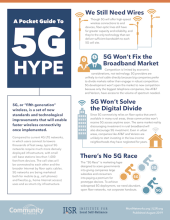
A Pocket Guide to 5G Hype Fact Sheet

It’s difficult to separate 5G fantasy from reality as reported in traditional news sources. Misunderstandings surrounding the demands and capabilities of 5G has snowballed, creating an incorrect assumption that the technology will solve America’s many connectivity problems. It’s true that 5G is an improvement, but it has limitations. In A Pocket Guide to 5G Hype, we address the most repeated errors surrounding 5G and explain why the technology should be considered another tool, not an exclusive remedy.

Download A Pocket Guide to 5G Hype [PDF] here.

Mistakes We Hear Over...and Over...and Over

Regardless of the source, several errors seem to be repeated and we address those in the fact sheet. We provide context to:

  • The fact that 5G still needs fiber optic connections
  • Why it won’t solve the problem of lack of competition
  • Why 5G won’t eliminate the digital divide
  • The myth of the 5G race

Orders, Complements, and More

The fact sheet also provides information about the FCC’s 2018 Order that interferes with local communities’ ability to control negotiations with 5G carriers. By choosing big telecom companies over local governments the FCC is preventing cities and counties from finding efficient paths to digital equity.

Our Pocket Guide to 5G Hype lays out a comparison between 5G and Fiber-to-the-Home (FTTH). Rather than replacing fiber with 5G, the two technologies can have the most impact when they work together; on the fact sheet, we've laid out the reasons in a side-by-side chart.

We want you to delve deeper into the issue of 5G and find out the truth, rather than get lost in the hype and we've offered a few additional resources to get you started on your own research. Share the fact sheet with others who are interested in the truth about 5G and be sure to send it to your local elected officials. As they create local policies affecting 5G deployment in your community, they need to base their decisions on realities, not hype.

David Young Shares the Story of Lincoln - Community Broadband Bits Podcast 364

This week, we’re bringing another podcast interview that Christopher conducted while at Mountain Connect in Colorado. David Young, former Fiber Infrastructure and Right-of-Way Manager for the city of Lincoln, Nebraska, sat down to reminisce about the city’s network that began as conduit and has evolved into citywide Fiber-to-the-Home (FTTH).

David has moved on to Kansas City in Kansas, but he was deeply involved in the advancement of Lincoln’s network that has done so much for competition and better connectivity in Lincoln. In addition to all the direct benefits that the city is enjoying from a gigabit fiber network, there’s a long list of indirect benefits that David and Christopher discuss that affect sectors such as education, economic development, and public safety.

Along with sharing the many ways the fiber infrastructure has helped the city and it’s people, David shares words of wisdom for other communities who may be considering similar investments. He offers some technical advice on deployment, important factors for communities working in a state with restrictions, and thoughts on their decision to choose a public-private partnership model.

We’ve documented Lincoln’s story, so check out more of their history here.

This show is 29 minutes long and can be played on this page or via Apple Podcasts or the tool of your choice using this feed

Transcript below. 

We want your feedback and suggestions for the show-please e-mail us or leave a comment below.

Listen to other episodes here or view all episodes in our index. See other podcasts from the Institute for Local Self-Reliance here.

Thanks to Arne Huseby for the music. The song is Warm Duck Shuffle and is licensed under a Creative Commons Attribution (3.0) license.