


Two city utility managers, an economist, and a fiber technologist walk into a virtual webinar …
And what followed was a deep dive into why delaying investment in smart city infrastructure is increasingly costly.
The hour-long livestream event – co-hosted by the Institute for Local Self-Reliance (ILSR) Community Broadband Networks initiative and the American Association for Public Broadband (AAPB) – brought together municipal utility managers, an economist, and a leading fiber technologist to explore how cities can future-proof themselves with digital infrastructure.
Guests who appeared on “Building Smarter Cities and the Cost of Doing Nothing” today emphasized how “smart cities” are built on fiber networks and what city investments in the gold-standard of Internet connectivity can do to boost economic development while improving the quality of life for local residents and businesses.
They highlighted the real costs of inaction, pointing to slower economic growth and lost municipal revenue opportunities as something many cities or towns overlook when thinking about local infrastructure.
The webinar featured Huntsville Utilities VP of Engineering Stacy Cantrell who provided key insights into the public-private partnership Huntsville Utilities struck with Google Fiber and what it has meant to “Rocket City.”
Another virtual case study was provided by Brieana Reed-Harmel, Broadband Manager for Pulse Fiber, discussing how the city’s fiber network is propelling economic revitalization efforts in Loveland and how the success of the network is now being extended into neighboring communities.
Dr. Bento Lobo, an economics professor at the University of Tennessee at Chattanooga delved into his studies on the Return-On-Investment Chattanooga's city-owned fiber network has brought America's first “gig city” and also how other communities can think about measuring the impact fiber infrastructure can have on local economies.
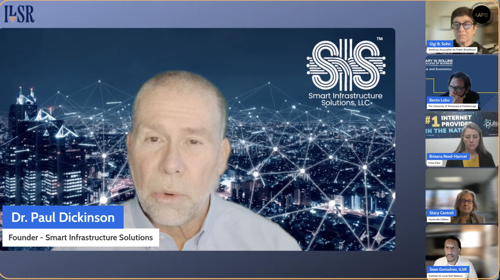
Meanwhile, Paul Dickinson, Founder of Smart Infrastructure Solutions, joined the conversation to offer a glimpse on how fiber networks can be leveraged to do far more than deliver broadband in ways that boost the bottom line of local businesses and households and help city planners better manage everything from traffic to utility systems.
The webinar concluded with a clear message: even as the Trump administration has been forcing states to invest more into capacity-constrained, less-reliable satellite technology, fiber systems today are – and will remain – essential to building resilient, competitive, and future-ready communities.
Watch the webinar in its entirety below:
Header image courtesy of Easy-Peasy.AI, CC BY-ND 4.0, Attribution-NoDerivatives 4.0 International