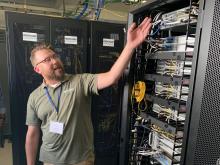


Rural cooperatives have been the backbone of modern efforts to bring affordable next-generation fiber to long-neglected rural U.S. communities.
So it’s important to listen to them when they warn that Trump administration NTIA changes to U.S. telecom subsidy programs are going to have a profoundly-negative impact on efforts to expand fast, affordable Internet access.
Earlier this month rural electric and broadband cooperatives gathered in Washington, DC, for the 5th annual Broadband Leadership Summit.
The topic du jour was broadly unpopular changes made by the NTIA to the Broadband, Equity, Deployment, and Access program (BEAD) created by the 2021 infrastructure bill.
As ILSR has repeatedly explored, NTIA BEAD changes reduced oversight of deployment, lowered quality standards, stripped away requirements that the resulting taxpayer Internet access be affordable and equitably deployed, and redirected billions of dollars away from affordable fiber to the low-Earth orbit space ambitions of billionaires Jeff Bezos and Elon Musk.
That’s not sitting well with the cooperatives doing the heavy and costly lifting to bring affordable access into long-neglected rural communities.
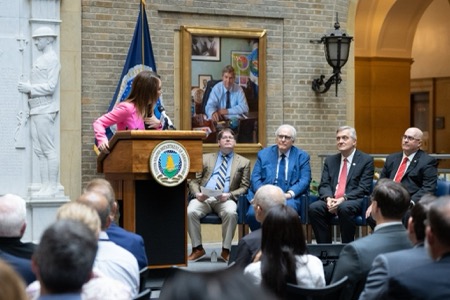
"Quite frankly, some decisions have been made in the BEAD program that we are not happy with," National Rural Electric Cooperative Association (NRECA) CEO Jim Matheson said at the event. "We were pretty disappointed that the preference for fiber was removed. We think that shifts the program's focus from what would be more of a proven, durable, scalable broadband technology. So we were not in favor of that decision.”
Suwannee Valley Electric Co-op (SVEC) CEO Michael McWaters had similar complaints in conversations with Light Reading.
"We're getting a lot of competition in the funding environment from fixed wireless and from other providers, and we just feel like fiber is the future-proof technology that can really help our communities grow and prosper as they should," he said.
Many state broadband office leaders have mirrored Matheson’s concerns, though many are hesitant to speak out for risk of losing significantly-pared back funding.
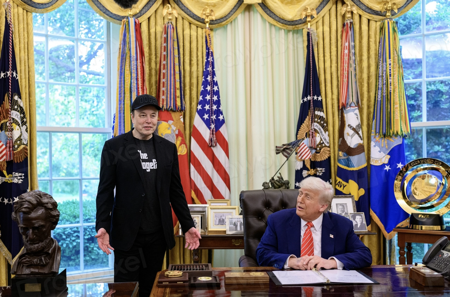
The redirection of funds to LEO satellite options like Starlink have been particularly concerning, given Starlink’s lack of affordability, congestion issues, environmental concerns, and the CEO’s unusually-close political ties to the President. Going cheaper on fiber now simply means additional costs down the line – especially if options like Starlink don’t survive.
Complications Abound
Cooperatives attending the event also expressed concerns at a number of cumbersome new bureaucratic hurdles imposed by the NTIA. Most prominently discussed was the NTIA’s decision to impose new pole attachment regulations on cooperatives that have historically been exempt.
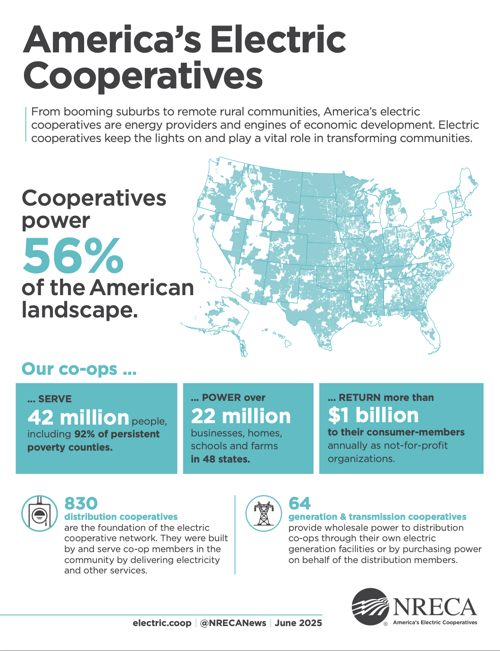
“Look, that flatly contradicts the intent of Congress," Matheson said. “Congress has exempted co-ops from those pole regs because co-ops set their rates on a local level by their member owners, not by profit-seeking utilities. This is long-standing federal policy. The decision by NTIA to go in a different direction puts more co-op projects, I think, in terms of broadband at risk."
The new changes – which cap the amount pole owners can charge and set stricter time limits on processing pole attachment requests – now apply to a cooperatives’ entire territory, not just areas being subsidized by BEAD grants.
"It adds to confusion, it adds to delay, it adds to cost. That's been disappointing," said NRECA's Matheson.
The rule changes were enough for one cooperative in Western Colorado, Delta-Montrose Electric, to say they were dropping out of BEAD participation altogether. The state had awarded Delta-Montrose $1.8 million to connect 180 broadband serviceable locations. In contrast, Amazon's Leo received $25.4 million in state grants to connect 42,252 potential subscribers (Amazon is significantly behind in its satellite launch obligations).
“We were a recipient of BEAD recently, and we decided ultimately to respectfully decline that grant because of the FCC pole attach [rules], that is, that the grant areas that we would have built out would have opened up our entire network to FCC pole attach rules, not just the grant-build area, and so we thought that was too onerous, and we ultimately turned the money back in," Delta-Montrose Electric Association CEO Jack Johnson said.
As tariffs, delays, and higher costs imperil many BEAD recipient deployment plans, a growing number of providers are expected to default on their bids, opening the door to Bezos and Musk receiving even more subsidies in exchange for LEO satellite services they already planned to deploy without subsidization.
Nebraska recently announced it would be re-running its BEAD bidding process after three Internet service providers refused to sign their award agreements due to constant program changes, ever-shifting timelines, and higher costs.
The Trump administration claims that the NTIA shift from future-proof fiber to slower and more congested satellite services “saved” taxpayers nearly $21 billion, though there won’t be much savings if customers in these region can’t afford satellite service, or the service – as experts have repeatedly warned – can’t consistently provide next-generation speeds at scale.
This $21 billion in leftover “non-deployment funds” have been a particular spot of contention for states, which have repeatedly stated that Congressional law requires that this funding be spent on improving U.S. internet access. The NTIA has failed to provide clear guidance to states and providers on who will be receiving these “leftover” funds.
Many of the cooperatives in attendance lamented the significant new delays in BEAD funding and deployments, ironically coming from an administration that heavily criticized BEAD last election season for being a sluggish mess.
"BEAD has been very slow to develop. I think that's one of our biggest concerns," Midwest Energy and Communications (MEC) CEO Terry Rubenthaler told Light Reading. "We're finishing up our other obligations. I was hoping to roll right into BEAD construction and get these folks that don't have service, you know, some broadband. And it's just delay after delay after delay. And they keep changing the rules."
Header image of Slow Down sign courtesy of Pixabay via Picryl.com, PDM 1.0, Public Domain Mark 1.0 Universal
Inline image of NRECA members celebrating 90 years of the Rural Electrification Act courtesy of NRECA Facebook page
Inline image of Elon Musk and President Trump in Oval office courtesy of Rawpixel, CC0 1.0, CC0 1.0 Universal