
regulation

Content tagged with "regulation"

Displaying 101 - 110 of 134

Comcast: Internet Access is Temporarily a Civil Right

You can now read this post at Huffington Post also. As a condition of its massive merger with NBC, the federal government is requiring Comcast to make affordable Internet connections available to 2.5 million low-income households for the next two years. In promoting the program, Comcast's Executive VP David Cohen, has made some unexpected admissions:
“Access to the internet is akin to a civil rights issue for the 21st century,” said David Cohen, Comcast’s executive vice president. “It’s that access that enables people in poorer areas to equalize access to a quality education, quality health care and vocational opportunities.”
It was only after the federal government mandated a low-cost option for disadvantaged households that Comcast realized everyone could benefit from access to the Internet. Sadly for Comcast, it has done a poor job of reaching those disadvantaged communities, by its own admission:
"Quite frankly, people in lower-income communities, mostly people of color, have such limited access to broadband than people in wealthier communities."
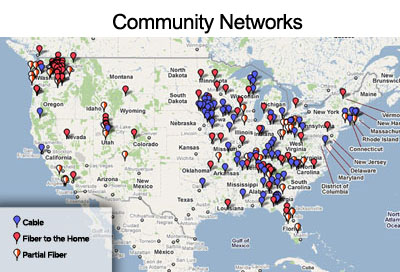
This is why so many communities are building their own next-generation networks - they know that these networks are essential for economic development and ensuring everyone has "access to a quality education, quality health care and vocational opportunities." And they know that neither Comcast nor the federal government are going to make the necessary investments. They need a solution for the next 20 years, not just the next 2. Community Networks Map Comcast has a de facto monopoly in many communities.

Tethering, Verizon, and the Problem with Public Interest Requirements

When Verizon won an auction to use the 700MHz band of the spectrum to deliver mobile broadband, it promised to adhere to a set of openness rules that included allowing customers to use applications and devices of their choosing. But Verizon is now blocking "tethering" apps that allow us to use our cell phones as a modem for our computers. Wendy Davis at MediaPost offered more context:
Whether it's legal for a wireless carrier to cripple tethering services is unclear. Verizon agreed to follow open Internet principles as a condition of acquiring the spectrum that it uses for 4G wireless phones. One interpretation of that condition is that the company shouldn't attempt to restrict tethering on its 4G network -- though apparently it's still free to do so on the 3G network. … But aside from neutrality issues, Verizon's move clearly seems hard to justify from a pricing standpoint. Given that the company is already going to charge new users based on the amount of data they consume, there's no reason for it to also impose a surcharge for tethering.
Free Press filed a complaint with the FCC to investigate: Free Press Logo
Free Press will file a complaint today with the Federal Communications Commission against Verizon for violating the rules that govern the licenses for its LTE network. Licensees of the C Block of the upper 700 MHz block, over which Verizon runs its LTE network, may not “deny, limit, or restrict” the ability of their customers to use the applications or devices of the customers’ choosing. Recent reports reveal that Verizon has been doing just that by asking Google to disable tethering applications in the Android Market. Tethering applications, which allow users to make their phones into mobile hot-spots, implicate the customers' ability to use both the applications and devices of their choice. Free Press argues that by preventing customers from downloading tethering applications from the Android Market, Verizon is restricting not only the applications available to them, but also limits use of tethered devices such as laptop or tablet computers.

Need Cloud Services like Online Backup? Steer Clear of Comcast

The net is buzzing about Comcast's data caps after a Seattle resident ran afoul of them. I found it particularly interesting given Seattle's recent decision to use its assets to further Comcast's monopoly following a poorly considered RFP. This story highlights many of the frustrations and injustices that come with companies as massive as Comcast effectively monopolizing an essential utility, with practically no oversight locally or federally. When Comcast enacted is 250GB monthly transfer cap years ago, many thought it was sufficiently high that few would run afoul of it. But the smart folks noted that if it did not increase as natural usage increases, it would hurt legitimate users (as opposed to those who run servers constantly trafficking in file sharing that violates copyright).
I made very clear to the gentleman I spoke with that I thought Comcast’s data cap policy was arbitrary, unfair, and extremely irritating… and that if I had any decent competitive options in the neighborhood I’d dump Comcast in a heartbeat. Since I don’t, I listened to him read his canned warning that if I exceeded their cap again I’d be cut off again.
Bear in mind that when you fill up the fuel tank in your car, you are at a gas station that is regularly inspected by the state to ensure it is correctly measuring the volume of gas dispensed. Comcast is not similarly regulated and we have to take Comcast's word on how much traffic we use. Most of the time I have visited Comcast's meter to see what my household usage is, I have been unable to even access it. But back to the story, our Seattle friend later found that he had unintentionally violated the cap again, despite taking precautions not to:
The Customer Security agent was polite, and after the standard identification questions notified me I was cut off for a year due to exceeding Comcast’s Acceptable Use Policy limits on their bandwidth cap. I asked for details on what had been using bandwidth, and again, Comcast would not share. In a sudden brainstorm, I then asked whether the 250 GB bandwidth cap applied to just downloads (which I had assumed, as the majority of most bandwidth used in households is downstream bandwidth), or download and upload bandwidth. Surprise, surprise!

Video Comparing American vs. European Broadband Networks

Rick Karr has produced a "can't miss" 15 minute video that shows what happens when telecommunications is treated more like infrastructure and less like a for-profit morass controlled by massive companies.  

We can have universal, fast, affordable, and reliable access to the Internet but we choose instead to let companies like AT&T and Comcast dominate telecommunications to the detriment of our economy, innovation, education, and health care.  It is a choice -- and one we desperately need to revisit.

This video is no longer available.

Boston Seeks Additional Power to Regulate Cable

With so many community broadband stories breaking this week, I did not dig into an update to Boston seeking authority to regulate some cable rates in response to the many rate hikes they have endured from Comcast. Boston's mayor has previously complained about basic cable rate increases. The Ars Technica story offers some good regulatory background that limits the power of Boston to do much about rates.
According to the City, Comcast's 2011 Basic Service Rate change went from $13.30 to $15.80 a month. This came in the wake of previous rate hikes—to $9.05 in 2008, to $10.30 in 2009, and to $13.30 in 2010. That all adds up to "more than 60%, on a service that is supposed to be affordable and is identified in the industry as ‘lifeline service'," Boston says. "In addition, when comparing Boston to neighboring communities that have rate regulation, Comcast has over-collected approximately $24 million from Boston's Basic Subscribers during the four year period from 2008 through 2011," the City's statement claims. Its own research indicates that neighboring cities that are still regulated, such as Cambridge, have cheaper rates.
This has led the Boston Globe to editorialize "If cable firms act as monopolies, cities should be able to regulate.
When the Federal Communications Commission took away Boston’s power to regulate basic cable rates almost a decade ago, the assumption was that competition for pay-TV services would hold prices down for consumers. That assumption has not panned out. Comcast Corp., the successor to Boston’s original cable franchisee, still dominates — not least because its former monopoly status conveys lingering advantages that hamper competition even now.

Organizing for Change: Rural Communities and Broadband

Over the past few years, I have worked with some great folks in a coalition called the Rural Broadband Policy Group to advocate for rural communities and businesses. This is a working group organized under the National Rural Assembly.
The Rural Broadband Policy Group is a growing national coalition of rural broadband advocates that emerged from the National Rural Assembly. The group's goals are  
  1. to articulate national broadband policies that provide opportunities for rural communities to participate fully in the nation's democracy, economy, culture, and society, and
  2. to spark national collaboration among rural broadband advocates.
 
We adopted the following principles:
  1. Communication is a fundamental human right.
  2. Rural America is diverse.
  3. Local ownership and investment in community are priorities.
  4. Network neutrality and open access are vital.
The principles are further explained here and you can sign up or ask questions about the group on that same site. We are especially keen on working with organizations in rural areas who want to have a say in federal or state issues. When we develop comments for a federal proceeding or connect with various policymakers, you can be notified and have the option of signing on. For instance, read a recent letter we submitted to the FCC [pdf]. Snippet:
Big telecommunications companies have failed in extending Internet service to rural areas. They claim it is costly and not profitable. We are tired of waiting for AT&T, Verizon, and Comcast.

Michigan's Failed Deregulation of Cable After 5 Years

Five years ago, Michigan decided to deregulate cable companies, preempting local authority to negotiate with cable companies in favor of a more relaxed statewide franchise. Many states have gone down this path in hopes of spurring competition and lowering the prices for service. All have seen very minimal gains (mostly from AT&T U-Verse and Verizon FiOS, deployments that have gone forward as well in states that did not preempt local authority). None have seen real decreases in prices. Michigan also created greater hurdles for the public sector (click on Michigan on our Community Broadband Preemption Map for an explanation of the legislation). In short, Michigan made a big bet that the private sector would build the networks they need to remain competitive. The results are in.
"No matter how you look at it, 70 percent of Michigan's communities still have only one cable provider four years after deregulation," said Deborah Guthrie, President of MI-NATOA, in a statement. "Even in the places where two providers offer service, if serious competition existed, prices wouldn't run up several times faster than inflation and customer service wouldn't be so poor."
Michigan's National Association of Telecommunications Officers and Administrators joined with the Michigan Alliance for Community Media (neither of which seems to have much a web presence) to note that Comcast's prices for lifeline basic have gone up 18% with other services increasing 3x the rate of inflation. Most communities remain stuck with Comcast or Charter solely, two of the most hated corporations in America. As we educate legislators around the country, we need to keep the lessons from Michigan in mind. Legislators often know very little about telecom issues and are bombarded by lobbyist talking points - but examples like Michigan clearly show what happen when the telco and cableco lobbyists make policy. And so long as we are discussing Michigan, it is worth noting that the City of Detroit is pushing to have Michigan's statewide franchise law invalidated.

Publicly Owned Broadband Networks: Averting the Looming Broadband Monopoly

Image

The Institute for Local Self-Reliance is pleased to release the Community Broadband Map and report, Publicly Owned Broadband Networks: Averting the Looming Broadband Monopoly. The map plots the 54 cities, big and small, that own citywide fiber networks and another 79 own citywide cable networks. Over 3 million people have access to telecommunications networks whose objective is to maximize value to the community in which they are located rather than to distant stockholders and corporate executives.

ILSR has been tracking telecommunications developments at the local and state level, working with citizens and businesses to preserve their self-determination in the digital age.

View the Community Broadband Map
Download the Report [pdf]
Read the Press Release [pdf]

Executive Summary

Quietly, virtually unreported on, a new player has emerged in the United States telecommunications sector: publicly owned networks. Today over 54 cities, big and small, own citywide fiber networks while another 79 own citywide cable networks. Over 3 million people have access to telecommunications networks whose objective is to maximize value to the community in which they are located rather than to distant stockholders and corporate executives.

Even as we grow ever more dependent on the Internet for an expanding part of our lives, our choices for gaining access at a reasonable price, for both consumers and producers, are dwindling. Tragically, the Federal Communications Commission has all but abdicated its role in protecting open and competitive access to the Internet.

Now more than ever we need to know about the potential of public ownership. To serve that need the Institute for Local Self-Reliance has published an interactive Community Broadband Map that gives the location and basic information for existing city owned cable and fiber networks.

Another Example of Regulatory Capture

As you observe (or hopefully, participate in), the debates around network neutrality or universal service fund reform, remember that many of the loudest voices in support of industry positions are likely to be astroturf front groups.  Between extremely well-financed astroturf organizations and industry-captured regulatory agencies, creating good policy that benefits the public is hard work.  It helps to study how industry has gamed the FCC in the past -- as documented by David Rosen and Bruce Kushnick in a recent Alternet article.

At the risk of being sarcastic, we can thank the FCC for working with the industry to make our phone bills to easy to read - an example is available here.