
muni

Content tagged with "muni"

Displaying 81 - 90 of 977

Great Expectations for Maine's SanfordNet Fiber; Completion Slated for This Fall

SanfordNet Fiber, considered the largest fiber optic community network in Maine to date, is under construction and expected to be completed late in 2019. The project recently attracted the attention of WGME, who profiled the community and the investment as part of their “Working Solutions” segment.

Check out the video at WGME's website.

Taking Control in Maine

Reporter David Singer visited Sanford and nearby Millinocket to talk with business owners and economic development experts in both communities. Sanford, centrally located in  the geographic center of southern Maine, was not connected to the Three Ring Binder, the state fiber optic network developed with funding from the American Recovery and Reinvestment Act (ARRA) during the Obama administration. "11,000 miles of fiber were strung up and down Maine but not in Sanford -- 10 miles to our east, 10 miles to our south,” said Jim Nimon, Executive Director of the Sanford Regional Economic Growth Council.

Rather than be left behind, the community of approximately 21,000 people decided that they needed to act on their own and pursue what has become known in the area as the “fourth ring.” Sanford’s project will emulate other projects in the state, and use the “Maine model.” The city is deploying the infrastructure and will work with private ISP GWI to bring gigabit connectivity to local businesses. GWI is a tested partner and will operate the network, having established a similar arrangement with Rockport. You can learn more about the “Maine model” in this conversation with GWI’s Fletcher Kittredge from episode 176 of the Community Broadband Bits podcast in 2015.


Baby Step Toward Better Broadband in Arkansas

Earlier this month, we learned about a Senate bill in the Arkansas State Legislature that, in it’s original form, would have rescinded state restrictions preventing many municipalities from improving local connectivity. After amendments, SB 150 lost most of its effectiveness, but the bill that became law this week is still a small step in the right direction for a state where the rate of broadband connectivity is some of the lowest in the country.

Beginning Promise

For years, Arkansas has been one of the states that doesn’t allow government entities from providing broadband services to the public. The ban specifically disallowed “directly or indirectly, basic local exchange, voice, data, broadband, video, or wireless telecommunication service.” There has always been an exception to the ban for communities that have their own electric or cable utilities and want to offer telecommunications services. No municipality may offer basic exchange service, interpreted as telephone service.

Only a few communities have taken advantage of the legal exception, such as Paragould, Clarksville, and Conway. In recent years, electric cooperatives are deploying in rural areas, but many of the state’s rural residents rely on DSL, fixed wireless, and satellite. In the few more populous communities, there may also be scattered cable connections available. 

seal-arkansas.png Even though large incumbent ISPs have collected federal grant funding in the past, deployment in Arkansas has been inadequate to connect all Arkansans. According to the FCC, connectivity to households is near the bottom of the list.

Small Town, Big Connections With Marshall FiberNet - Community Broadband Bits Podcast 345

This week, Marshall FiberNet’s Customer Service and Marketing Manager Jessica Slusarski talks to Christopher about the town’s investment in their community broadband network. Quiet and quaint Marshall, Michigan, didn’t expect to become one of the state’s communities with the best Internet access, but here we are. Like many other small towns where big incumbent providers didn’t want to make infrastructure investments, most of Marshall was stuck with DSL and some premises were still using dial-up connections. Their solution was clear — build a Fiber-to-the-Home (FTTH) network.

Jessica and Chris discuss how the idea became a reality and what were some of the services that the city decided they wanted to include for subscribers, based on the needs of residents and businesses. They also discuss how, even though Michigan requires local communities to reach out to the private sector first, a lack of responses allowed the town to move forward. Jessica describes the favorable response from users and how subscribers are taking advantage of better Internet access than they’ve ever experienced.

We also learn about nuts and bolts, including what it took to get the network deployed, how the city administrates the utility, and what’s next. You can learn more details by reading our coverage of Marshall’s FiberNet.

This show is 23 minutes long and can be played on this page or via Apple Podcasts or the tool of your choice using this feed

Transcript below. 

We want your feedback and suggestions for the show-please e-mail us or leave a comment below.

Listen to other episodes here or view all episodes in our index. See other podcasts from the Institute for Local Self-Reliance here.

Thanks to Arne Huseby for the music. The song is Warm Duck Shuffle and is licensed under a Creative Commons Attribution (3.0) license.

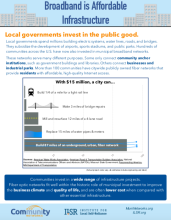
Broadband is Affordable Infrastructure Fact Sheet

Local governments spend billions on all sorts of infrastructure every year to advance the public good for their communities. Roads and bridges keep day-to-day activity moving. Investments such as water and sewer infrastructure keep cities clean and livable. Fiber infrastructure is used for a wide range of purposes, including economic development, education, and to keep a city’s administration connected. To get a look at how fiber network infrastructure compares to other public investments, we've developed the Broadband is Affordable Infrastructure fact sheet.

Download the fact sheet.

Side-by-Side Comparisons

The fact sheet looks at investments in both larger and smaller cities. Each of the projects that we compared to fiber optic networks required similar local investment and contributed to the well-being of the communities where they were developed. The fact sheet offers a snapshot of cost, how the projects were funded, and the results.

Some of the projects we compared are located in Wilson, North Carolina; Lafayette, Louisiana; and Chattanooga, Tennessee, where the networks have been in place long enough to bring economic benefit and other public benefits.

We found that:

Communities invest in a wide range of infrastructure projects. Fiber optic networks fit well within the historic role of municipal investment to improve the business climate and quality of life, and are often lower cost when compared with other essential infrastructure.

This fact sheet helps illustrate how high-speed networks are public infrastructure and it helps with a visual of how that infrastructure stacks up compared to traditional forms of municipal investment. Share this resource with city managers, city council members, mayors, and other elected officials. The fact sheet will also help when discussing municipal investment with other people interested in how to improve local connectivity.

Arkansas Senate Considers Bill to Lift Restriction on Muni Broadband

*Update: After amending the bill significantly, SB 150 passed through the Arkansas Senate to the House. We were initially excited because the original version of the bill reinstated local authority to develop publicly owned broadband networks. The amendment adopted in Committee, however, changed the bill to only allow communities that apply for and receive grants and loans to invest in community networks and only to specific areas and at the speeds defined in those grants and loans. We still consider it a step in the right direction, but the move forward is miniscule. Read the amended bill here.*


This session, a new force in the Arkansas State Legislature — the Republican Women’s Legislative Caucus — has decided that they’ll take on the issue of poor connectivity. As part of their “Dream Big” initiative, they’ve introduced SB 150, a bill to restore local telecommunications authority.

"Dreaming Big" Means Bigger Broadband

The bill was introduced on January 23rd along with a suite of four other bills aimed at a variety of issues, including juvenile justice and education. Senator Breanne Davis of Russellville is the lead sponsor of SB 150, which would repeal restrictions preventing communities from developing broadband networks. Current law has an exception for communities that have a municipal electric utility but if SB 150 is adopted, any government entity will be able to offer high-quality connectivity.  

Legislators are focusing on opportunities for local communities to partner with private sector ISPs as a way to solve some of the poorest access to broadband in the country. They're also emphasizing that, if no partner wants to work with a government entity, this bill will allow a city, town, or county to invest on their own.

In a recent conversation with Talk Business & Politics, Davis described the impetus and goal of the bill: 

Fort Collins Full Steam Ahead, FTTH Taking Shape

It was one of telecom’s famous David and Goliath stories, and when it was over, the people in Fort Collins, Colorado, were ready to press on to invest in better connectivity for their community. That’s what they’re doing now and community leaders anticipate rolling out service as early as this summer.

Deep Pockets vs. Self-Determination

We shared the 2017 story about massive spending by large corporate ISPs in the Colorado town to prevent voters from approving a city charter amendment. Big incumbents wanted to prevent competition that might arise from public investment in high-quality Internet access and were willing to spend almost a million dollars to stop it.

Fortunately, people heading up grassroots efforts in Fort Collins had educated the public about the benefits of fiber, public ownership, and the risks of doing nothing. Voters supported the charter change and later Fort Collins residents and businesses went on to support the city’s efforts to develop a business plan for a municipal Internet access utility.

Connexion

Fort Collins started construction of the estimated $80 million project, dubbed Connexion, and they are hoping to connect the first subscribers in August 2019. They anticipate completing the network in 2021. The city’s light and power department is working with the contractor hired to deploy the network; construction began in November.

In May, the city issued approximately $142.2 million in revenue bonds in order to fund construction, cover the needed capital costs, and get the service on its feet. Bonds sold out in two days.

The city released a promotional video to introduce the service to the Fort Collins public:

Anacortes, Washington, Solidifies Plans for Better Connectivity With Muni Network

Last spring, we reported on Anacortes, Washington’s efforts to evaluate private sector partners to deliver high-quality connectivity via their publicly owned fiber optic infrastructure. After examining their financial position, the desires of the community, and considering the pros and cons, the community has decided to offer services directly to the public. The island community will start deployment in 2019 and plans to have the network completed within four years.

Moving Along

Director of Anacortes Administrative Services Emily Schuh reached out to us to let us know that the city will be expanding from their fiber back bone to serve businesses and households in the community and to update us on the project. She also wanted to let us know that Anacortes is actively recruiting for a Municipal Broadband Business Manager.

Anacortes (pop. approx. 17,000) lies off the coast of Washington on Fidalgo Island, connected to the mainland via two bridges and ferry. Regular readers of MuniNetworks.org will recognize Mount Vernon on the map, located east and operating a municipal open access network for decades. Comcast offers Internet access throughout Anacortes and DSL service is available from Frontier, but businesses and residents want access to more reliable connections and faster upload speeds, which are not forthcoming with the incumbent ISPs.

Vinton, Iowa, Stepping Forward on Fiber Network Deployment

It was more than two years ago when voters in Vinton, Iowa, resoundingly gave their blessing to the city to form a telecommunications utility. After study and consideration, the municipality is now ready to move from design to deployment.

In mid-December, a Notice to Bidders went out from the Vinton Municipal Electric Utility (VMEU) and the engineering firm working with the community to develop a publicly owned Fiber-to-the-Premise (FTTP) network. According to the notice, Vinton plans to build the network “in its entirety” over the next year.

According to the media release, the city plans an underground deployment and anticipates the network will include approximately 82 miles of fiber. The Media Release indicates that several RFPs will be forthcoming throughout 2019.

Read the Notice to Bidders Media Release here.

It’s Feasible

In the fall of 2015, after Vinton voters decided 792 to 104 to put VMEU in control of the broadband initiative, it took until early 2017 for the city to hire a firm to develop a feasibility study. Many people in the community of about 5,100 people were tired of poor Internet access via slow DSL. Cable Internet access is available in some areas of town, but both residents and businesses feel that without high-quality connectivity, Vinton will lose out to other Iowa towns  that already have created municipal networks.

Cedar Falls and Waverly are both within an hour's drive north of Vinton. Other communities in Iowa have invested in fiber networks to improve economic development, including Spencer, Lenox, and Harlan.

It's Christmas Eve and We're STILL Thinking of Muni Fiber!

As authors at MuniNetworks.org have the opportunity to add to our growing cache of holiday-themed, broadband-centric writings, we try to remember to share classics like this one from 2015. “Twas the Night Before Muni Fiber” was crafted by Tom Ernste and Hannah Trostle. Both have moved on to the next phases of their careers but their contributions to ILSR’s work, including this poem in the style of “A Visit from St. Nicholas” by Clement Clarke Moore will be appreciated for many years to come.

Enjoy, share, and thank you for your support!


2015-12-Twas-the-Night-Before-Muni-500.png

A Holiday Favorite: The Grinch Who Stole Network Neutrality

As our readers begin their holiday celebrations, some may remember our spin on the classic Christmas tale, "How The Grinch Stole Christmas" by Dr. Seuss. Although several states have passed or are considering legislation to combat Grinchy-Pai and the other FCC Commissioners who erroneously repealed federal network neutrality protections in 2017, their decision has still left millions unprotected.

We decided to share the poem again this year in the hopes that, perhaps, it will be the last time! Enjoy!


The Grinch Who Stole Network Neutrality

A holiday poem in the style of "How The Grinch Stole Christmas" by Dr. Seuss.


Every American online liked network neutrality a lot

But the FCC’s Grinchy Pai, former lawyer for Verizon, did not!


Pai hated net neutrality! He despised it, he dreaded it!

And on December 14th, he and his cronies, they shredded it.


It could be, perhaps, that he wanted more dough.

ISPs could make more with lanes fast and lanes slow.


But whatever the reason, cash or prestige,

His choice pissed off subscribers by many degrees.


Americans cried out in anger and dismay!

“We like net neutrality! Don’t take it away!”


“It’s good for free speech and new businesses too! Selling, reporting, and artistic debut!

We need it for school kids who have tests to take.

We need it for far away doctors with prognoses to make.

We need it so businesses can hit the ground running.

We need it for working from home, for homework, for funning.

We need it to save money. To get good Internet service.

We don’t want ISPs to decide what to serve us.”


candy-cane-for-christmas.jpg

“You have market protection,” he said with a snort.

But ILSR elves proved there was nothing of the sort.