
infrastructure

Content tagged with "infrastructure"

Related Topics
Displaying 141 - 145 of 145

North Carolina and Broadband as Infrastructure

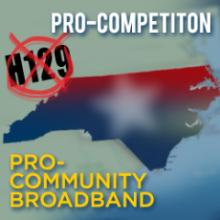
We dedicated a lot of coverage to Time Warner Cable's purchasing legislation to handicap communities from building competitive networks. Kara Millonzi, from the University of North Carolina School of Government, examined the new law and made a potentially interesting point. Communities have a steep mountain to climb to build a self-financing community network in the state but if a community wanted to treat broadband infrastructure like the roads they manage, the law may not impact them.
As stated above, S.L. 2011-84 imposes some significant limitations on a municipality’s authority to provide cable and Internet services. With some exceptions, the limitations apply to a “city-owned communications service provider.” A city-owned communications service provider is defined as:
  • a city
  • that provides cable, video programming, telecommunications, broadband, or high-speed Internet access service (collectively, communication services)
  • directly, indirectly, or through interlocal agreement or joint agency
  • to the public
  • for a fee
  • using a wired or wireless network (communications network).
This definition is important because the new limitations only apply to municipalities that meet all of its elements. In particular, the Act’s provisions only apply to a municipality that provides the listed services “for a fee.” That means that the requirements do not apply to any municipality that provides the above-listed communication services for free to the public. Many local governments provide free Wi-Fi service in their downtown or other central business areas. (In fact, I am taking advantage of Town of Carrboro’s free Wi-Fi as I draft this post.) If a municipality uses its unrestricted general fund revenue to finance this service, or any other communications services, it is not subject to the new Act’s provisions. (Note that many local governments actually offer this service by taking advantage of excess capacity on their internal broadband networks.)
Though it is an extreme long shot, it would be fascinating to see a community build a network without charging a direct fee to access.

Wanna Be a Wonk? Understanding Regulatory Capture

In the world of essential infrastructure, thousands of years of history have taught us that entities, acting on their own narrow interest, cannot be trusted to build or govern the building blocks of commerce or transportation. The temptation to abuse that powerful position has always proved too much for those without accountability to the public. For instance, if the only way to move goods is a canal, private canal owners will price at a high level or use their position to take a stake in all the industries using the canal. Such an arrangement is great for the canal owners but poor for the rest of society. Witness the history of canals and railroads. Two options to dealing with this problem have historically been either regulation or public ownership of such infrastructure. Readers of this site are undoubtedly well aware of our preference for public ownership - a structural approach using coops, local government, or non-profits to ensure the interests of the public at large receive the highest priority. This post explains one of the reasons a regulatory approach, whereby private companies still own the infrastructure (and often make key decisions) but must go through some form of public body that is supposed to prevent the natural interests of the private company from taking over and reducing the benefits to society at large. Writing in the Financial Times, John Kay explains regulatory capture, the process by which the agency or commission supposed to regulate effectively begins to act more in the interests of those regulated rather than the public. An obvious example of this is the Minerals Management Agency that has long improperly overseen the extraction industry, leading to the BP Gulf Oil Hole. As Kay rightly explains, there are multiple kinds of capture from outright corruption to something that leads some political science geeks bring up Gramsci and Hegemony...
But the most common form of capture is honest and may be characterised as intellectual capture. Every regulatory agency is dependent for information on the businesses it regulates. Many of the people who run regulated companies are agreeable, committed individuals who are properly affronted by any suggestion that their activities do not serve the public good.

Internet is Infrastructure, Not Nicety

Over the holiday break, I was visiting family in central Minnesota where they rely on dial-up for getting on the Internet. Translation: They are not on the Internet. Though I have previously said this, my experiences reminded me that nothing I do on the Internet on a daily basis is possible to do over dialup. I use gmail for my email - the delays in reading messages are intolerable and render email painful. Checking news sites is right out - they load up with all kinds of images and rich media advertisements. There is no "surfing" because it takes minutes to load a page - more like running through water than surfing over it. When I visit other family south of the metro area, I can use slow DSL - the best connection available there (at a price greater than what I pay in Saint Paul for a far faster connection) and the difference is notable - particularly when I try to send a large file to someone. When I returned home, I was ever-so-thankful for my faster cable connection... which is still far slower than options in many European or Asian countries though I pay far more than they do. Last month, Ben Scott of Free Press spoke on the NPR show "On the Media" regarding the importance of Internet access:

Checking in on Seattle

We occasionally look in on Seattle's broadband discussions because they are the largest city in the U.S. in which there is something approaching a serious discussion about a publicly owned community fiber network. They have a mayoral candidate who makes it a high priority and their Chief Technology Officer, Bill Schrier, both gets it and has an excellent staff that understands the benefits of such a network. Glenn Fleishman has just interviewed Bill Schrier about the network and subsequently discussed the public need for broadband in specific neighborhoods due to extreme market failure. I like Glenn's style - he asks difficult questions and pushes for real answers. That said, I still want to push back on one of his statements because I think it instructive:
Government is often criticized for eliminating competition, inefficiently providing private services, and removing the profit motive. However, market failures are often where governments are asked or begged to step in, and, when accomplished correctly, can provide new opportunities for private enterprise.
Glenn is absolutely right both in capturing some of the criticisms leveled at public networks as well as noting that publicly owned broadband tends to occur in the most difficult environments. Contrary to telco rhetoric, local government officials tend not to want to jump into telecommunications efforts unless they see it as vital for the community. They are busy enough and these networks take years of planning, public hearings, and lots of loud attacks from the very companies that refuse to build the needed networks. But look at the first two items that Glenn notes government is accused of: eliminating competition and inefficiently providing services. How is it that it can do both? Governments cannot coerce people into using the network and federal regulations prevent the local government from abusing its authority over the rights-of-way for the public network. Local governments can use untaxable bonds but private companies get depreciation, tax incentives, and can cross-subsidize from the nearby communities where they charge monopoly prices. As for removing the profit motive - this is hardly a criticism. Infrastructure should not be controlled by any entity with a profit motive - it is the foundation of all other markets.