
gigabit

Content tagged with "gigabit"

Related Topics
Displaying 321 - 330 of 393

Cedar Falls Schools Get 1 Gig from Cedar Falls Utilities

As of December 2, students and staff in Cedar Falls schools have access to 1 gig Internet service from Cedar Falls Utilities (CFU). The WCF Courier reports that the Board of Education recently decided to switch from the Iowa Communications Network (ICN):

Doug Nefzger, the district's financial officer, said though Des Moines-based ICN has been a great partner for a number of years, it's always best to go with a local group.

"We may be paying a little bit more money but what this provides for our kids far outweighs the added expense associated with that," Nefzger said.

The District will pay CFU approximately $11,400 per year for gigabit Internet access to be shared between nine schools and three other District facilities. ICN provided 130 Mbps Internet service for $8,200 per year. The District will now have the capacity to provide a tablet or laptop to each student by 2015. The 1:1 goal is part of the District's five-year technology plan.

According to Rob Houlihan, Network Service Manager at CFU, each building is already connected via CFU fiber. As a result, District buildings will also enjoy a 1 gig WAN. Robust Internet access is important, but a high capacity WAN improves communication between facilities with no need to send data to the Internet. CFU provides fiber connections at no charge to the District, saving significant public dollars. Shane Paige, Supervisor of Technology Services at the Cedar Falls Schools noted via email:

That could easily cost us $5,000-$10,000 per month after discounts if we were leasing lines. We have been extremely fortunate in the fact that we have never been put in that position of having to deal with the extra costs of point to point connections for our buildings.

CFU also provides free cable television service to twelve District facilities, saving approximately $600 per month.

SpringNet Continues Driving Jobs and Revenue for Local Community

A year has passed since we covered SpringNet in Springfield, Missouri, and its remarkable impact on local businesses and economic development. We recently spoke with SpringNet Director, Todd Murren, and Network Architecture Manager, Todd Christell, to get an update on how the network is progressing.

Demand for SpringNet’s high-speed data services continues to grow steadily. Financial statements for City Utilities of Springfield show the network generated $16.4-million in operating revenue last year against costs of $13.2-million. Better yet, revenues have increased around 3% per year while cost increases are closer to 0.5%. The end result is close to $3 million in annual net income for SpringNet. And all of this comes from a network that only serves commercial and public sector clients because Missouri state law restricts municipal network provision to only “Internet service,” meaning SpringNet cannot offer triple-play packages to compete with incumbent providers.

One of the highlights of SpringNet’s economic development success has been the attraction and retention of travel giant Expedia. After a large national provider failed to deliver on negotiations with the company, SpringNet stepped in to make sure Expedia brought its call center to Springfield. That effort has paid off handsomely for SpringNet and the local community. Expedia now employs close to 900 in the area after announcing in July that it was hiring another 100 employees in Springfield.

Up next for SpringNet is an effort to leverage its fiber infrastructure to create even more jobs. Believing that future job growth will revolve around the advancements enabled by gigabit networks, SpringNet is working with the Mid-America Technology Alliance (MATA) to host a hackathon with partners in Kansas City to explore what is possible between gigabit cities.

Cedar Falls Shows Long Term Muni Network Success: Community Broadband Bits Episode #75

Cedar Falls Utilities operates one of the oldest community owned networks in the nation. It started as a cable network in the 90's, upgraded to FTTH recently, and this year began offering the first citywide gigabit service in Iowa. CFU Communication Sales Manager Kent Halder and Network Services Manager Rob Houlihan join me for Community Broadband Bits podcast 75. We discuss why Cedar Falls Utilities decided to add cable to their lineup originally and how it has achieved the incrediblely high take rates it maintains. We also discuss the importance of reliability for municipal network and why they decided to transition directly to a FTTH plant rather than just upgraded to DOCSIS 3 on their cable system. Finally, we discuss its expansion into the rural areas just outside of town. Read all of our coverage of Cedar Falls on MuniNetworks.org. Read the transcript of our discussion here. We want your feedback and suggestions for the show - please e-mail us or leave a comment below. Also, feel free to suggest other guests, topics, or questions you want us to address. This show is 20 minutes long and can be played below on this page or via iTunes or via the tool of your choice using this feed. Listen to previous episodes here. You can can download this Mp3 file directly from here. Find more episodes in our podcast index. Thanks to Haggard Beat for the music, licensed using Creative Commons.

Los Angeles Wants Better Networks

The City of Los Angeles has announced a confusing intention to release an RFP for a vendor to install a gigabit fiber network. A recent Government Technology article touches on the broad plan to build a massive fiber and wireless network to every public and private premise. 

GovTech spoke with Steve Reneker, general manager of the Los Angeles Information Technology Agency. We last spoke with Reneker in Episode #11 of the Community Broadband Bits podcast. In that interview, he described how Riverside, California, used the publicly owned network to revitalize the economy and support the community's digital inclusion plan. Los Angeles wants to emmulate Riverside's success. From the GovTech article:

“[The plan] is really focused on fixing the operational issues that due to the economy have been left by the wayside over the last three and four years,” Reneker said. “So, correcting the lack of investment, the lack of technology refresh, the reduction in staff that make operational aspects of our infrastructure difficult to keep going forward, tries to deliver an incremental approach to starting a long, lengthy rebuilding process.”

Councilman Bob Blumenthal introduced a proposal in August, 2013 to also blanket the city in free Wi-fi. Blumenfield's website states the city has 3,500 existing wireless hotspots.

Engadget reports that the City Council unanimously approved the proposal to move forward with the plan at a November 5th meeting. A Request for Proposals will be issued in the coming months for the fiber and free wireless network:

Burlington's Next Step: Become a Gigabit Community

Burlington has seen ups and downs over the past few years but a new chapter is about to begin. The non-profit U.S. Ignite and the City are partnering to create BTV Ignite. The initiative will develop a gigabit community infrastructure and the applications that use it. With help from U.S. Ignite, Burlington will join the growing list of gigabit communities.

An advisory committee is fueling interest in the project. Mayor Miro Weinberger describes the effort as a way to develop a tech friendly local economy and increase access for individuals and institutions. A recent Government Technology article quoted the Mayor:

“We believe we’re well on our way to being the first city in the country that provides gigabit access to every student from kindergarten through college and even graduate school here in Burlington,” Weinberger said. 

The City and its partner have developed five critical steps based on consultation with Kansas City, Chattanooga, and other gigabit communities:

1.    Develop Structure to Foster Applications-Driven Energy

Much like the KC Digital Drive in Kansas City, [Executive Director of U.S. Ignite Bill] Wallace said the mayor’s advisory committee must play a key role in helping drive development.

2.    Create the Most Robust Infrastructure

Wallace said this will be particularly necessary for schools, businesses and libraries.

3.    Embrace Technology Through Community Events and Hackathons

By setting up a continuous stream of events like community hackathons, digital sandboxes and a hacker homes network similar to one developed in Kansas City, the city will be able to focus more on app development for specific capabilities, like cybersecurity or the development of complex systems.

4.    Share Practices With Other Cities to Deploy Networks

This could also mean sharing practices on how to generate applications.

5.    Tap into Federal Resources

Wallace said looking to federally funded resources like the National Science Foundation will be important when building out the infrastructure and developing applications.

Longmont Referendum: Haven't We Been Here Before?

November 5th probably seems like deja vu for the people of Longmont, Colorado. For the third time, the voters will respond to a ballot question that will impact their community's connectivity. Past referendums addressed whether or not the community could use its fiber ring for connecting businesses and residents.

They now have that authority. This year the question will be "when?"

Local incumbent providers grossly outspent municipal network supporters in 2009 and in 2011 with astroturf campaigns against referendums. Nevertheless, voters decided in 2011 to grant the local utility permission to use existing fiber resources to bring connectivity to businesses and residents. 

Since then, Longmont Power and Communications (LPC) began a slow build-out of fiber to businesses and homes within 500 feet of the existing loop. Local businesses, frustrated with poor service from Comcast and CenturyLink, jumped at the opportunity to have real high-speed connections. With a long list of businesses in queue for their connections, the City Council voted to use LPC reserve funds to connect businesses and residents to the loop. Clearly, the people of Longmont were ready for something better than the existing incumbent services.

Local blogger Steve Elliott connected to the service in September. To satisfy his curiosity, he ran speed tests immediately before and after he transitioned from Comcast service.

Comcast timed in at 26.08 Mbps download and 5.76 Mbps upload. LPC provided 89.99 Mbps download and 62.01 Mbps upload

From his post:

NATOA Keynote Panel Discusses Role of Local Governments in Improving Internet Access

In September, I joined the keynote lunch panel at the annual NATOA Conference to discuss what local governments can do to improve Internet access. Joanne Hovis moderated a discussion between Rondella Hawkins of City of Austin, Milo Medin of Google, and myself.

I have embedded the video below so it starts with the panel discussion. However, if you go back to the beginning, you will also be able to watch the annual award presentations, including one to Longmont in Colorado, as well as Milo Medin's 10 minute presentation prior to this panel discussion.

We discuss many important issues, particularly the various actions local governments can take to either build their own networks or to make the community more tempting to others who might build a network.

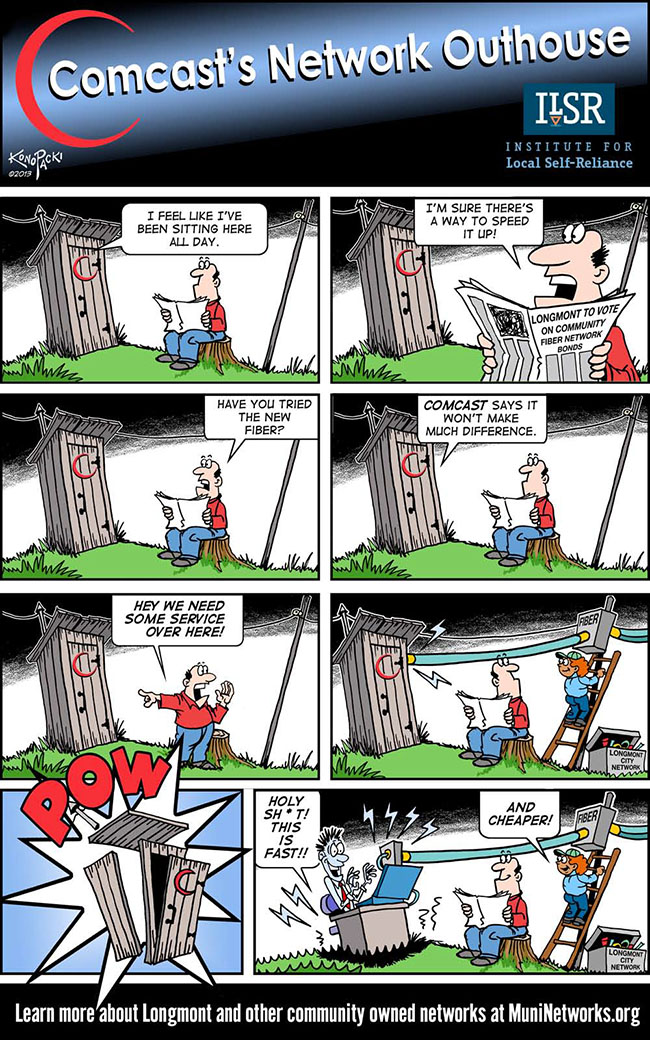
New Comic: Longmont Fiber Crushes Comcast's Cable Outhouse

Longmont Power and Communications, a city-owned utility north of Denver in Colorado, is slowly rolling out a FTTH network to local businesses and residents that are in close proximity to its existing fiber loop. They are offering a symmetrical gigabit of Internet access for just $50/month. Longmont Fiber Comic Strip Download this comic as a pdf. Sign up for our one-email-per-week newsletter with ongoing coverage of community owned networks. The local newspaper notes that some local businesses have already signed on, including a clinic:
Jurey said the city's network is three times faster than the speeds the clinic got before at a cost savings of $1,600 a month.
On November 5, citizens will decide a referendum on whether to expedite the building by issuing revenue bonds without increasing local taxes. A brochure explaining pro and con is available here [pdf]. Approving the bonds means building the network to everyone in a few years while not approving it will mean building the network over several decades. We recently did a podcast with Longmont Power and Communications Broadband Services Manager Vince Jordan and a local citizen campaigning for the referendum. Listen to that show here. Read the rest of our coverage about Longmont here.

Longmont Prepares to Vote on Fiber Bonds - Community Broadband Bits Episode #68

As Longmont prepares to vote on November 5, we are paying special attention to question 2B, which will authorize the city utility to issue revenue bonds to finance the FTTH network already being built. The successful referendum from 2011 gave the City authority to build the network and this referendum, if successful, will finance a rapid expansion rather than the present incremental approach that will take decades. We have a double interview today, with Vince Jordan rejoining the show from Longmont Power and Communications. He previously spoke with us on episode 10 but today he just gives us the facts about the network and scenarios of what will happen depending on how the city votes. The second interview is with George Oliver, co-founder of the grassroots group Friends of Fiber that is advocating for people to vote yes on question 2B. George explains the benefits of passing this debt, namely that area residents and businesses will gain access to a world class networks without increasing any taxes. Friends of Fiber is on Twitter and Facebook. Read our other stories on Longmont here. Read the transcript from this show here. We want your feedback and suggestions for the show - please e-mail us or leave a comment below. Also, feel free to suggest other guests, topics, or questions you want us to address. This show is 30 minutes long and can be played below on this page or via iTunes or via the tool of your choice using this feed. Listen to previous episodes here. You can can download this Mp3 file directly from here. Find more episodes in our podcast index. Thanks to Break the Bans for the music, licensed using Creative Commons.

Industry Lobbyists Oppose Gigabit Communities Race to the Top Proposal - Part 2

This is Part 2 in a two-part series discussing comments submitted to the FCC in response to a petition filed by Fiber-To-The-Home Council proposing a new Gigabit Community Race to the Top program.

In Part 1 of this post, I focused mainly on the complaints filed by the National Cable & Telecommunications Association (NCTA) against FTTHC’s Race to the Top proposal. While there was nothing new in those arguments (we see them all the time from industry spokespeople), I wanted to highlight their errors in light of this promising proposal to promote community networks. This post will focus on some of the more technical arguments which further demonstrate the industry’s false assertions.

NCTA attacks the FCC’s authority to implement Race to the Top, claiming that neither Section 254 (addressing universal service) nor Section 706 (addressing “advanced telecommunications capability”) of the Telecom Act authorize such a program.

The cable lobby’s argument against Section 254 authority hinges on the statute’s requirement that universal service funds only support services in small and rural markets that are “reasonably comparable” to those available in the rest of the country. Therefore, NCTA argues, Race to the Top would “enable a small number of communities to receive faster broadband speeds than the vast majority of Americans in urban areas have chosen to purchase.”

NCTA essentially believes its members get to dictate American broadband policy. If the majority of Americans “choose to purchase” only single-digit Mbps (megabits-per-second) broadband because that’s the only affordable option in their area, then the FCC cannot subsidize faster networks, anywhere. Or so argues the NCTA.

Even more tortured is the NCTA’s argument against the FCC’s Section 706 authority to implement Race to the Top. Section 706 instructs the FCC to regularly assess the deployment of “advanced telecommunications services,” and when it finds that such services are not rolling out fast enough, the FCC must make efforts to accelerate deployment.