
FTTH

Content tagged with "FTTH"

Fiber to the Home
Displaying 311 - 320 of 1312

Join Us Thursday, February 3rd at 5pm ET, for a Reality Check: Scaling Networks in 2022 - Episode 32 of the Connect This! Show

Join Us Thursday, February 3rd at 5pm ET, For A Reality Check: Scaling Networks in 2022 - Episode 31 of the Connect This! Show.


In this episode of the Connect This! Show, co-hosts Christopher and Travis Carter (USI Fiber) are joined by Monica Webb (Ting) and Robert Boyle (Planet Networks) to talk about the realities of expanding network infrastructure in 2022.


The panel will dig into supply chain issues, challenges faced in scaling up, and what type of partnerships help grow networks quickly.


Subscribe to the show using this feed on YouTube Live or here on Facebook Live, or visit ConnectThisShow.com.


Email us broadband@muninetworks.org with feedback and ideas for the show. Watch here on YouTube Live, here on Facebook live, or below.

Chico, California Moves Launches Pilot Project with Eye On Citywide Open Access Fiber Plan

Hoping to leverage both a major new California broadband expansion initiative and American Rescue Plan (ARP) funds, Chico, California is moving forward with its plan to deliver affordable fiber broadband to historically-underserved city residents. 

The Chico city council last year began exploring using $4.8 million of the city’s $22 million in American Rescue Plan (ARP) funds to build a citywide fiber network. After spending $250,000 to research its options, the city council voted last week to move forward with the plan.

Dual Purposes

City leaders hope the network will provide more reliable connectivity for the first responders battling historic wildfires in the region. But like many communities, Chico was also spurred to action by telecom market failure, a lack of competition among regional monopolies, and the slow speeds, spotty coverage, and high prices that routinely result. 

“All of us have had experience with the existing incumbents and what we pay for versus what we get,” said Chico's Information Systems Manager Josh Marquis. “There's a lot of areas of our region that do not have access either through affordability gaps or through service gaps.”

Much like Fort Pierce, Florida, Chico will begin by running a pilot project first targeting lower income parts of the city like the Chapman Mulberry neighborhood. There, residents will be provided inexpensive access to symmetrical fiber either through the city or a partner, made cheaper still once the FCC’s Emergency Broadband Benefit (EBB) discounts are applied. 

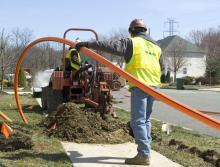
Building a Fiber-to-the-Home Network

What’s it take to run fiber to the home? In a new animated video, ILSR Senior Researcher Maren Machles breaks down conduit, the central office, and the "last mile" to give you a birds-eye-view of a typical fiber optic network. Coming in at just under two and half minutes, this video is suggested for folks who need a quick overview of what the last-mile is, and what it takes to build a subterranean fiber optic network. 

Special thanks to USI Fiber, and their willingness to give our team an inside look of the building and operation of their network in Minneapolis. 

Writing and voice over by ILSR Senior Researcher Maren Machles. Animation by ILSR Digital Media Specialist Henry Holtgeerts.


Join Us Thursday, January 20th at 5pm ET to Talk About Fiber in 2022 - Episode 30 of the Connect This! Show

In this episode of the Connect This! Show, co-hosts Christopher and Travis Carter (USI Fiber) will be joined by Heather Gold (CEO, HBG Strategies LLC) and Milo Medin, an industry veteran who recently left Google as VP of wireless services.

The panel will tackle what we can expect to see in the broadband marketplace in 2022, with a special focus on fiber, including who is building it and why the capital markets are so hungry for it. What are we likely to see from builders big and small? What will competing against the national monopoly providers look like? Is fixed wireless a viable option ten years from now?

Subscribe to the show using this feed on YouTube Live or here on Facebook Live, or visit ConnectThisShow.com

Email us broadband@muninetworks.org with feedback and ideas for the show.

Watch here on YouTube Live, here on Facebook live, or below.

Sprout Fiber Takes Root in Rural Alabama

In June of 2020, Cullman Electric Cooperative launched Sprout Fiber Internet, a fiber-to-the-home (FTTH) network to bring broadband access to its members in rural Alabama. Sprout Fiber has taken significant strides since then, connecting its 1,300th subscriber in October of 2021.   

By July of 2020, Sprout Fiber had started the first phase of network construction, with plans to connect 25 percent of Cullman’s membership – or 12,000 households – by spring of 2022. Sprout’s first customer was connected in January 2021. By the following September, Sprout was serving “over 1,000 broadband customers and handling about 12 activations per day,” with a little under half of its Phase I deployment finished. This puts its take rate around 20 percent in less than a year. By November, Sprout Fiber had completed a fiber ring backbone to connect its offices and substations.

Expanding Access and Choices

Local competition includes AT&T and Charter Spectrum, which offer service to the town of Cullman itself but not to its surrounding areas. Several wireless and satellite providers also offer service locally. There is significant demand for Sprout Fiber’s service, however, including from members in gap areas that don’t have other options for high-speed Internet access. According to Sprout Fiber, “twenty-five percent of [its] service territory still does not have any access to [the] Internet, and other areas do not have access to a quality Internet connection.”  

Guided by member demand and targeting areas without existing robust broadband infrastructure, Sprout Fiber plans to expand broadband service into ten new areas and to 9,000 additional members in 2022 (see map below, with green areas live right now, with pink scheduled to go live early in 2022 and purple to follow thereafter. For a high-resolution version of the map, click here). Cullman Electric CEO Tim Culpepper told members: 

Allentown, Pennsylvania Proposes Using Rescue Plan Funds for Muni Fiber Network

Once a booming center of manufacturing, Allentown, PA (pop. 120,900) is looking to reinvigorate its economy by reinventing itself as a modern 21st century “smart city,” bringing fiber-to-the-home Internet connectivity to every resident in the city.

In October, the city proposed using $7 million of its $57 million in American Rescue Act Funds to aid in the deployment of a citywide FTTH network. City leaders hope the investment will help them reach the goal outlined in its strategic economic development plan to become a smart city by 2030.

The city will work with Iota Communications to conduct a feasibility study they hope will be complete in the coming months. While the possibility of a FTTH network is in the early stages for the city, the proposal signals a serious ambition to bridge the digital divide in the region.

Feeling The Way Forward

Allentown is one of three cities that make up a larger geographic area known as Lehigh Valley, with the other cities being Easton (pop. 27,000) and Bethlehem (pop. 75,500). For a while now, leaders in the valley have been talking about the digital divide and it’s been made clear with the pandemic that it can no longer be put on the backburner.

Pennsylvania lawmakers passed a law 2019 clearing the way for municipalities to have more of a say in how 5G is deployed in their communities. And while many local officials say the new law will help pave the way for Allentown to stay ahead of the curve, some have cautioned that a focus on 5G is a major distraction.

A Local Coalition Gets Organized to Bring Quality Connectivity to Maine’s Midcoast

Five small towns in rural Maine are connecting with one another in a steady grassroots effort to expand broadband access in the Midcoast. After conducting a survey which affirmed the towns’ acute need for better connectivity, a local coalition is navigating state funding and weighing network options. 

In Waldo County, a collection of local officials and community volunteers have formed the Southwestern Waldo County Broadband Coalition (SWCBC) to organize efforts to bring broadband to five towns in rural Maine, clustered about 30 miles east of Augusta. Freedom, Liberty, Montville, Palermo and Searsmont combined have only 3,300 houses along 340 miles of road. The need for better Internet access became particularly visible during the pandemic, as local officials tried to convene online for Selectmen’s meetings. Two selectpersons from neighboring towns connected over this shared need for access, and the coalition grew from there. 

Fort Pierce, Florida Utility Aims To Deliver Affordable Fiber To All

Since 1972, the Fort Pierce Utilities Authority (FPUA) has provided gas, electric, water, and natural gas services to Fort Pierce, Florida and surrounding areas. Now, inspired by efforts in cities like Chattanooga, the utility hopes to leverage that expertise to deliver affordable fiber Internet access to the city’s 45,000 residents as part of a significant expansion of its internal fiber network. 

Building on Its I-Net

Since the early 2000s, FPUA has deployed 110 miles of optical fiber via its FPUAnet Communications division. Initially, the project focused on bringing ultra-fast fiber broadband to large businesses, schools, hospitals, and other community anchor institutions. 

In 2018, the city decided to expand its footprint to boost the local economy and cement Fort Pierce’s future reputation as a smart city of the future. First by upgrading the company’s existing utility systems (connected to 30,000 existing customer energy meters), then by utilizing that access to drive expanded fiber connectivity to smaller business and residential customers alike. 

“We wanted to look at what we can do, and what are the needs in the community,” Jason Mittler, FPUAnet manager told me. “We have other local competition…Comcast, AT&T are competitors in the area. But in the realm of symmetrical speeds, no one really offers it.”

Fort Pierce certainly isn’t alone in that regard. Even the notoriously inflated FCC data indicates that most U.S. communities rarely have access to symmetrical speeds of 100 Megabits per second (Mbps) downstream and faster, and competition at those speeds is largely nonexistent. Addressing this market failure created an obvious business expansion opportunity for FPUANet that would not only bring additional value to its existing utility customers in the form of improved reliability and cost savings, but improve regional connectivity while keeping those dollars local

RiverNet Feeds Three South Carolina Counties Hungry for Broadband

Pageland, South Carolina, a small rural town in Chesterfield County, is known for its watermelon. The town once billed itself as the “Watermelon Capital of the World” and still hosts an annual Watermelon Festival every summer that draws thousands of visitors each year. But these days something different is growing off the vine out of Pageland that is rejuvenating the region.

Spanning three rural counties in the north-central part of the state, the Lynches River Electric Cooperative (LREC) – a member-owned cooperative headquartered in Pageland – announced a partnership with North Carolina-based Fiber Optic Solutions in January of 2020 on the start of construction for a fiber-to-the-home network. Through its wholly-owned subsidiary RiverNet Connect, the “goal is to provide world-class Internet [access] to every house, on every dirt road that wants it and we won’t stop until we’ve done just that.”

High Speed Construction and Service

Having already deployed fiber to connect its electric substations, in June of 2019 LREC surveyed its members to gauge whether they wanted the co-op to extend the network and begin offering high-speed Internet service. Over 5,000 members responded to the survey indicating they were overwhelmingly in favor of the idea.

Image

Two months later, the LREC Board of Trustees voted unanimously to bring fiber Internet service in phases to its members living in Chesterfield, Kershaw, and Lancaster counties. That was followed by an announcement in October of 2019 at LREC’s annual membership meeting that the co-op had created RiverNet Connect.

New Fairlawn Gig Video Highlights Impact of Municipal Broadband

FairlawnGig has released a new, short, six-minute video that captures why broadband infrastructure is essential for improving quality of life and boosting economic development in communities across Ohio, highlighting a lesson more cities and towns across the nation are learning first-hand: if the goal is to build a bridge over the digital divide, local communities will likely have to build it themselves.

The video (which you can watch in its entirety by clicking on the video embedded below) also serves as a subtle but fitting admonition of an anonymous state Senator who submitted an amendment into the state budget earlier this year. If passed, it would have threatened to put the award-winning fiber network out of business and prevented other communities in the Buckeye State from following in Fairlawn’s footsteps.

Thankfully, the amendment – a gift to incumbent monopoly ISPs intent on crushing any competition – was rejected after state lawmakers were inundated with constituent complaints about the “in the dark of night” proposal.

Compelled to Take It on Themselves

Fairlawn, a small city of approximately 7,500 Ohioans about 10 miles northeast of Akron, created a telecommunications utility in 2015 to bring city-wide access to high-speed Internet service after years of dealing with subpar broadband offerings. Today, the network enjoys a take-rate of 60 percent while subscribers enjoy a choice of three residential services tiers: a 300 Megabits per second symmetrical connection for $55/month; symmetrical gig speed service for $75/month; or 2.5 Gigabits per second service for $149/month.

In the video, the narrator begins with an observation that is fast becoming obvious to just about everyone:

Many communities in the U.S. are being left behind due to a lack of adequate Internet service and access to state of the art technology.