
fixed wireless

Content tagged with "fixed wireless"

Displaying 181 - 185 of 185

Minnesota House Proposal to Kill Broadband is the Wrong Move for Economic Development

Representative Pat Garofalo’s (R-53B) proposal to cut funding for broadband grants is the wrong move for Minnesota. The Institute for Local Self-Reliance (ILSR) is absolutely opposed to any suggestion Minnesota should have two-tiered Internet access - a fast standard in urban areas and slower, less reliable access in Greater Minnesota.

Wireless technology and satellite Internet are not sufficient for homes and businesses in the modern economy. They certainly won’t lead to the kind of job creation or retention that Greater Minnesota needs. Modern jobs require modern connections.

ILSR has long fought the notion, often advanced by the cable monopoly lobbyists in Saint Paul, that wireless is good enough for people that don't live in the metro. Nearly 100 years ago, the United States wisely pursued policies to electrify farms and the boosts to the economy were staggering. Given the significant budget surplus, now is the not the time for the Legislature to turn its back on Greater Minnesota.

“It’s outrageous to us that a lawmaker who is supposedly in favor of needed job creation for our communities would turn around and slash the very thing that could support it,” says Christopher Mitchell, director of the Community Broadband Networks Initiative at the Institute for Local Self-Reliance (ILSR). “Rural Minnesotans should not be constantly moved to the back of the line for 21st century connectivity. We can’t wait any longer for the kinds of investments that will carry our schools and businesses across the digital divide.”

In Windom, Minnesota, for instance, the community has seen strong job growth, including at the Toro Manufacturing plant, because it could get better Internet access from the small city's utility than it could get at Twin City locations. Those jobs would not exist if local employers relied only on wireless or satellite technologies.

More information:

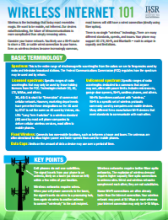
Wireless Internet Access Fact Sheet

Wireless networks have been incredibly successful, from home Wi-Fi networks to the billions of mobile devices in use across the planet. So successful, in fact, that some have come to believe we no longer need wires.

We developed this fact sheet to clarify some misconceptions about what wireless Internet networks are capable of and the importance of fiber optic cables in building better wireless networks as our bandwidth needs continue to increase.

This fact sheet defines important terms, offers some key points clarifying common misconceptions, compares 4G and 3G wireless to wired cable, and more. We also include references to additional resources for those who want to dig deeper.

Download our Wireless Internet 101 Fact Sheet Here [pdf].

If you want updates about stories relating to community Internet networks, we send out one email each week with recent stories we covered here at MuniNetworks.org. Sign up here.

Port Angeles' "The Mesh" Up and Running

Citywide Internet will soon be available as a monthly service in Port Angeles on Washington's Olympic Peninsula. Mayor Cherie Kidd, Police Chief Terry Gallagher, and Councilwoman Brooke Nelson participated in a ceremonial "cable cutting" event last week. The event was to celebrate the new network, nicknamed "The Mesh." Arwyn Rice, of the Olympic Peninsula Daily News covered the event in a recent article.

According to the Metro-Net website, a $2.6 million Broadband Technology Opportunity Program (BTOP) grant funded part of the $3.7 million Wi-fi system. The network serves a dual purpose, serving public safety first responders and a separate level for public access. From the News article:

The public safety system allows police officers to track each other through the city so that they know where their backup is without having to call radio dispatchers.

They also can do their own searches on driver's licenses and license plates, check recent call histories and access reports, said Officer Erik Smith, who demonstrated the use of the system in his patrol car.

Eventually, the system will be patched into the city's security cameras and police car dashboard cameras — and potentially Port Angeles School District security cameras — so that officers will be able to monitor situations at City Pier from their cars at Lincoln Park, said Police Chief Terry Gallagher.

“The limitation is our imagination,” Gallagher said.

While access is free through October 31, OlyPen MetroNet will start offering a variety of plans on November 1. Mobile and fixed-point service will be available and range from $5.95 (some sources say $4.95) for one day to $37.95 per month. Every user will receive the first hour of Internet access free each day.

As we have often found, the spirit of collaboration and determination on a local level helped realize this possibility:

Vermonters Angry at Wireless Broadband Stimulus Grant Instead of Fiber Loan

Vermonters are asking some hard questions about the federal broadband stimulus decision to throw money at a wireless network for Vermont rather than loaning money to an organization dedicated to delivering real broadband. Senator Bernie Sanders convened a meeting to discuss the awards toward the end of October.
Senator Bernie Sanders led off his “broadband town meeting” Saturday morning at Vermont Technical College with a ringing affirmation of the need for better broadband coverage in Vermont and the nation. However, nobody in the crowd of nearly 300 people needed to be convinced of that. What they wanted to know was whether a huge new federal grant to a private company was the right way to do it.
VTel, a small private telephone company, received a $116 million grant to build a FTTH network to serve their existing 18,000 footprint as well as a wireless network that is intended to serve the entire state. In contrast, the East Central Vermont Fiber Network (which we have covered previously), applied for a loan to build a FTTH network to everyone in the 24 communities that have joined together to form the network. The ECFiber network would be run by a nonprofit and would repay the loan from revenue generated by selling triple-play services on the network.

Warwick, Massachusetts Builds Community Wireless Network

While researching the Wired West Network in rural Massachusetts, I learned about another community broadband network. The little town of Warwick built a wireless network for itself; the story behind it gives a glimpse into the ways that the federal approach to broadband really fails small communities. Miryam Ehrlick Williamson described their motivations and experiences. In 2008, after considering their options, they voted to borrow $40,000 in a town meeting (Warrick has 750 people) to build a simple wireless system that would be far superior to the existing options of dial-up and satellite (neither of which are a service that could properly be termed broadband). State and federal programs ostensibly meant to help towns in this position do little good:
We know about a USDA program meant to bring broadband to rural America. Our information is that most of the money has gone to suburban communities in Texas, and we don’t have a professional grant administrator to chase down any money that might be left. We’re aware that the Massachusetts governor just signed a $40 million act establishing the Massachusetts Broadband Institute, to figure out how to bring broadband to unserved and underserved towns. We’re also aware that the money will go to vendors to develop regional systems and we don’t have the patience to wait the two or three years it will take for anyone to get around to thinking about maybe serving us.
Ultimately, the City was able to lend itself the money:
As it has turned out, we didn’t need to borrow — town financial officers found the funds without going to the bank for them. We got the necessary permits from the owners of two towers here, bought the equipment, got a couple of people trained to install the equipment, and turned on our first customers in March, 2009.
Between a local mountain and available cell tower, the topology apparently fits a fixed-wireless approach (at least for a significant part of the population).