

competition

Content tagged with "competition"

Related Topics
Displaying 661 - 670 of 713

Continuing Push to Stop North Carolina Monopoly Protection Act
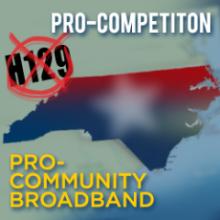
As part of the effort to stop the bill that will codify Time Warner Cable's monopoly in North Carolina, we published a press release today (previous coverage of the bill here):
While the rest of the world is working to become more innovative and competitive, the North Carolina General Assembly is considering a bill that will stifle innovation, hurt job creation and slow economic development. The Bill, H129/S87 will effectively prevent any community from building a broadband network and impose onerous restrictions on existing networks, including Wilson’s Greenlight and Salisbury’s Fibrant. Greenlight and Fibrant are the most technologically advanced citywide networks in the state, comparative to the best available in the U.S. and international peers, according to a study released by the Institute for Local Self-Reliance (ILSR) in November, 2010. This bill will protect the aging networks of incumbent cable companies—furthering their effective monopolies—that have refused to invest in newer, faster technologies. “This bill is a job and competitiveness killer. I don’t know why North Carolina wants to protect old technology, but if they want to get on the information super highway in a horse and buggy—the world is going to pass them by,” said Christopher Mitchell, Director of ILSR’s Telecommunications as Commons Initiative. The bill says it is an act to “protect jobs,” a claim that puzzles Mitchell. “Community owned networks create jobs both directly and indirectly – and there is no evidence they have resulted in the elimination of any jobs.”
You can now Sign a petition showing your support for community networks in North Carolina - please make sure this link circulates among any contacts you have in NC!

Digging into H129: Another Bill in NC to Limit Local Authority and Broadband Competition

As we predicted, Time Warner Cable is pushing a new bill in North Carolina to limit competition and local authority to build broadband networks (Save NC Broadband is alive again). H129 purports to be An Act to Protect Jobs and Investment By Regulating Local Government Competition with Private Business - [download a PDF of the bill as introduced]. This bill is another example of state legislators refusing to allow communities to make their own decisions -- imposing a one-size-fits-all policy on communities ranging from the metro area of Charlotte to small communities on the coast and in the mountains. Many of the provisions in this bill apply tough constraints on the public sector that are not applied to incumbent providers, but this analysis focuses only on a few. Let's start with the title:
An Act to Protect Jobs and Investment by Regulating Local Government Competition with Private Business
There is no support anywhere in this bill to explain what the impact of community networks is on jobs. Nothing whatsoever. There is a claim that "the communications industry is an industry of economic growth and job creation," but ignores the modern reality that that the communications industry goes far beyond the private sector. In fact, the recent history of massive telecommunications providers is one of consolidation and layoffs. It is the small community owned networks that create jobs; larger firms are more likely to offshore or simply cut jobs. Certainly all businesses depend on communications to succeed. Unfortunately, they are often limited to very few choices because the of the problem of natural monopoly.

AT&T Pushes to Prevent Potential Broadband Competition in South Carolina

In South Carolina (the state TWC Forgot), AT&T is pushing harsher restrictions on any publicly owned broadband system in an attempt to derail one or more broadband stimulus projects. South Carolina already greatly restricts community broadband networks, likely one of the reasons no incumbent there bothers to upgrade in a similar time frame as the rest of the country. This should be seen a significant overreach -- AT&T is trying to shut down County efforts to improve middle mile access -- whereas most preemption tends to heavily restrict community last-mile networks. This is a whole new world of anti-competitive policy to favor AT&T (not dissimilar from what AT&T wants to do in Wisconsin and Fairpoint did in Maine).
The bills would force Oconee County to follow guidelines as a broadband service provider that would likely cripple the county’s current three-year project to construct 245 miles of broadband cable, county administrator Scott Moulder said. ... Oconee County’s goal is to be a so-called “middle mile” provider, Moulder said, essentially providing a network that would allow private broadband providers to extend their service into areas they aren’t serving. In most cases, those are areas where the private providers have found it is not financially feasible to install their own infrastructure. AT&T, Moulder said, has been asked to be a partner in the project as a retailer, but the company’s current actions are a rebuff.
The Oconee project is meant to attract additional independent service providers to invest in projects, not the County itself. But that hardly matters to AT&T, which wants to preserve the present lack of competition in order to maximize their gains at the public expense. The Bill, S 483 is viewable here and contains the same old tired arguments claiming the public sector has all the advantages.

Whose Internet? NC Communities Should Defend Freedom to Build Networks

Durham's Herald Sun published our op-ed about community broadband networks in North Carolina. Reposted here:

Who should decide the future of broadband access in towns across North Carolina? Citizens and businesses in towns across the state, or a handful of large cable and phone companies? The new General Assembly will almost certainly be asked to address that question.

Fed up with poor customer service, overpriced plans and unreliable broadband access, Wilson and Salisbury decided to build their own next-generation networks. Faced with the prospect of real competition in the telecom sector, phone and cable companies have aggressively lobbied the General Assembly to abolish the right of other cities to follow in Wilson and Salisbury's pioneering footsteps.

The decision by Wilson and Salisbury to build their own networks is reminiscent of the decision by many communities 100 years ago to build their own electrical grids when private electric companies refused to provide them inexpensive, reliable service.

An analysis by the Institute for Local Self-Reliance (http://tiny.cc/MuniNetworks) compares the speed and price of broadband from incumbent providers in North Carolina to that offered by municipally owned Greenlight in Wilson and Fibrant in Salisbury.

Wilson and Salisbury offer much faster connections at similar price points, delivering more value for the dollar while keeping those dollars in the community. For instance, the introductory broadband tiers from Wilson (10 downstream/10 upstream Mbps) and Salisbury (15/15 Mbps) beat the fastest advertised tiers in Raleigh of AT&T (6/.5 Mbps) and TWC (10/.768 Mbps). And by building state-of-the-art fiber-optic networks, subscribers actually receive the speeds promised in advertisements. DSL and cable connections, for a variety of reasons, rarely achieve the speeds promised.

Curbing innovation

Gotta Love that Efficient, Competitive Broadband Market

As previously noted on both Fiber Evolution and Joho the Blog, Brough Turner (creator of netBlazr) created a slide showing the state of broadband competition in one of our largest cities: Boston. Commercial Broadband Competition The building on the right has a bunch of carriers who are competing. But only Verizon serves the building on the left with dedicated access (a committed information rate as opposed to the standard "up to" connections most residents and many small businesses use). Thanks to Brough for circulating the slide.

Dave Burstein Reflects on FCC Policy

Dave Burstein of DSL Prime is interviewed on a recent episode of America's Report on TelecomTV.

This video is no longer available.

The Economist Again Blasts US Anti-Competitive Telecom Policy

The Economist has again editorialized about US telecom policy, in this case specifically about network neutrality.
This debate is loudest in America, uncoincidentally the developed market with the least competitive market in internet access. Democrats, who are in favour of net-neutrality rules, insist regulation is needed to prevent network operators discriminating in favour of their own services. A cable-TV firm that sells both broadband internet access and television services over its cables might, for example, try to block internet-based video that competes with its own television packages. Republicans, meanwhile, worry that net neutrality will be used to justify a takeover of the internet by government bureaucrats, stifling innovation. (That the internet’s origins lie in a government-funded project is quietly passed over.)
They take a fairly middling approach, regarding the network neutrality rules as decent, arguing that some measure of discrimination should be allowed and could be beneficial (one wonders if they truly thought deeply about this: before YouTube, connections would have been optimized against streaming traffic and YouTube may never have succeeded). In any event, they answer their own question: the real problem in the U.S. is lack of competition among Internet service providers.
These details are important, but the noise about them only makes the omission more startling: the failure in America to tackle the underlying lack of competition in the provision of internet access. In other rich countries it would not matter if some operators blocked some sites: consumers could switch to a rival provider. That is because the big telecoms firms with wires into people’s homes have to offer access to their networks on a wholesale basis, ensuring vigorous competition between dozens of providers, with lower prices and faster connections than are available in America. Getting America’s phone and cable companies to open up their networks to others would be a lot harder for politicians than prattling on about neutrality; but it would do far more to open up the net.
Unfortunately, they do not consider another remedy: local ownership that is accountable to the public.

Problem of Scale Hurts Frontier with FiOS

Frontier has been bitten by the same disadvantage many communities face when building their own networks -- little market power means having to overpay for everything. When Frontier bought millions of Verizon rural lines, it bought a few FiOS connections as well. But not enough to gain any bargaining power with channel owners. So Frontier had to raise the costs of its video services up for 46%. Lest anyone feel too sorry for Frontier, they are doing just fine. It is their customers who suffer. But it is a reminder that the issue of scale and market power are barriers to all competition, not just community networks. If we want to have real competition in this country, the Congress and the FCC need to stop ignoring the problems caused by massive players distorting the market. This unregulated market is an invitation for big players to join together and screw everyone else.

Susan Crawford: Why Comcast/NBCU Matters

The Comcast/NBCU merger poses a real threat to the future of innovation, competition, and the open Internet. Put simply: size matters. The larger Comcast gets, the more market power it has and the more all other markets that depend on broadband and media will be distorted. Susan Crawford knows this better than most and explains why everyone should be concerned about it. As we've harped on time and time again:
The crucial thing to understand is that high-speed Internet access to the home really is a crushingly-expensive natural monopoly service to install. The telephone companies haven’t found a way to make this work, because it’s so much more expensive to dig up the streets to install fiber than it is to upgrade cable electronics to DOCSIS 3.0. So they have backed off. The cable industry has made its investment, and is ready to reap its rewards of scale and high fixed costs - secure in the knowledge that no competition is coming after it, and having divided up the country neatly among its members. Meanwhile, the telcos are steadly losing fistfuls of money. As Morgan once said of railroads, “The American public seems to be unwilling to admit . . . that it has a choice between regulated legal agreements and unregulated extralegal agreements. We should have cast away more than 50 years ago the impossible doctrine of protection of the public by railway competition.” In the cable world, we are deep into unregulated extralegal agreements, and competition is not going to rescue us.
The longer communities wait to build this important infrastructure, the harder it will be. It is hard to imagine national candidate speaking more stridently about the important of the open Internet than did Obama and even he bowed to the pressure of the private Internet access providers. While we should pressure the federal government to regulate in the public interest, we must take responsibility for our future at the local level with smart investments.

Interview With Jay Ovittore of Communities United for Broadband

In another TelecomTV segment, Jay Ovittore speaks with Guy Daniels discussing Communities United for Broadband. This video is no longer available.