
BTOP

Content tagged with "BTOP"

Related Topics
Displaying 21 - 30 of 44

Merit Collaborates With OARnet and Local Community in Hillsdale, Michigan

A recent press release from the Merit educational and research network in Michigan announces a new connection to its Ohio sister, OARnet. Member entities and local communities now enjoy better redundancy, expanded reach, and better services. Local communities continue to benefit from the presence of the middle mile infrastructure.

The network helps local Hillsdale College to cut connectivity costs; the Merit announcement quotes Hillsdale College leadership:

"Hillsdale College has been a Merit member since 1992," stated David Zenz, executive director of information technology services for Hillsdale College, "and it was always a dream to figure out some way to eliminate expensive data circuit costs to free up funds to purchase more bandwidth. In 2008 The City of Hillsdale, the Hillsdale Intermediate School District, Hillsdale College, and Merit figured out how to do just that."

Through a long term collaborative effort, Merit, the City of Hillsdale, Hillsdale Board of Public Utilities (BPU), Hillsdale College, and Hillsdale County Intermediate School District (ISD) came together to establish the Hillsdale Community Network. Each entity now benefits from lowered connectivity costs, better infrastructure, and improved opportunities. 

A 2009 story from Merit, describes the situation at ISD:

Local Efforts Will Bring Free Wi-Fi to Vidalia, Louisiana

Vidalia joins the growing list of communities with plans to offer free Wi-Fi. A recent Miami Herald article reports on recent plans. Community leaders hope to get the project ready for launch in spring 2014.

Vidalia, home to 4,300 residents, hoped to use funds from a 2010 Broadband Technology Opportunities Program (BTOP) grant to build a fiber network. Unfortunately for the entire state, the grant was revoked due to Governor Jindal's shenanigans. Jindal's plans for the funds violated the terms of the grant. Vidalia, with its own electric utility, then sought funding from other sources. 

According to the Herald article:

The Telecommunications Development Fund Foundation awarded the city a $30,000 grant, announced last week, to deploy a wireless network. The foundation was founded in 2008 with the mission of bringing communications technology and opportunities to areas underserved by Internet providers.

The Natchez Democrat reports that the service will cover 77 acres that include the Vidalia municipal complex, including City Hall and public safety facilities, and recreation fields used by Concordia Recreation District No. 3. Mayor Hyram Copeland told the Democrat that visitors to the complex repeatedly ask for Wi-Fi access.

The Democrat also reports Senator Mary Landrieu is leading the effort to improve connectivity in the area:

The senator said the Wi-Fi project perfectly complements Vidalia’s ongoing work to build a technology center and install high-speed fiber optic Internet access throughout the city.

“This project will add to Vidalia’s excellent quality of life for residents and promote additional entrepreneurial opportunities for local businesses,” Landrieu said.

Local media coverage of the project:

NoaNet and Benton PUD Finish Expansion in Washington, Celebrate Completion of Fiber Network

South central Washington's Benton PUD and the Northwest Open Access Network (NoaNet) recently finished a 50-mile fiber-optic expansion [PDF of the press release]. The new construction brings high-speed Internet service to the Paterson School District. The District serves 110 kids in grades K-8.

A $1.8 million Broadband Technologies Opportunity Program (BTOP) award paid in part for the expansion of the 100% underground network. The network includes 230 miles of middle-mile connectivity across rural Benton County. 

The recently completed NoaNet project totaled $140 million for 1,831 fiber miles over three years. The open access network hosts 61 last mile providers and ten Washington State Public Utility Districts (PUDs) belong to the nonprofit.

In a Yakima Herald article on the network completion, Governor Jay Inslee noted:

“It is underground, but its results are above ground,” he said. “In every place, it reaches about 500 communities from Asotin to Zillah and places between.”

Washington's Okanogan County PUD Expanding Fiber Network

Okanogan County, located along the extreme north central border of Washington State, is expanding its wholesale fiber optic network to more small local communities. The Okanogan Public Utility District (PUD) received a $5.5 million grant and a $3.7 million loan through the American Recovery and Reinvestment Act (ARRA) and will extend service to about 80% of the PUD service area. The county is home to about 41,000 people.

According to a recent Methow Valley News article, the construction began in February and the project is schedule for completion by the end of 2013. The network will be about 200 miles long and will also include 143 wireless access points along the power line route. Construction will also include new poles, tall enough to host both power and fiber optic lines. According to the PUD's director of power:

Some people who will now have the option of faster Internet connections were previously served only by dial-up or satellite services, said [Ron] Gadeberg. Even with the expanded “last-mile” network, “there are still tons of unmet needs, because it’s such a big county and some people are so remote that it is cost-prohibitive to serve them,” he said.

A local ISP, MethowNet.com, offers service to customers on the PUD's existing fiber network and will expand northward to serve additional communities north of its current service area.

Governments Should Focus on Infrastructure Despite False Statistics Peddled by NY Times and Others

Having just read the New York Times story "Most of U.S. is Wired, but Millions Aren't Plugged In," I was reminded that even the top mainstream telecom journalists really have little understanding of what they write. This is a bit ranty but comes back together constructively at the end. I just read that "nearly 98 percent of American homes now have access to some form of high-speed broadband." Really? Just what exactly does that mean? It is definitely not the current FCC minimum standard speed required to engage in basic Internet activities: 4 Mbps downstream and 1 Mbps upstream. Not even close. To get 98%, I can only assume that the author has started with flawed stats from the FCC that are comprised on systematically overstated DSL availability in rural areas by carriers like Windstream, Frontier, CenturyLink, and others. He likely then included satellite Internet access availability, which is explicitly not broadband due to the inevitable lag of a 50,000 mile roundtrip to geosynchronous orbiting satellites. But we don't know. We just know that Edward Wyatt knows that by some definition, nearly everyone in America has "high speed" broadband. This is news to the vast majority of rural communities I hear from, who see maps paid for by their tax dollars claiming they can get broadband in their homes. But when they call the company to get it, they find it is not actually available, even though that company had just told the government that it is available there. These are the statistics that are now apparently official, without any need to even note where they come from. Note that this comes after the New York Times repeatedly erred in claiming few Europeans have access to high speed networks. Wyatt goes on to laud the Obama Administration's stimulus effort to expand broadband networks:
The Obama administration allocated $7 billion to broadband expansion as part of the 2009 economic stimulus package. Most of it went to build physical networks.

UC2B Saves Public Money With Better Broadband in Illinois

The City of Champaign is now celebrating the transition to the UC2B fiber network. With underground fiber lines, the City will no longer be plagued by weather related interruptions. Champaign is also counting on significant savings on a network that is more than 1000 times faster than the old connections. From the City of Champaign website:

UC2B fiber and Internet access also means real cost savings to the City. The City will now save $30,240 annually by dropping all of our T1 data lines, and $31,200 annually by using UC2B as our Internet provider. While a significant portion of this savings is offset by annual maintenance fees for the fiber rings the City uses, we still save over $13,000 net annually and have a much faster, much more reliable system that will allow our digital data transfers and Internet use to expand for years to come!

For more on the UC2B network, listen to episode #42 of the Broadband Bits podcast. We spoke with Carol Ammons and Brandon Bowersox-Johnson, both involved in Champaign's efforts to use the UC2B network to its full potential.

Rockbridge Area Network Authority Close to Launch in Virginia

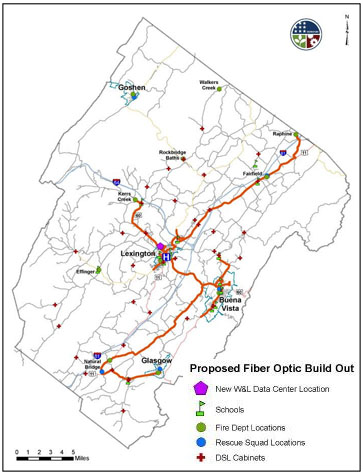
The Rockbridge Area Network Authority (RANA) is almost ready to launch its open access network in north central Virginia, home to about 22,000 people. A recipient of the BTOP stimulus program, the main focus is connecting community anchor institutions and spurring economic development. However, it has been built to allow service providers to also offer DSL to some residents in the area.

Dan Grim, GIS Manager for Rockbridge County, and one of the driving forces behind the network was kind enough to walk us through the project. In early 2007, the cities of Buena Vista, Lexington, and the County joined forces to commission a study to determine the need for a county wide broadband network. The three jurisdictions matched funding from the state Department of Housing and Community Development to pay for the study, completed in 2008.

Grim had already consulted with local provider, Rockbridge Global Village, about using a regional network to improve public safety mapping. Rockbridge Global Village President, Dusan Janjic, suggested a bigger project and that the three entities apply together for American Recovery and Reinvestment Act (ARRA) funding. 

Richard Peterson, Chief Technology Officer from nearby W&L determined that the school needed a new and updated data center. In 2009, RANA was officially formed as a collaboration between the local governments and Washington & Lee. The University joined the group and contributed $2.5 million toward a $3 million grant fund match. With the grant fund match to improve their chances, RANA applied for a $10 million BTOP award and received $6.9 million in funding through round two in 2010.

Peterson passed away in 2011. Grim notes that without Peterson, the network would never have expanded so far and may not have become a reality. The data center was later named after him to honor his memory. Network construction started in February 2012.

RANA Map

Comcast Cuts Deal in Cape Cod as OpenCape Deployment Continues

CapeCodToday, recently ran two interviews relating to OpenCape, the publicly owned network nearing completion in Massachusetts. The interviews follow a belated March press release from Comcast, announcing its new service contract with Cape Cod Community College (CCCC). Like some others familiar with the project, we were surprised to see the college choosing Comcast for connectivity instead of OpenCape.

As we previously noted, CCCC and Woods Hole Oceanographic Institute were two OpenCape founding members in 2006. The nonprofit OpenCape received $32 million in a Broadband Technology Opportunity Program (stimulus) award and gathered an additional $8 million in funds from the state, the county, and CapeNet, the company building and operating the network.

Reporter Walter Brooks asked CCCC President John Cox about the arrangement via email. Comcast began serving CCCC last fall and when asked why parties delayed the announcement, Cox said:

Regarding the delay in publicity, the College was not willing to comment on the connection, including statements to Comcast itself, until we had actively used it for a couple of months.

When the contract was negotiated, CCCC needed fiber service and OpenCape was not ready to serve them. Cox stated that the college needs to stay competitive and referred to a Bridgewater University satellite campus that will soon open in the community. Community colleges rely heavily on reliable connectivity as students look for distance learning opportunities.

Joanne Hovis on Business Plans for Municipal Fiber

Joanne Hovis, President of CTC Technology and Energy, recently published a must-read article in Broadband Properties Magazine. Whether you are a community leader investigating the possibility of a publicly owned network or an engaged citizen looking for pros and cons, this piece explains practical benefits succinctly. In her article, The Business Case For Government Fiber Networks [PDF], Hovis looks at life beyond stimulus funding. She points out how we should evaluate municipal networks in an environment where shareholder profit is not the first consideration.

Hovis gives a brief history of how local communities reached this point of need. As many of our readers know, local communities used to be able to negotiate with cable providers for franchise opportunities and rights-of-way. Often cable providers would construct broadband infrastructure in exchange for a franchise to operate in a given community, creating I-Nets for local government, schools and libraries. Once states inserted themselves into the process with state-wide franchising, local negotiating power evaporated. Many of those franchise agreements are ending and local leaders are considering municipal fiber optic networks.

Hovis stresses that municipalities do not function in the same environment as the private sector. While they still have a fiscal responsibility to their shareholders (the taxpayers) the main function is providing public safety, encouraging economic development, offering education, and using tax dollars to better the quality of life. Hovis describes how redefining return on investment (ROI) needs to go beyond the balance sheet bottom line. 

These benefits have nothing to do 
with traditional financial measures. Rather, they represent the return 
to the community in terms of such largely intangible societal benefits 
as enhancing health care quality, narrowing the digital divide, providing enhanced educational opportunities to school children, delivering job search and placement opportunities at public computer centers and helping isolated senior citizens make virtual social connections.

First BTOP Project Connects Rural North Georgia Communities

Back in December, 2009, Vice President Biden travelled to Dawsonville, Georgia, to officially kick off the American Recovery and Reinvestment Act (ARRA) program. The first award, a grant of $33.5 million, went to the North Georgia Network Cooperative. The group combined that grant with local and state funding and in May, 2012, lit the North Georgia Network (NGN).

We spoke with Paul Belk, CEO of NGN, who shared the network's story and described how it is improving economic development while serving schools and government across the region. We also recently published a podcast interview with Paul Belk.

In 2007, Bruce Abraham was the Lumpkin County Development Authority President and could not recruit new business to the region. Atlanta is only 60 miles away but companies and entrepeneurs were not willing to branch out toward north Georgia. Business leaders repeatedly told Abraham they were not interested because of the lack of broadband. DSL was available from Windstream, but businesses kept telling Abraham, "That's not broadband." North Georgia was losing jobs and there was no strategy to replace them.

Abraham found economic development representatives from Forsyth, White, Union, and Dawson counties shared the same problem. With North Georgia College & State University in Dahlonega, the group decided to address the problem together.

In 2008, they received a OneGeorgia Authority BRIDGE grant. They used the $100,000 award to commission a feasibility study that suggested the area had potential as a new tech hub. The study also indicated that the region's traditional manufacturing and agricultural industries would continue to dwindle. The group, determined to pursue the establishment of a new tech economy, knew the first step would be next-generation infrastructure.