
Bristol, Tennessee

Content tagged with "Bristol, Tennessee"

Parent
Displaying 11 - 20 of 23

New Resource: Map, List Of Citywide FTTH Munis
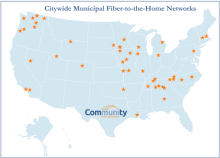
It’s no small feat to plan, deploy, and operate a municipal citywide Fiber-to-the-Home (FTTH) network, but communities are doing it. We’ve put together a Citywide Municipal FTTH Networks list and a map, with quick facts at your fingertips. If your community is considering such an investment, this list can offer a starting point on discovering similarly situated locations to study.

The list is divided by state and each state heading offers a description of any barriers that exist and a link to the statute in question. Under each community, we also included relevant links such as to the provider’s website, coverage on MuniNetworks.org, and reports or resources about the network.

We used four basic criteria to put a community on our list and map:

  • The network must cover at least 80% of a city.
  • A local government (city, town, or county) owns the infrastructure.
  • It is a Fiber-to-the-Home network.
  • It is in the United States. 

Share the list far and wide and if you know of a community network that meets our criteria that we missed, please let us know. Contact H. Trostle at htrostle@ilsr.org to suggest additions.

Discussing (Ranting) Consolidation - Community Broadband Bits Episode 209

In celebration of Independence Day, we are focused this week on consolidation and dependence. At the Institute for Local Self-Reliance, we are very focused on independence and believe that the consolidation in the telecommunications industry threatens the independence of communities. We doubt that Comcast or AT&T executives could locate most of the communities they serve on a blank map - and that impacts their investment decisions that threaten the future of communities. So Lisa Gonzalez and I talk about consolidation in the wake of Google buying Webpass and UC2B's partner iTV-3 selling out to Countrywide Broadband. And we talk about why Westminster's model of public-private partnership is preferable to that of UC2B. We also discuss where consolidation may not be harmful and how the FCC's order approving the Charter takeover of Time Warner Cable will actually result in much more consolidation rather than new competition.

This show is 18 minutes long and can be played on this page or via Apple Podcasts or the tool of your choice using this feed

Transcript below. 

We want your feedback and suggestions for the show-please e-mail us or leave a comment below.

Listen to other episodes here or view all episodes in our index. See other podcasts from the Institute for Local Self-Reliance here.

Thanks to Fifes and Drums of the Old Barracks for the music, licensed using Creative Commons. The song is "Cork Hornpipe."

Bristol's Muni A Boon for Electric Users

Business and residential electric customers in Bristol, Tennessee are experiencing shorter power outages thanks to recent upgrades to the city’s municipal fiber-optic network. And collectively, that represents annual savings of about $6 million for electric users, according to the CEO of the Bristol Tennessee Essential Services (BTES):

In an opinion piece for the Bristol Herald Courier newspaper, BTES CEO Mike Browder, said a recent upgrade to the electric system, which uses the city’s fiber-optic network, has helped cut power outage time by 35 percent:

“Our goal is less than 60 minutes average outage time per year per customer. In 2015, we exceeded that goal, reducing our outage time to 34 minutes per customer.”

According to BTES' About Us page, customers who lose power can depend on the smart grid to alert the utility to any outages:

Those customers with fiber services to their homes have automatic power outage detection, meaning that they do not need to make a telephone call if their power goes out. In addition, the system provides automatic meter reading and theft detection.

Browder offered this example in his piece:

"BTES recently had an outage that caused half of The Pinnacle, including Bass Pro Shops and Belk, to lose power. Using the fiber optic system, the BTES electric system automatically opened one switch and closed three more in sequence while testing each section of line. All of The Pinnacle had service restored in less than one minute!"

Bristol’s Smart Network

Reducing outage time is among a number of benefits that Bristol's 26,000 residents and its local businesses are enjoying from the city’s municipal fiber network, which it launched in 2005. The city also uses the infrastructure for fast, reliable, affordable connectivity in the community.

Sale of OptiNet: BVU Caught Between Virginia's Rock And A Hard Place

For more than a decade, the people of Bristol, Virginia have enjoyed what most of us can only dream about - fast affordable, reliable, connectivity.  In recent days, we learned that Bristol Virginia Utilities Authority (BVU) has entered into a deal to sell its OptiNet triple-play fiber network to a private provider. The deal is contingent on approval by several entities.

As we dig deeper into the situation, we understand that troubles in southwestern Virginia and Bristol have led to this decision. Nevertheless, we urge the Bristol community to weigh the long-term consequences before they sacrifice OptiNet. Once you give up control, you won’t get it back.

"...A Few Bad Apples..."

If the people of Bristol surrender this valuable public asset to the private market, they run the risk of undoing 15 years of great work. None of this is a commentary on the private provider, Sunset Digital Communications, which may be a wonderful company. The problem is that Sunset will be making the decisions in the future, not the community. 

OptiNet has helped the community retain and create jobs, attracting and retaining more than 1,220 well-paying positions from Northrup Grumman, CGI, DirecTV, and Alpha Natural Resources. Businesses have cut Internet access and telecommunications costs. Officials estimate around $50 million in new private investment and $36 million in new annual payroll have come to the community since the development of OptiNet. The network allowed public schools to drastically reduce telecommunications expenses and introduce gigabit capacity long before such speeds were the goal among educators.

Schools and local government saved approximately $1 million from 2003 - 2008. Subscribers have saved considerably as well, which explains OptiNet's high take rate of over 70 percent. Incumbent telephone provider Sprint (now CenturyLink) charged phone rates 25 percent higher than OptiNet in 2003. The benefits are too numerous to mention in one short story.

TN For Fiber's New Video On Family Life In Bradley County

In a new video, Tennessee Fiber Optic Communities profiles what it is like for a family living in Bradley County, just outside of the reach of Chattanooga's EPB Fiber Optic network. Debbie Williams describes how she and her family struggle with a long list of issues most of us associate with the bygone era of dial-up Internet. 

Watch this video and you will realize how families just outside of statutory limitations of EPB Fiber are living a different life than families served by the network. No one should have to deal with these kinds of problems. As Debbie puts it, "It's just wrong."


DebbieWilliams from TN For Fiber on Vimeo.

New Video on Economic Development and High-Speed Connectivity in Tennessee

Tennessee Fiber Optic Communities has released another quality video focused on restoring local telecommunications authority. This three minute feature describes the importance of high speed connectivity to local economic development.

The video offers specific examples of businesses that relocated to places like Jackson and Chattanooga, comparing business connectivity in places with municipal networks to areas where high-speed connections from incumbents are costly and hard to come by.

Check out the video from the Tennessee Fiber Optic Communities:

TNFOC_EconomicDevelopment2 from TN For Fiber on Vimeo.

Tennessee Bill to Strike Anti-Muni Laws Tabled Until Next Session

Senator Janice Bowling and Representative Kevin Brooks have decided to table their legislative efforts to remove state restrictions in Tennessee. While backing for SB 1134 and HB 1303 was growing beyond the walls of the state Capitol, the sponsors decided to shore up stronger legislative support rather than risk derailing the bill entirely. 

Brooks told the Tennessean:

"We have had a lot of good progress, and we don't want to throw it all away," Brooks said. The votes were not there in the Senate, and he and co-sponsor state Sen. Janice Bowling, R-Tullahoma, have asked to roll the bill to the beginning of the 2016 calendar, giving them more time to garner support from their colleagues.

"We have pressed the pause button to keep it alive," Brooks said.

Communities around the state, including Bristol, went on record in support of the bill. The Tennessee Farm Bureau, representing 600,000 members, also backed the legislation

Energized by the recent FCC decision nullifying state laws restricting Chattanooga from expanding, Bowling, Brooks, and other local leaders thought the time was right to once again try to eliminate state barriers. The FCC decision has already been formerly challenged by Tennessee's Attorney General with the support of the Governor. Rather than depend on federal intervention to establish an environment that will encourage connectivity, SB 1134 and/or its companion HB 1303 would have solved the problem on the home front.

Bristol City Council Passes Resolution Supporting Bill to End Tennessee Muni Barriers

At its March 3rd City Council meeting, elected leaders in Bristol voted 4 - 1 to adopt resolution 15 - 8 reported TriCities.com. The resolution officially supports state legislation removing state barriers that prevent municipal electric utilities from offering Internet service beyond their electric service footprint. State Senator Janice Bowling and Representative Kevin Brooks are sponsoring SB 1134 and its companion HB 1303 [PDF].

Bristol Tennessee Essential Services (BTES) is one of the state's gigabit FTTH networks but like Chattanooga, is limited by state geographic restrictions. The recent FCC decision to overturn Tennessee and North Carolina state barriers has removed that legal provision but Bowling and Brooks want to make sure it happens and that Tennessee is able to embrace smarter policy without FCC intervention.

Bristol recognizes that its gigabit network provides a rare advantage in Tennessee. From the City Council agenda on the issue:

The service is an essential element of economic development, enhances educational opportunities, increases regional and global competitiveness, and provides a better quality of life. While we enjoy the benefits of being a “Gigabit Community”, there are many areas of Tennessee that lack access to high-speed broadband service. The ability to extend this service beyond the municipal electric service territory will provide an opportunity for customers to choose their provider and ensure a high quality of broadband service at a competitive price.

At the meeting, members of the Council noted that eliminating the restriction would allow BTES the ability to bring service to areas left behind by traditional providers. TriCites.com reported:

Chattanooga Profiled in Al Jazeera America

“There are companies that do what we do, but we can do it in hours, and they can take weeks,” said Posey. “Anywhere else, it would take a lot more time and a lot more money ... Chattanooga is essential to our business model.”

Al Jazeera America's Peter Moskowitz recently spoke with Clay Posey, one of the entrepreneurs flocking to Chattanooga for the network. Posey works in one of the startup incubators there, Co.Lab, developing his idea for pre-operative models that allow surgeons to prepare before operating on patients.

While Chattanooga may not be the norm and may not be an easy venture for every municipality, it lifts the bar. From the article:

“Whenever a corporation like Comcast wants to do something like raise prices, we can point at Chattanooga and say, ‘Why can’t we have something like that?’” said Christopher Mitchell, head of the community broadband networks initiative at the nonprofit Institute for Local Self-Reliance. “It establishes a baseline or at least an aspirational standard.”

The article describes lobbying efforts by large corporate providers designed to stop the municipal networks model. Another Chattanooga entrepreneur told Moskowitz:

“Having public or quasi-public Internet service providers is a good solution to consolidation because they most likely won’t be sold,” said Daniel Ryan, a local Web developer who helped run the digital operation of Barack Obama’s 2012 presidential campaign. “Do I think if every city did this, Comcast would go out of business? No. But it means there will always be competition.”

Moskowitz included a brief historical summary of the network, its contribution to the electric utility, and the challenges created by state barriers. He included our Community Broadband Networks map.

Community Broadband Bits 24 - Dr Browder of Bristol, Tennessee

Dr Browder runs Bristol Tennessee Essential Services, the municipal utility on the southern side of Bristol's Virginia border. For our 24th Community Broadband Bits podcast, he tells us how they built a FTTH network and how it has helped the community. Like so many others, they started by seeking to ensure maximum reliability of the electrical grid. Now they offer telephone, television, and Internet access to the whole community. In fact, they just announced that they can offer a gigabit to anyone in the area, making them the fifth such city in America to have that level of service available. All of them are community networks. One of the things Dr. Browder explains is how connecting all their schools with 100 Mbps and 1 Gbps connections has led to stronger schools and new opportunities for kids to learn. Read the transcript from this episode here. We want your feedback and suggestions for the show - please e-mail us or leave a comment below. Also, feel free to suggest other guests, topics, or questions you want us to address. This show is 20 minutes long and can be played below on this page or subscribe via iTunes or via the tool of your choice using this feed. Search for us in iTunes and leave a positive comment! Listen to previous episodes here. You can download the Mp3 file directly from here. Find more episodes in our podcast index. Thanks to mojo monkeys for the music, licensed using Creative Commons.