
Lamoille FiberNet CUD

Content tagged with "Lamoille FiberNet CUD "

Related Topics
Displaying 1 - 4 of 4

Lamoille FiberNet CUD Finishes County-Wide Fiber Deployment

Vermont’s expanding Communications Union Districts (CUD) are pioneering creative efforts to deploy affordable broadband to the rural parts of the Green Mountain State. That includes the Lamoille FiberNet CUD, which has been making steady progress expanding affordable fiber access to fiber in the most neglected parts of rural Vermont.

Back in 2023, the Lamoille FiberNet greenlit a $24 million public-private partnership with Fidium Fiber to deliver fiber broadband access to nearly every deliverable address in Lamoille County. Two years later and the county now says that target goal has been completed.

According to an announcement by the CUD, the collaboration resulted in the deployment of 550 miles of fiber, resulting in gigabit-capable next-generation broadband access being made available to 5,000 unserved or underserved addresses across the county.
Image
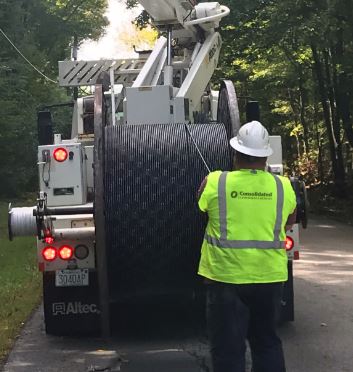
A Lamoille FiberNet in a glowing yellow vest pulls fiber from a spool on the back of a truck

“This achievement represents years of collaboration, persistence, and smart partnership,” Andrew Ross, Lamoille FiberNet chair and Wolcott representative to the board, said in a statement. “Our shared goal was simple but ambitious: to make sure every home and business in our territory could connect to reliable, affordable, high-speed internet.”
Neighborly Networks: Vermont's Approach to Community Broadband

Image
Neighborly Networks report

In partnership with the Benton Institute for Broadband and Society, today ILSR releases a new report examining how the state of Vermont is supercharging its telecommunications infrastructure efforts to reach the unconnected by puttings its weight behind community broadband-driven efforts.

The report - Neighborly Networks: Vermont's Approach to Community Broadband [pdf] - traces the emergence of a unique public-public partnership arrangement that first appeared in the Green Mountain State in 2008. The Communications Union Districts (CUD) model first emerged more than a decade and a half ago among a coalition of towns in the eastern part of the state long-ignored by for-profit Internet Service Providers. There, a collection of community broadband champions came together to prove that the solution to the broken marketplace lay internal to east-central Vermont. ECFiber, a publicly owned, nonprofit ISP was borne of that effort, and began bringing affordable, fast, reliable service to households in the region.

Image
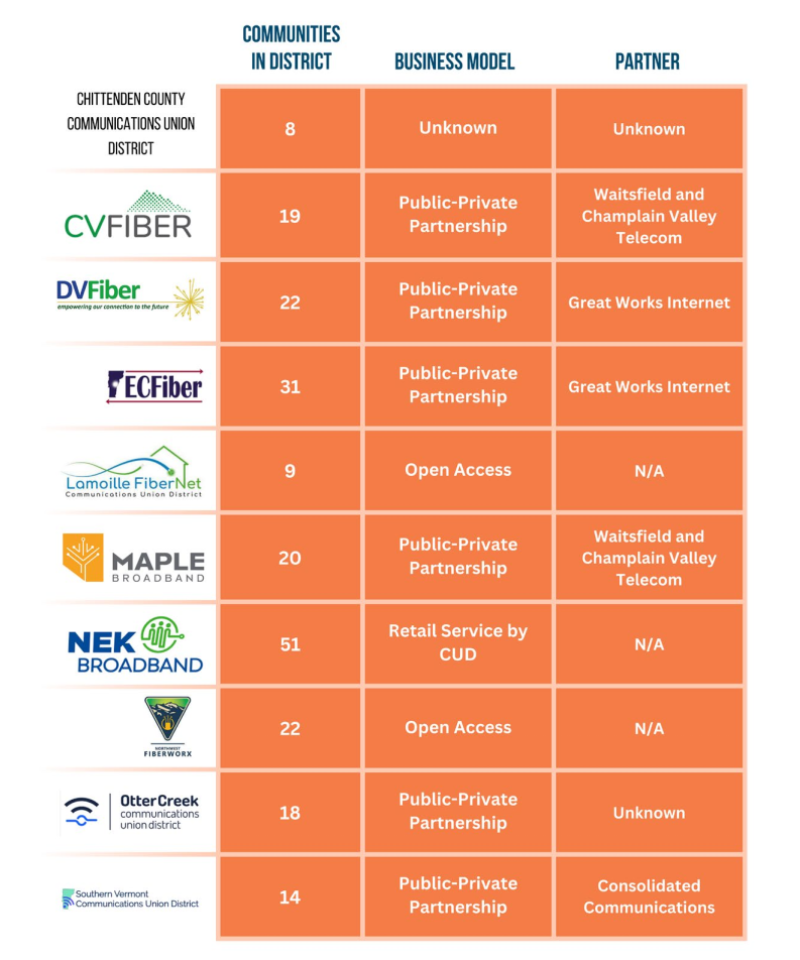
CUD models

Ten years later, when the state began formulating a plan for the future of Internet access, the progress made by and lessons learned from ECFiber drove a landmark shift in public policy in the state. Volunteers emerged, towns voted, and CUDs were placed at the center of Vermont’s effort to bridge the infrastructure gap in the state. Today, there are ten CUDs covering 216 towns across the state, and Vermont’s leaders have put the lion’s share of public funds behind the communications union district model.

New Report: Neighborly Networks - Vermont's Approach to Community Broadband

In partnership with the Benton Institute for Broadband and Society, today ILSR releases a new report examining how the state of Vermont is supercharging its telecommunications infrastructure efforts to reach the unconnected by puttings its weight behind community broadband-driven efforts.

The report - Neighborly Networks: Vermont's Approach to Community Broadband [pdf] - traces the emergence of a unique public-public partnership arrangement that first appeared in the Green Mountain State in 2008. The Communications Union Districts (CUD) model first emerged more than a decade and a half ago among a coalition of towns in the eastern part of the state long-ignored by for-profit Internet Service Providers. There, a collection of community broadband champions came together to prove that the solution to the broken marketplace lay internal to east-central Vermont. ECFiber, a publicly owned, nonprofit ISP was borne of that effort, and began bringing affordable, fast, reliable service to households in the region.

Image
CUD models

Ten years later, when the state began formulating a plan for the future of Internet access, the progress made by and lessons learned from ECFiber drove a landmark shift in public policy in the state. Volunteers emerged, towns voted, and CUDs were placed at the center of Vermont’s effort to bridge the infrastructure gap in the state. Today, there are ten CUDs covering 216 towns across the state, and Vermont’s leaders have put the lion’s share of public funds behind the communications union district model.

Tracing the history of this effort from 2008 to today, this report breaks down the conditions that led to this sea change, where the CUDs are at today, and how we might learn from the Vermont case to improve Internet access elsewhere across the country.

Lamoille FiberNet CUD Gets Green Light For Major Vermont Broadband Expansion Plan

Vermont’s nascent Communication Union Districts (CUD) are pioneering creative efforts to deploy affordable broadband to the rural parts of the Green Mountain State. That includes the Lamoille FiberNet CUD, which has greenlit a major new plan to expand affordable access to fiber in the most neglected parts of rural Vermont.

At an Aug. 14th meeting, the Vermont Community Broadband Board (VCBB) approved Lamoille FiberNet’s $1.3 million pre-construction grant, followed by a mid-September approval of the CUD’s $13.6 million construction grant.

“This grant means that, by the end of 2024, we can bring high-speed internet to almost all the homes and businesses in our CUD that are unserved or underserved,” Lamoille FiberNet Communications CUD Chair Jeff Tilton said in a statement.

With the Lamoille CUD covering 10 towns in the north central part of the state (Belvidere, Cambridge, Eden, Elmore, Hyde Park, Johnson, Morristown, Stowe, Waterville and Wolcott), Lamoille plans to have Fidium Fiber and Consolidated Communications deploy and manage 630 miles of new fiber connecting more than 4,800 unserved and underserved Lamoille County homes and businesses. The network will be deployed in two phases.