
Bristol, Tennessee

Content tagged with "Bristol, Tennessee"

Parent
Displaying 1 - 10 of 23

In Our View: Success Stories to Counter the Tide of Big Telecom Propaganda

Welcome to In Our View. From time to time, we use this space to explore new ideas and share our thoughts on recent events playing out across the digital landscape, as well as take the opportunity to draw attention to important but neglected broadband-related issues.

As federal funds to expand high-speed Internet access began to flow to states and local communities through the American Rescue Plan Act, and with billions more coming under the Infrastructure Investment and Jobs Act, Big Telecom is beginning to mount its expected opposition campaign designed to discourage federal (and state) decision-makers from prioritizing the building of publicly-owned networks.

Predictably, a centerpiece of this anti-municipal broadband campaign is the trotting out of well-worn - and thoroughly debunked - talking points, arguing that federal funding rules should not “encourage states to favor entities like non-profits and municipalities when choosing grant winners” because of their “well-documented propensity to fail at building and maintaining complex networks over time.” That’s what USTelecom, a trade organization representing big private Internet Service Providers (including the monopolies) wrote in a memo sent last week to President Biden, the FCC, cabinet secretaries, House and Senate members, Tribal leaders, as well as state broadband offices. 
Maple Broadband Sets the Table for FTTH Network

Vermont’s nine Communication Union Districts (CUDs) were formed to build communication infrastructure to deliver reliable and affordable high-speed Internet access across one of the most rural states in the nation.

The East Central CUD, which owns and operates EC Fiber, has led the charge since its founding in 2011. But over the last few years other CUDs have launched their own plans to build fiber-to-the-home (FTTH) networks in their respective districts with each at various stages of planning or building.

Addison County is situated on the western border of the state about 35 miles west of the state capital (Montpelier), tucked between Lake Champlain and the Green Mountains. The region has long been served, or rather underserved, by Comcast, as the area’s primary Internet Service Provider does not cover the most rural parts of the county, leaving many of the county’s approximately 36,200 residents with outdated DSL service.

New Fact Sheet: Snapshots of Municipal Broadband

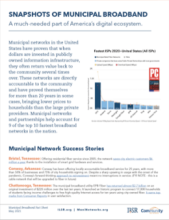
Municipal networks in the United States have proven that when dollars are invested in publicly owned information infrastructure, they often return value back to the community several times over. This new fact sheet [pdf] highlights municipal broadband success stories from across the country and some of the many benefits the networks have brought to the communities they serve. 

These networks are directly accountable to the community and have proved themselves for more than 20 years in some cases, bringing lower prices to households than the large private providers. Municipal networks and partnerships account for 9 of the top 10 fastest broadband networks in the nation.

Download Snapshots of Municipal Broadband: A Much-Needed Part of America's Digital Ecosystem [pdf] here.

For timely updates, follow Christopher Mitchell or MuniNetworks on Twitter and sign up to get the Community Broadband weekly update.

Two Publicly Owned Networks Move To Privatize

If you’re a regular reader at MuniNetworks.org, listen to our podcasts, or if you simply follow publicly owned network news, you know an increasing number of communities have decided to invest in local connectivity solutions in recent years. We’ve watched the number of “pins” on our community network map multiply steadily, but every now and then, a network drops off through privatization.

FastRoads Sold To N.H. Optical Systems

New Hampshire FastRoads received America Recovery and Reinvestment Act (ARRA), which combined with state funding, created the open access fiber optic network in the southwest section of the state. Over the next several years, the network expanded with private donations and local matching funds. Many of the premises that connected to the network had relied on dial-up before FastRoads came to town. But in part because state law makes bonding for network expansion difficult, Fast Roads will no longer be locally controlled.

The Monadnock Economic Development Corporation (MEDC), a nonprofit organization whose purpose is working to see like projects are completed that will improve economic development prospects in the region managed the project. MEDC contracted with another entity to maintain the network, which cost approximately $15,000 per month. Since they had achieved their core goal - the construction and launch of the network - MEDC had been looking for another entity to take over the network or to partner with them. They recently finalized a deal to sell the network to New Hampshire Optical Systems

Tennessee Muni Rates Fact Sheet

In addition to studying how and where local communities examine the potential for publicly owned Internet networks, we’ve looked at rates over time in select areas of the country. We recently put together a comparison of historical rates for municipal networks in Tennessee. Our findings are consistent with what we’ve seen all over the country - publicly owned networks don't hesitate to raise speeds while keeping rates affordable. We've documented the data on our fact sheet: Municipal Networks: Speed Increases & Affordable Prices.

Not Like The Big Guys

National providers make it a habit to periodically raise rates and over time those increases add up. They’ve done it so often, subscribers have come to expect it on a regular basis. Price increases don’t usually include a speed increase. With no need to appease shareholders, officials in charge of publicly owned networks can set rates at a level that allow a network to be sustainable rather than rates that maximize profits.

Publicly owned networks have increased speeds for subscribers, often with little or no fanfare other than quietly alerting subscribers to their improved service. Places Chattanooga’s EPB, Morristown’s FiberNET, and BET in Bristol are in a much different habit than Comcast or AT&T - they increase speeds with no increase in price. Other Tennessee communities have increased speeds significantly with only slight price increases over years of service.

Speeds, Rates Then And Now

On our fact sheet, we include prices for the basic tiers now and when the network began offering services. We also compare the basic speeds when the network began serving the community and today. The results reflect how publicly owned networks focus on providing fast, affordable connectivity to subscribers rather than collecting profit from customers.

Some results may surprise you:

Addressing UPenn Report: Dud Data, Unsuitable Approach

For the second week in row, our staff has felt compelled to address a misleading report about municipal networks. In order to correct the errors and incorrect assumptions in yet another anti-muni publication, we’ve worked with Next Century Cities to publish Correcting Community Fiber Fallacies: Yoo Discredits U Penn, Not Municipal Networks.

Skewed Data = Skewed Results

Professor Christopher S. Yoo and Timothy Pfenninger from the Center for Technology, Innovation and Competition (CTIC) at the University of Pennsylvania Law School recently released "Municipal Fiber in the United States: An Empirical Assessment of Financial Performance." The report attempts to analyze the financial future of several citywide Fiber-to-the-Home (FTTH) municipal networks in the U.S. by applying a Net Present Value (NPV) calculation approach. They applied their method to some well-known networks, including Chattanooga's EPB Fiber Optics; Greenlight in Wilson, North Carolina; and Lafayette, Louisiana's LUS Fiber. Unfortunately, their initial data was flawed and incomplete, which yielded a report fraught with credibility issues.

So Many Problems 

In addition to compromising data validity, the authors of the study didn’t consider the wider context of municipal networks, which goes beyond the purpose of NPV, which is determining the promise of a financial investment.

Some of the more expansive problems with this report (from our Executive Summary):

S&P Global Discusses Discredited Municipal Broadband Report

S&P Global Market Intelligence - May 26, 2017

Hard Data on Municipal Broadband Networks

Written by Sarah Barry James

There is a dearth of good data around municipal broadband networks, and the data that is available raises some tough questions.

A new study from University of Pennsylvania Law School Professor Christopher Yoo and co-author Timothy Pfenninger, a law student, identified 88 municipal fiber projects across the country, 20 of which report the financial results of their broadband operations separately from the results of their electric power operations. Municipal broadband networks are owned and operated by localities, often in connection with the local utility.

...

Yet Christopher Mitchell, director of the Community Broadband Networks Initiative at the Institute for Local Self-Reliance, argued that Yoo's study did not present an entirely accurate or up-to-date picture of U.S. municipal networks.

"When I looked at the 20 communities that he studied — and his methodology for picking those is totally reasonable and he did not cherry pick them — I was not surprised at his results because many of those networks are either in very small communities … and the others were often in the early years of a buildout during a period of deep recession," Mitchell said.

As an example, Mitchell pointed to Electric Power Board's municipal broadband network in Chattanooga, Tenn. — one of the five networks Yoo identified as having positive cash flow but at such a low level that it would take more than 100 years to recover project costs.

...

In fact, without the revenue generated by the fiber-optics business, EPB estimated it would have had to raise electric rates by 7% this year.

According to Mitchell, Yoo's study captured the Chattanooga network when it was still "small and growing," but misses "what's going to happen for the rest of the life of the network, which I think is the more important part."

...

Telecompetitor Talks Awful Municipal Broadband Report

Telecompetitor - May 25, 2017

Municipal broadband networks do not have a strong financial track record, according to an analysis conducted by the University of Pennsylvania’s Center for Technology, Innovation and Competition. The municipal broadband financial analysis, which looked at 20 municipal fiber projects, found that only nine were cash-flow positive and that of those, seven would need more than 60 years to break even.

...

An Opposing View

Municipal network advocate Christopher Mitchell, director of the Community Broadband Networks Initiative at the Institute for Local Self-Reliance, pointed to several flaws in the Penn Law municipal broadband financial analysis.

He noted, for example that a substantial portion of the 20 networks studied were “early in the process and very small.” He also argued that the 2010-2014 study period may have biased the results, as that period included a recession and subscribership for some of the networks has increased substantially since 2014. He noted, for example, that EPB’s broadband network in Chattanooga had about 50,000 to 55,000 subscribers in 2014 but has now hit the 90,000 mark.

The Penn Law authors’ approach was “not the proper way to measure these networks,” said Mitchell in a phone call with Telecompetitor. The analysis “doesn’t take into account jobs created or the impact on the municipal budget,” he said.

He argued, for example, that a municipality that previously paid $1 million annually for connectivity might instead pay itself $500,000 for connectivity on the municipal network.

...

Read the full story here.

BVU OptiNet Update: Deal Coming Together

A little over a year ago, we first shared the news about Bristol’s decision to privatize its FTTH network, OptiNet. Virginia based Sunset Digital Communications offered to purchase the network for $50 million. The network has saved Bristol millions of dollars, stimulated economic development, and cut telecommunications costs for local residents and businesses. Nevertheless, after several corrupt officials drove the network into a dark period of scandal, all those advancements paled and Bristol was ready to sell the network.

After months of negotiations with BVU’s partner in the Cumberland Plateau area service area, the details for the sale are coming together.

When There's A Partner

One of the last steps to completing the sale required approval from the Cumberland Plateau Company (CPC), which operates as a partner with BVU to bring connectivity to four additional counties in Virginia. As a partner with OptiNet in those areas, CPC owns approximately 50 percent of the assets.

When Sunset Digital offered $50 million for the BVU assets, CPC obtained the right of first refusal for the assets in the four counties where BVU and CPC work together as partners according to their contract.

Back in the fall of 2016, CPC was concerned about the legality and the details of the proposed transaction; they decided to wait for federal and state review before granting approval. Because the NTIA, the Economic Development Administration (EDA), and the Virginia Tobacco Commission provided grant funding to the CPC region for the deployment, the agencies needed to review and approve the proposal. The agencies approved the sale, but required that a large amount of BVU debt be paid. One of the claims that they required be paid was a claim for $8 million from CPC.

Approving The Offer

As part of the offer, Sunset promises to invest $6.5 million to connect more homes and businesses in the CPC region. They estimate CPC will gain about $21 million in revenue over 13 years while Sunset operates the network. CPC will retain ownership of its assets in the CPC service area and Sunset will transfer ownership of equipment in the CPC area to CPC.

Moving Forward, Remember Past Local Government Resolutions

We have already seen Virginia and Missouri take up legislation to preempt local control and deter municipal networks. Although bearing innocuous names such as the “Virginia Broadband Deployment Act,” these bills stifle competition instead of empowering communities. 

Local governments, however, have often stepped forward to champion municipal networks and push back against state preemption bills. We’ve collected several over the years. Let these excerpts of resolutions from years past inspire you throughout the rest of 2017:

2011 - Chapel Hill, North Carolina: “WHEREAS, historically it was government that funded much of the current corporate telecommunications infrastructure in the United States and government paid for and developed the Internet on which these providers depend for their profit…” (Read more here.)

2013 - Alpharetta, Georgia: “WHEREAS, House Bill 282 would tie the hands of municipal officials in their efforts to build digital networks they need to attract economic development and create a high quality of life for their citizens...” (Read more here.

2014 - The Louisiana Municipal Association: “WHEREAS, local governments, being closest to the people are the most accountable level of government and will be held responsible for any decisions they make...” (Read more here.)

Many other cities have also passed resolutions opposing state legislation and encouraging local control, including:

mpls-city-council.jpg